
Açorda
Portuguese bread soup with garlic, cilantro, and poached eggs
Açorda is a Portuguese dish where pieces of stale bread are combined with garlic, cilantro, olive oil, and poached eggs, then soaked in broth. It is especially linked to the Alentejo region, where it is considered a local classic and often served as a main meal.
- Açorda uses stale bread, garlic, cilantro, and poached eggs
- Alentejo is especially known for its soup-style açorda
- The dish was mentioned in a 16th-century Portuguese play
- Variations include versions with cod or shrimp
- Açorda was a finalist in the 7 Wonders of Portuguese Gastronomy
What is Açorda?
Açorda is a dish from Portugal that uses chunks or slices of stale bread as its base. Garlic and cilantro are mashed together and mixed with olive oil, then poured over the bread. Poached eggs are added, and everything is soaked with hot broth, letting the bread soften and absorb the flavors. The result is a soup or sometimes a thick porridge, with a greenish color from the herbs. The taste is savory, with the freshness of cilantro and the richness of olive oil.
Where does Açorda come from?
Açorda has its roots in Portuguese cooking as a way to use up leftover bread, turning it into a filling meal. The earliest known mention comes from a 16th-century play, showing it was already familiar at that time. Over the years, it became a staple in the Alentejo region, where it is now seen as a symbol of local food culture. The dish started as a simple, practical food and grew into a classic of Portuguese cuisine.
How is Açorda made?
To make açorda, stale bread is cut or torn into pieces and placed in a bowl. Garlic and cilantro are crushed with salt and mixed with olive oil, sometimes with a splash of vinegar. This mixture is poured over the bread. Eggs are poached in water or broth, then set on top of the bread. Finally, hot broth or the poaching liquid is ladled over everything, and the dish is left to rest so the bread absorbs the liquid. Some versions cook the bread and herbs together in the broth, while others assemble the ingredients without further cooking.


How and when is Açorda eaten?
Açorda is usually served as a main course for lunch or dinner. In Alentejo, it is a common home-cooked meal and can also be found in restaurants. It is eaten hot, straight from the bowl, often with a spoon. The dish is simple and comforting, making it a regular part of everyday meals. Sometimes it is served with extra olive oil or a side of olives.
Kinds of Açorda
Across Portugal, açorda takes on different forms. In Alentejo, it is a soup with plenty of broth, while in other areas it can be thicker, almost like a porridge. Some versions add ingredients such as sausage, shrimp, or cod, with the cod version called açorda de bacalhau and the shrimp version popular in Lisbon as açorda de marisco. There is also a version in Macanese cooking.
What Açorda means
Açorda is closely tied to the identity of Alentejo, where it is considered a signature dish and an icon of the region's food. It was a finalist in the 7 Wonders of Portuguese Gastronomy, reflecting its importance in national culture. The dish is a reminder of resourcefulness, turning leftover bread into a beloved meal, and is a familiar sight in both homes and restaurants.
Questions people ask about Açorda
What is açorda made of?
Açorda is made from stale bread, garlic, cilantro, olive oil, poached eggs, and broth. The bread soaks up the seasoned liquid, creating a soup or thick porridge.
Where does açorda come from?
Açorda comes from Portugal and is especially associated with the Alentejo region, where it is a staple of local cooking.
How is açorda usually served?
Açorda is typically served as a main course for lunch or dinner, hot and in a bowl, often with a spoon.
Are there different kinds of açorda?
Yes, there are many versions. Some are soup-like, others are thicker. Some include cod (açorda de bacalhau) or shrimp (açorda de marisco), and the dish is also found in Macanese cuisine.
Is açorda vegetarian?
The basic version is vegetarian, but some variations include seafood or sausage, so it can vary.
Good reading and sources
The facts on this page come from the Wikipedia article "Açorda", written by its contributors and used under the CC BY-SA 4.0 licence, and from its Wikidata record (CC0). Thali rewrote the text in its own words, with AI assistance, and compares every page with the article to make sure no passage is copied. It may be reused under the same CC BY-SA 4.0 licence with a link back.
It may contain mistakes, and it is not dietary or allergy advice: recipes differ from cook to cook. If something is wrong, tell us. Last refreshed 2026-10-03.
More from Portugal
All the food of Portugal GazpachoVegan
🇪🇸 Spain and 1 moreChilled soup of blended raw vegetables, served cold in Spain and Portugal
Soup, Lunch, Dinner
GazpachoVegan
🇪🇸 Spain and 1 moreChilled soup of blended raw vegetables, served cold in Spain and Portugal
Soup, Lunch, Dinner
 Cataplana
🇵🇹 PortugalSeafood and meat stew cooked in a sealed metal vessel from Portugal's Algarve
Main dish, Lunch, Dinner
Cataplana
🇵🇹 PortugalSeafood and meat stew cooked in a sealed metal vessel from Portugal's Algarve
Main dish, Lunch, Dinner
 ChorizoMeat
🇪🇸 Spain and 5 moreA seasoned pork sausage from the Iberian Peninsula, made in many regional styles
Sausage or cured food, Breakfast, Lunch
ChorizoMeat
🇪🇸 Spain and 5 moreA seasoned pork sausage from the Iberian Peninsula, made in many regional styles
Sausage or cured food, Breakfast, Lunch
 Empanada
🇪🇸 Spain and 5 morePastry turnovers filled with meat, cheese, or vegetables, baked or fried
Pie or savoury pastry, Lunch, Dinner
Empanada
🇪🇸 Spain and 5 morePastry turnovers filled with meat, cheese, or vegetables, baked or fried
Pie or savoury pastry, Lunch, Dinner
Its cousins elsewhere
All soups Lablabiلبلابي
🇹🇳 Tunisia and 1 moreTunisian chickpea soup poured over torn bread and topped with bold garnishes
Soup, Breakfast, Lunch
Lablabiلبلابي
🇹🇳 Tunisia and 1 moreTunisian chickpea soup poured over torn bread and topped with bold garnishes
Soup, Breakfast, Lunch
 Sancocho
🇩🇴 Dominican Republic and 5 moreA hearty stew of meat, tubers and vegetables in a rich broth
Soup, Lunch, Dinner
Sancocho
🇩🇴 Dominican Republic and 5 moreA hearty stew of meat, tubers and vegetables in a rich broth
Soup, Lunch, Dinner
 ChanguaVegetarian
🇨🇴 ColombiaColombian breakfast soup of milk, water, eggs and herbs
Soup, Breakfast, Snacks
ChanguaVegetarian
🇨🇴 ColombiaColombian breakfast soup of milk, water, eggs and herbs
Soup, Breakfast, Snacks
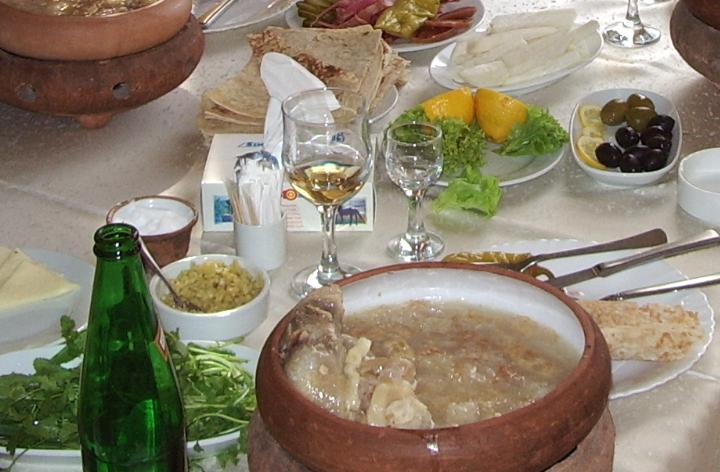 KhashMeatխաշ
🇦🇲 Armenia and 5 moreA rich stew of slow-cooked cow or sheep parts, eaten across the Caucasus and Middle East
Stew or curry, Breakfast
KhashMeatխաշ
🇦🇲 Armenia and 5 moreA rich stew of slow-cooked cow or sheep parts, eaten across the Caucasus and Middle East
Stew or curry, Breakfast