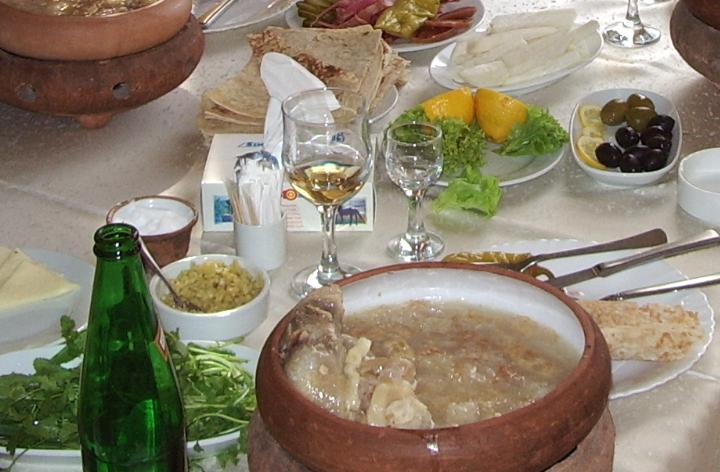
Khash
In its own language: խաշ
A rich stew of slow-cooked cow or sheep parts, eaten across the Caucasus and Middle East
Khash is a hearty stew made by simmering parts of a cow or sheep, such as the head, feet, and stomach. It began in Armenia and is now found in many countries, especially in the Caucasus, Iran, and Iraq. Traditionally served hot in the morning during colder months, it is often flavored with garlic and eaten with bread.
- Khash is one of Armenia’s oldest traditional dishes.
- It is made by simmering cow or sheep head, feet, and stomach.
- The dish is often eaten for breakfast in winter.
- In Iraq, pacha is a festive food for Christmas among Assyrians.
- Each region adds its own spices and serving customs.
What is Khash?
Khash is a soup or stew made by simmering various parts of a cow or sheep, often including the head, feet, and the lining of the stomach (tripe). The result is a rich, gelatinous broth with tender pieces of meat and offal. Garlic, salt, and black pepper are common seasonings, and it is usually served with flatbread such as lavash. The dish is known for its strong aroma and hearty texture, making it a warming meal, especially in cold weather.
Where does Khash come from?
Khash traces its roots to Armenia, where it is considered one of the oldest traditional dishes. The name comes from an Armenian word meaning 'to boil.' Medieval Armenian texts mention khash as early as the 11th century, describing it as a food with supposed healing qualities. Over time, the dish spread to neighboring regions, taking on new names and forms in places like Iran, Iraq, and the South Caucasus.
How is Khash made?
To prepare khash, the chosen animal parts—such as head, feet, and stomach—are thoroughly cleaned and then simmered for several hours until the meat becomes soft and the broth thickens. In some countries, the stomach may be stuffed with rice and lamb before cooking. Seasonings like garlic, onion, and black pepper are added, and the dish is often finished with a splash of vinegar or lemon. It is served hot, with bread often dipped into the broth.


How and when is Khash eaten?
Khash is most commonly eaten early in the morning, especially during winter. In Armenia and nearby regions, it is a social meal, sometimes enjoyed after celebrations or as a remedy for hangovers. Diners typically add garlic and salt to taste, and use bread to soak up the broth. In Iran and Iraq, it is also a breakfast dish, sometimes eaten during festive times or family gatherings.
Kinds of Khash
Many countries have their own versions of khash. In Iran, kalle-pache includes the sheep’s head and feet, and is often flavored with lemon and cinnamon. In Iraq, pacha may feature stuffed stomach and is served with bread in the broth. Albania’s paçe uses cattle head and sometimes thickens the stew with flour. In Greece, patsás can be seasoned with vinegar, garlic, or egg-lemon sauce. Each region adapts the dish to local tastes and ingredients.
What Khash means
Khash holds a special place in the food traditions of Armenia and neighboring countries. In Armenia, it is linked to winter gatherings and is sometimes thought to have restorative properties. In Iraq, pacha is made for Christmas by Assyrian families. In Greece and the Caucasus, it is known as a hangover cure, with some restaurants serving it late at night. The dish’s reputation for bringing people together around the table is shared across cultures.
When Khash is on the table
Questions people ask about Khash
What is khash made of?
Khash is prepared by boiling parts of a cow or sheep, such as the head, feet, and stomach. Garlic, onion, and black pepper are common seasonings, and it is usually served with bread.
Where does khash come from?
Khash originated in Armenia and is considered one of the country’s oldest dishes. It later spread to other regions including Iran, Iraq, and the Caucasus.
When is khash usually eaten?
Khash is most often served hot in the morning, especially during winter. In some places, it is also eaten after celebrations or as a hangover remedy.
Are there different versions of khash?
Yes, many countries have their own takes on khash. For example, Iran’s kalle-pache includes lemon and cinnamon, while Greece’s patsás may use egg-lemon sauce.
Is khash considered a festive or everyday dish?
Khash is eaten both as an everyday meal and for special occasions. In Iraq, it is made for Christmas by Assyrian families, while in Armenia it is common at winter gatherings.
Good reading and sources
The facts on this page come from the Wikipedia article "Khash (dish)", written by its contributors and used under the CC BY-SA 4.0 licence, and from its Wikidata record (CC0). Thali rewrote the text in its own words, with AI assistance, and compares every page with the article to make sure no passage is copied. It may be reused under the same CC BY-SA 4.0 licence with a link back.
It may contain mistakes, and it is not dietary or allergy advice: recipes differ from cook to cook. If something is wrong, tell us. Last refreshed 2026-10-03.
More from Armenia
All the food of Armenia KeşkekMeat
🇹🇷 Turkey and 3 moreA ceremonial wheat and meat stew shared across Turkey, Armenia, and the region
Stew or curry, Lunch, Dinner
KeşkekMeat
🇹🇷 Turkey and 3 moreA ceremonial wheat and meat stew shared across Turkey, Armenia, and the region
Stew or curry, Lunch, Dinner
 PitiMeat
🇦🇿 Azerbaijan and 3 moreMutton and chickpea stew slow-cooked in a sealed crock
Stew or curry, Lunch, Dinner
PitiMeat
🇦🇿 Azerbaijan and 3 moreMutton and chickpea stew slow-cooked in a sealed crock
Stew or curry, Lunch, Dinner
 AbgooshtMeatآبگوشت
🇮🇷 Iran and 2 morePersian lamb and chickpea stew served in stoneware pots
Main dish, Lunch, Dinner
AbgooshtMeatآبگوشت
🇮🇷 Iran and 2 morePersian lamb and chickpea stew served in stoneware pots
Main dish, Lunch, Dinner
 Tarhana
🇮🇷 Iran and 5 moreFermented grain and yoghurt dried and used to make a tangy soup
Soup, Lunch, Dinner
Tarhana
🇮🇷 Iran and 5 moreFermented grain and yoghurt dried and used to make a tangy soup
Soup, Lunch, Dinner
Its cousins elsewhere
All stews and curries GoulashMeatgulyás
🇭🇺 Hungary and 5 moreA paprika-spiced meat and vegetable soup from Hungary
Soup, Lunch, Dinner
GoulashMeatgulyás
🇭🇺 Hungary and 5 moreA paprika-spiced meat and vegetable soup from Hungary
Soup, Lunch, Dinner
 BouillabaisseFish or seafood
🇫🇷 FranceA Marseille fish stew with local seafood, herbs, and saffron broth
Stew or curry, Lunch, Dinner
Beef bourguignonMeatBœuf bourguignon
🇫🇷 FranceFrench beef stew simmered in red wine with onions, mushrooms and herbs
Stew or curry, Lunch, Dinner
BouillabaisseFish or seafood
🇫🇷 FranceA Marseille fish stew with local seafood, herbs, and saffron broth
Stew or curry, Lunch, Dinner
Beef bourguignonMeatBœuf bourguignon
🇫🇷 FranceFrench beef stew simmered in red wine with onions, mushrooms and herbs
Stew or curry, Lunch, Dinner
 Yassa
🇸🇳 SenegalChicken, fish or lamb marinated with lemon, onions and mustard, then stewed
Main dish, Lunch, Dinner
Yassa
🇸🇳 SenegalChicken, fish or lamb marinated with lemon, onions and mustard, then stewed
Main dish, Lunch, Dinner