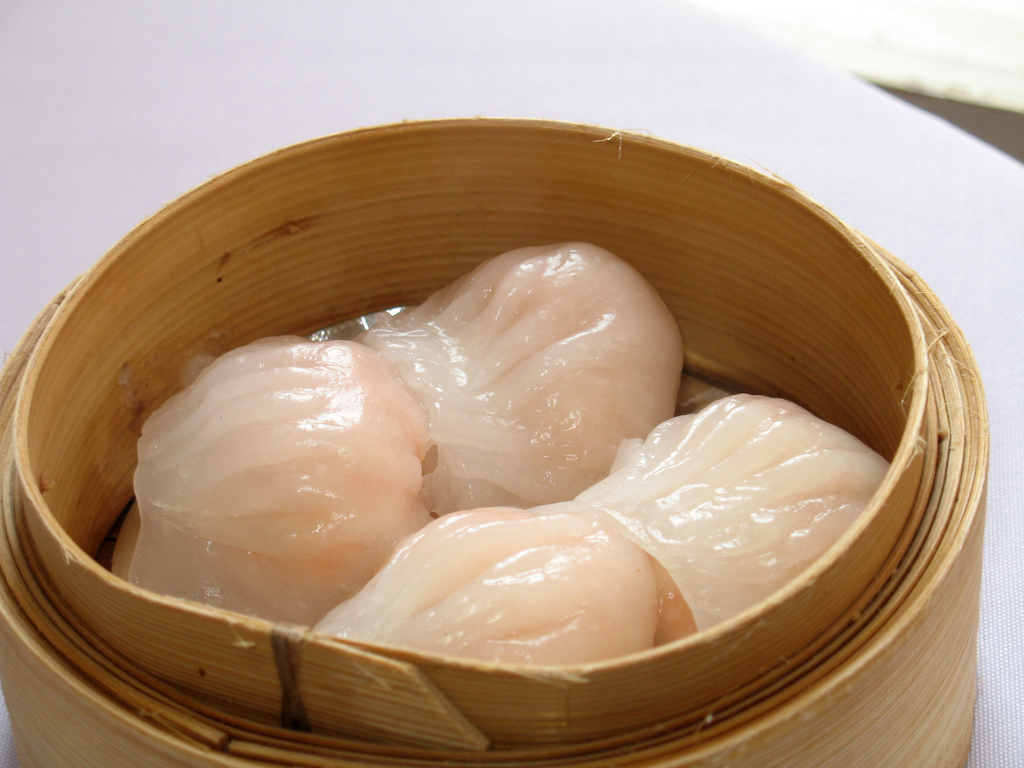
Har gow
In its own language: 蝦餃
Translucent shrimp dumplings served as part of Cantonese dim sum
Har gow are delicate shrimp dumplings from Guangdong, China, known for their thin, translucent wrappers and juicy filling. Served hot in bamboo steamers, they are a staple of Cantonese dim sum and are often paired with shumai. The dumplings are filled with shrimp, bamboo shoots, and sometimes pork fat, wrapped in a wheat and tapioca starch dough.
- Har gow are known as 'crystal shrimp dumplings' for their translucent wrappers
- The dumpling should have at least seven pleats on its wrapper
- First served at Yi Zhen restaurant in Wufeng Village, Guangzhou
- A classic dish of Cantonese dim sum, often paired with shumai
What is Har gow?
Har gow are small, steamed dumplings filled mainly with shrimp and bamboo shoots, sometimes with added pork fat for richness. The wrapper is made from a mix of wheat and tapioca starch, which turns translucent and slightly glossy after steaming. Each dumpling is shaped with several pleats, giving it a bonnet-like appearance. The filling is juicy, and the wrapper is thin yet strong enough to hold together when picked up with chopsticks. Har gow are known for their smooth, delicate texture and subtle seafood flavor.
Where does Har gow come from?
Har gow originated in Guangdong province, China, and are closely tied to Cantonese cuisine. The first restaurant to serve them was Yi Zhen in Wufeng Village, Guangzhou, where they were called Wufeng Har Gow. Over time, har gow became a benchmark for dim sum chefs, with their skill judged by the quality of these dumplings. They are now one of the classic dishes of Cantonese dim sum, often mentioned alongside shumai, cha siu bao, and egg tarts as the 'Four Heavenly Kings' of dim sum.
How is Har gow made?
To make har gow, a dough is prepared from wheat and tapioca starch, rolled into thin circles. The filling is a mixture of chopped shrimp, bamboo shoots, and sometimes pork fat, seasoned with scallions, sesame oil, soy sauce, and sugar. The filling is wrapped in the dough, which is pleated to form a bonnet shape. The dumplings are then steamed in a bamboo basket until the wrappers turn translucent and the filling is cooked through.


How and when is Har gow eaten?
Har gow are served hot, usually in bamboo steamers as part of a dim sum meal. They are often enjoyed at lunch or during tea, sometimes alongside shumai and other dim sum specialties. Diners typically eat them with chopsticks, appreciating the delicate wrapper and juicy filling in one bite. Har gow are a staple in Cantonese teahouses and are commonly shared among friends and family.
Kinds of Har gow
While the classic har gow filling is shrimp and bamboo shoots, some versions may include pork fat for extra juiciness or use slightly different seasonings. The number of pleats on the wrapper can vary, but skilled chefs aim for at least seven, with some making ten or more. Outside China, har gow may be adapted to local tastes, but the translucent wrapper and shrimp filling remain the defining features.
What Har gow means
Har gow are a symbol of Cantonese dim sum culture and are considered a test of a chef's skill. The quality of the wrapper, the number of pleats, and the juiciness of the filling are all points of pride. Har gow are often paired with shumai, and together they are seen as essential items in any dim sum spread. Their popularity has spread beyond China, making them a familiar dish in Chinese restaurants worldwide.
Questions people ask about Har gow
What is har gow made of?
Har gow are dumplings filled mainly with shrimp and bamboo shoots, sometimes with pork fat, wrapped in a thin dough made from wheat and tapioca starch, and seasoned with scallions, sesame oil, soy sauce, and sugar.
Where does har gow come from?
Har gow originated in Guangdong province, China, and were first served at Yi Zhen restaurant in Wufeng Village, Guangzhou. They are a staple of Cantonese dim sum.
How is har gow served?
Har gow are served hot in bamboo steamers as part of a dim sum meal, often alongside shumai and other small dishes, and are typically eaten with chopsticks.
What makes har gow wrappers special?
The wrappers are made from wheat and tapioca starch, which become thin, smooth, and translucent after steaming, allowing the filling to show through.
Is har gow vegetarian?
No, har gow are not vegetarian. They are filled mainly with shrimp and sometimes pork fat.
Good reading and sources
The facts on this page come from the Wikipedia article "Har gow", written by its contributors and used under the CC BY-SA 4.0 licence, and from its Wikidata record (CC0). Thali rewrote the text in its own words, with AI assistance, and compares every page with the article to make sure no passage is copied. It may be reused under the same CC BY-SA 4.0 licence with a link back.
It may contain mistakes, and it is not dietary or allergy advice: recipes differ from cook to cook. If something is wrong, tell us. Last refreshed 2026-10-03.
More from China
All the food of China Chuanr串
🇨🇳 ChinaGrilled skewers of meat, seafood or vegetables from northern China
Grill or roast, Dinner, Snacks
Chuanr串
🇨🇳 ChinaGrilled skewers of meat, seafood or vegetables from northern China
Grill or roast, Dinner, Snacks
 Tofu skin roll
🇨🇳 ChinaTofu skin wrapped around a savoury filling, served steamed or fried as dim sum
Main dish, Lunch, Dinner
Tofu skin roll
🇨🇳 ChinaTofu skin wrapped around a savoury filling, served steamed or fried as dim sum
Main dish, Lunch, Dinner
 Fried rice
🇨🇳 China and 5 moreCooked rice stir-fried with eggs, vegetables, meat or seafood, and seasonings
Main dish, Breakfast, Lunch
Fried rice
🇨🇳 China and 5 moreCooked rice stir-fried with eggs, vegetables, meat or seafood, and seasonings
Main dish, Breakfast, Lunch
Its cousins elsewhere
All dumplings Dampfnudel
🇩🇪 Germany and 3 moreSoft yeast dumplings cooked in a covered pan until golden underneath
Dumpling, Lunch, Dinner
Dampfnudel
🇩🇪 Germany and 3 moreSoft yeast dumplings cooked in a covered pan until golden underneath
Dumpling, Lunch, Dinner
 RavioliRavioliai
🇮🇹 Italy and 4 moreStuffed pasta parcels, usually square, with varied fillings and sauces
Main dish, Lunch, Dinner
RavioliRavioliai
🇮🇹 Italy and 4 moreStuffed pasta parcels, usually square, with varied fillings and sauces
Main dish, Lunch, Dinner
 Gnocchi
🇮🇹 Italy and 5 moreSoft dumplings of dough, often made with potato, flour and egg
Dumpling, Lunch, Dinner
Pierogi
🇵🇱 Poland and 6 moreDumplings of unleavened dough filled with savory or sweet mixtures
Dumpling, Lunch, Dinner
Gnocchi
🇮🇹 Italy and 5 moreSoft dumplings of dough, often made with potato, flour and egg
Dumpling, Lunch, Dinner
Pierogi
🇵🇱 Poland and 6 moreDumplings of unleavened dough filled with savory or sweet mixtures
Dumpling, Lunch, Dinner