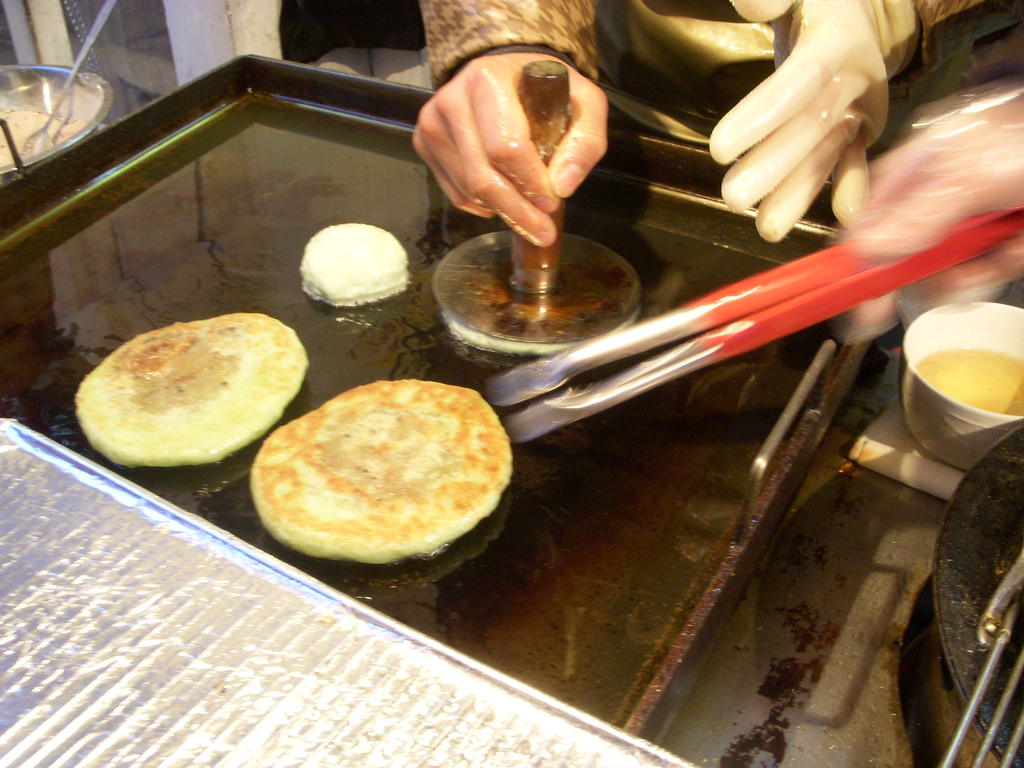
Hotteok
In its own language: 호떡
Korean street pancake with a sweet, nutty filling
Hotteok is a filled pancake popular as a street snack in South Korea. It was introduced by Chinese merchants in the 19th century and is made by enclosing a sweet mixture, often with brown sugar, peanuts, and cinnamon, inside a leavened dough. Hotteok is especially enjoyed in winter and has inspired many modern varieties.
- Hotteok is a favorite winter street snack in South Korea.
- It was introduced by Chinese merchants in the 19th century.
- The filling melts into syrup when cooked.
- Ready-made hotteok mixes are widely available.
- Modern versions include green tea and savory fillings.
What is Hotteok?
Hotteok is a round, pan-cooked pancake with a crisp golden crust and a gooey, sweet filling. The outside is made from a soft, yeasted dough, while the inside usually holds a mix of brown sugar, chopped peanuts, honey, and cinnamon. When cooked, the sugar melts, creating a syrupy center. The pancake is typically pressed flat on the griddle, making it thin and easy to eat by hand. Its aroma is warm and nutty, and the taste is both sugary and spiced.
Where does Hotteok come from?
Hotteok came to Korea in the late 1800s with Chinese merchants from the Qing dynasty. These traders settled in Korea and began selling various Chinese wheat-based snacks, which Koreans grouped under the name hotteok. The dish spread quickly as an affordable treat. During Japanese rule, it was called 'Shina pan,' meaning 'China bread.' Unlike many other Korean pancakes, which are often savory, hotteok became known for its sweet filling, reflecting local preferences.
How is Hotteok made?
To make hotteok, a dough is prepared using wheat flour, water, milk, sugar, and yeast, and left to rise. Small portions of this dough are flattened and filled with a mixture of brown sugar, honey, nuts like peanuts or walnuts, and cinnamon. The filled dough is sealed, placed on a greased griddle, and pressed into a circle with a flat tool. As it cooks, the filling melts and the pancake browns. Ready-made mixes are also sold for home preparation.


How and when is Hotteok eaten?
Hotteok is a common winter snack in South Korea, sold by street vendors and eaten hot. People often buy it as a quick treat while walking or shopping. It is usually eaten plain, straight from the griddle, and is held in a paper sleeve to avoid burning fingers on the hot syrup inside. There are no special accompaniments, and it is enjoyed for its warmth and sweetness, especially in cold weather.
Kinds of Hotteok
While the classic hotteok filling is a mix of brown sugar, peanuts, and cinnamon, new versions have appeared in recent years. Some vendors offer green tea, berry, or corn-flavored pancakes, and savory types with noodles and vegetables called yachae-hotteok. Companies also sell packaged mixes and fillings, making it easy to prepare at home. These changes reflect both modern tastes and the popularity of the snack.
What Hotteok means
Hotteok is a symbol of Korean street food culture, especially in winter. The phrase 'The hotteok store is burning' is used in Korean to describe a noisy or chaotic scene, a nod to the bustling stalls where the pancakes are made. The snack’s history links it to both Chinese immigrants and the Silk Road, and it remains a nostalgic treat for many Koreans.
Questions people ask about Hotteok
What is hotteok made of?
Hotteok is made from a yeasted dough and filled with a sweet mixture, usually brown sugar, peanuts, honey, and cinnamon. The dough is cooked on a griddle until golden and crisp.
Where did hotteok originate?
Hotteok was brought to Korea by Chinese merchants from the Qing dynasty in the late 19th century. It became popular as a street food in Korea.
How is hotteok usually eaten?
Hotteok is eaten hot, often as a snack from street vendors. It is typically served in a paper sleeve and enjoyed plain, with the syrupy filling inside.
Are there different types of hotteok?
Yes, besides the traditional sweet filling, there are versions with green tea, berries, corn, and even savory fillings like noodles and vegetables.
Is hotteok vegetarian?
Hotteok is usually vegetarian, as it contains no meat or fish. The main ingredients are flour, sugar, nuts, and spices.
Good reading and sources
The facts on this page come from the Wikipedia article "Hotteok", written by its contributors and used under the CC BY-SA 4.0 licence, and from its Wikidata record (CC0). Thali rewrote the text in its own words, with AI assistance, and compares every page with the article to make sure no passage is copied. It may be reused under the same CC BY-SA 4.0 licence with a link back.
It may contain mistakes, and it is not dietary or allergy advice: recipes differ from cook to cook. If something is wrong, tell us. Last refreshed 2026-10-03.
More from South Korea
All the food of South Korea KabochaVeganカボチャ
🇯🇵 Japan and 5 moreA sweet, dense winter squash with edible skin, used in Japanese and Asian cooking
Main dish, Lunch, Dinner
KabochaVeganカボチャ
🇯🇵 Japan and 5 moreA sweet, dense winter squash with edible skin, used in Japanese and Asian cooking
Main dish, Lunch, Dinner
 SikhyeVegan식혜
🇰🇷 South KoreaSweet Korean rice drink made by fermenting rice with malt
Drink
SikhyeVegan식혜
🇰🇷 South KoreaSweet Korean rice drink made by fermenting rice with malt
Drink
 Udonうどん / 饂飩
🇯🇵 Japan and 4 moreThick wheat noodles served hot or cold in Japanese cooking
Noodle or pasta dish, Lunch, Dinner
Udonうどん / 饂飩
🇯🇵 Japan and 4 moreThick wheat noodles served hot or cold in Japanese cooking
Noodle or pasta dish, Lunch, Dinner
Its cousins elsewhere
All street food Bagel
🇵🇱 Poland and 2 moreRing-shaped bread roll, boiled then baked for a dense, chewy texture
Bread, Breakfast, Lunch
Bagel
🇵🇱 Poland and 2 moreRing-shaped bread roll, boiled then baked for a dense, chewy texture
Bread, Breakfast, Lunch
 Lángos
🇭🇺 Hungary and 5 moreHungarian deep-fried flatbread, often topped with cheese or sour cream
Bread, Breakfast, Snacks
Lángos
🇭🇺 Hungary and 5 moreHungarian deep-fried flatbread, often topped with cheese or sour cream
Bread, Breakfast, Snacks
 Crêpe
🇫🇷 FranceThin French pancakes, served sweet or savoury with a range of fillings
Main dish, Breakfast, Lunch
Crêpe
🇫🇷 FranceThin French pancakes, served sweet or savoury with a range of fillings
Main dish, Breakfast, Lunch
 OliebolVegetarian
🇳🇱 Netherlands and 2 moreDutch deep-fried dough balls, often with raisins and dusted with powdered sugar
Sweet or dessert, Snacks
OliebolVegetarian
🇳🇱 Netherlands and 2 moreDutch deep-fried dough balls, often with raisins and dusted with powdered sugar
Sweet or dessert, Snacks