
Lamington
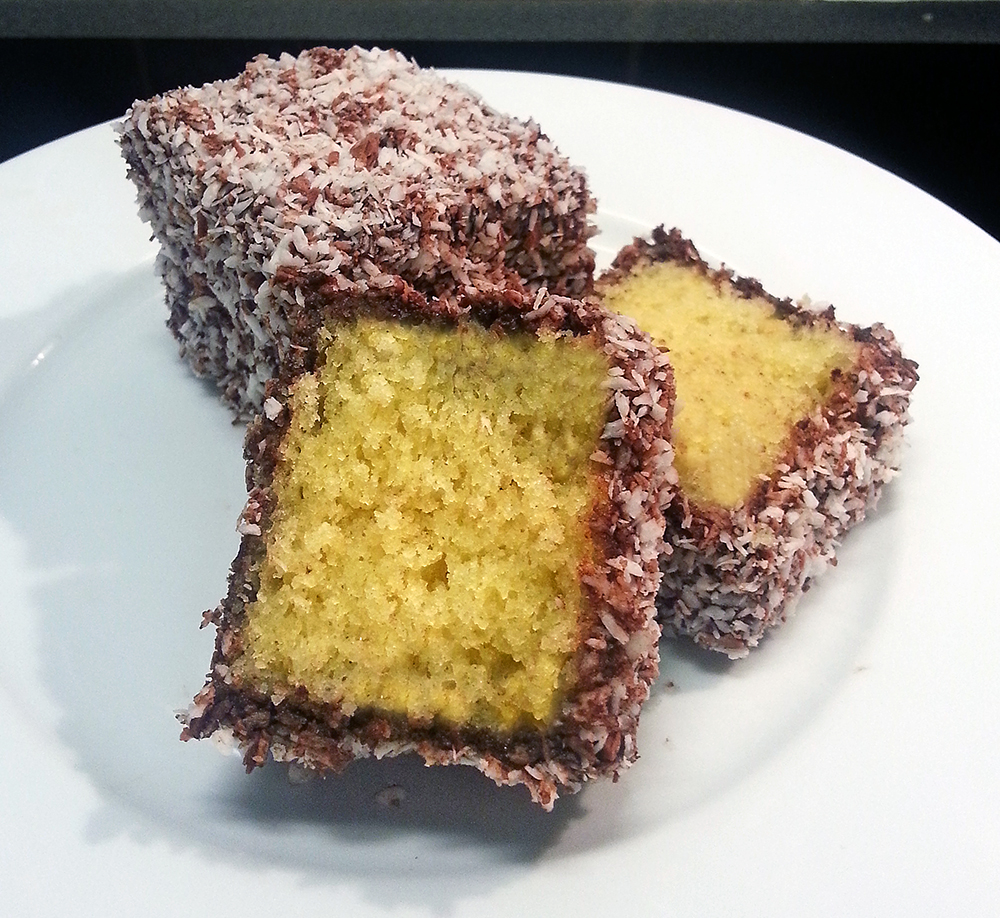
Sponge cake squares dipped in chocolate and rolled in coconut
Lamington is an Australian sweet made from squares of sponge or butter cake, coated with chocolate sauce and covered in desiccated coconut. It is closely linked to Queensland and often appears at fundraisers and celebrations. Some versions include a layer of cream or strawberry jam inside.
- Named after Lord Lamington, former Governor of Queensland
- Squares of cake dipped in chocolate and rolled in coconut
- Often sold at school and charity fundraisers called 'lamington drives'
- National Lamington Day is celebrated on 21 July in Australia
- Variations include cream or jam filling
What is Lamington?
A lamington is a sweet treat made from squares of light sponge or butter cake. Each piece is dipped in a thin chocolate sauce, which soaks into the outer layer, and then rolled in fine, dried coconut. The result is a soft, moist cake with a chocolatey, coconut-coated exterior. Some versions are filled with cream or strawberry jam, making them richer and adding a fruity note.
Where does Lamington come from?
The lamington is widely associated with Queensland, Australia, and is believed to be named after Lord Lamington, who was Governor of Queensland at the turn of the twentieth century. Stories about its creation often mention Lord Lamington's French-born chef, Armand Galland, who may have invented the cake to serve unexpected guests using leftover sponge cake. The earliest known reference to the name dates to 1896, but the exact origin remains debated, with several Queensland locations claiming the first lamington.
How is Lamington made?
To make lamingtons, squares of sponge or butter cake are prepared and allowed to cool. Each piece is dipped into a chocolate sauce, which is thin enough to soak into the cake's surface. The coated cake is then rolled in desiccated coconut, which sticks to the chocolate layer. Some lamingtons are sliced and filled with a layer of cream or strawberry jam before being assembled and coated.
How and when is Lamington eaten?
Lamingtons are enjoyed as a snack or with tea, often at gatherings, school events, or charity fundraisers known as 'lamington drives'. They are served at room temperature and can be found in bakeries, cafes, and homes. On National Lamington Day, many Australians celebrate by making or sharing lamingtons. The cake is easy to eat by hand and is popular with both children and adults.
Kinds of Lamington
While the classic lamington uses chocolate and coconut, many versions exist. Some have a filling of cream or strawberry jam. Other countries have similar cakes, such as kókuszkocka in Hungary, čupavci in Croatia and Serbia, and pink lamingtons in Malta, which use fruit-flavoured jelly. In Mauritius, red lamington cake is made with red dye and sometimes topped with whipped cream and fruit.
What Lamington means
Lamingtons are considered an Australian icon and are closely tied to Queensland's identity. They are often used in fundraising events and have a dedicated National Lamington Day on 21 July. The cake was named a Q150 Icon of Queensland in 2009, highlighting its place in local culture. The name is sometimes shortened to 'Lammo' or 'Lammos' in everyday speech.
Questions people ask about Lamington
What is a lamington made of?
A lamington is made from squares of sponge or butter cake, dipped in chocolate sauce and rolled in desiccated coconut. Some versions include a layer of cream or strawberry jam inside.
Where did lamingtons originate?
Lamingtons originated in Queensland, Australia, and are named after Lord Lamington, who was Governor there from 1896 to 1901.
Are lamingtons vegetarian?
Yes, lamingtons are typically vegetarian, as they are made from cake, chocolate sauce, and coconut. Some versions may include cream or jam.
When are lamingtons usually eaten?
Lamingtons are commonly eaten as a snack or with tea. They are also popular at fundraisers, celebrations, and on National Lamington Day.
Are there different types of lamingtons?
Yes, some lamingtons have a filling of cream or strawberry jam. Other countries have similar cakes with different flavours, such as pink lamingtons in Malta and red lamington cake in Mauritius.
Good reading and sources
The facts on this page come from the Wikipedia article "Lamington", written by its contributors and used under the CC BY-SA 4.0 licence, and from its Wikidata record (CC0). Thali rewrote the text in its own words, with AI assistance, and compares every page with the article to make sure no passage is copied. It may be reused under the same CC BY-SA 4.0 licence with a link back.
It may contain mistakes, and it is not dietary or allergy advice: recipes differ from cook to cook. If something is wrong, tell us. Last refreshed 2026-10-03.
More from Australia
All the food of Australia Doughnut
🇺🇸 United States and 5 moreSweet fried or baked rings or balls, often glazed or filled
Sweet or dessert, Breakfast, Snacks
Doughnut
🇺🇸 United States and 5 moreSweet fried or baked rings or balls, often glazed or filled
Sweet or dessert, Breakfast, Snacks
 Pie
🇬🇧 United Kingdom and 5 moreA baked dish with a pastry crust and sweet or savoury filling
Main dish, Lunch, Dinner
Pie
🇬🇧 United Kingdom and 5 moreA baked dish with a pastry crust and sweet or savoury filling
Main dish, Lunch, Dinner
 Scone
🇬🇧 United Kingdom and 5 moreA quick bread, sweet or savoury, served with tea in Britain and beyond
Bread, Tea time, Breakfast
Scone
🇬🇧 United Kingdom and 5 moreA quick bread, sweet or savoury, served with tea in Britain and beyond
Bread, Tea time, Breakfast
 Christmas pudding
🇬🇧 United Kingdom and 4 moreSteamed or boiled sweet pudding with dried fruit, served at Christmas dinner
Sweet or dessert, Dinner
Christmas pudding
🇬🇧 United Kingdom and 4 moreSteamed or boiled sweet pudding with dried fruit, served at Christmas dinner
Sweet or dessert, Dinner
Its cousins elsewhere
All sweets and desserts ChajáVegetarian
🇺🇾 Uruguay and 4 moreUruguayan dessert of sponge cake, meringue, cream and fruit
Sweet or dessert
ChajáVegetarian
🇺🇾 Uruguay and 4 moreUruguayan dessert of sponge cake, meringue, cream and fruit
Sweet or dessert
 Ice cream
🇺🇸 United States and 5 moreA frozen dessert made from sweetened, flavoured milk or cream
Sweet or dessert, Snacks
Ice cream
🇺🇸 United States and 5 moreA frozen dessert made from sweetened, flavoured milk or cream
Sweet or dessert, Snacks
 SachertorteVegetarian
🇦🇹 Austria and 1 moreAustrian chocolate sponge cake with apricot jam and a glossy chocolate glaze
Sweet or dessert, Tea time, Snacks
SachertorteVegetarian
🇦🇹 Austria and 1 moreAustrian chocolate sponge cake with apricot jam and a glossy chocolate glaze
Sweet or dessert, Tea time, Snacks
 Cream teaVegetarian
🇬🇧 United KingdomAfternoon tea with scones, clotted cream and strawberry jam
Sweet or dessert, Tea time
Cream teaVegetarian
🇬🇧 United KingdomAfternoon tea with scones, clotted cream and strawberry jam
Sweet or dessert, Tea time