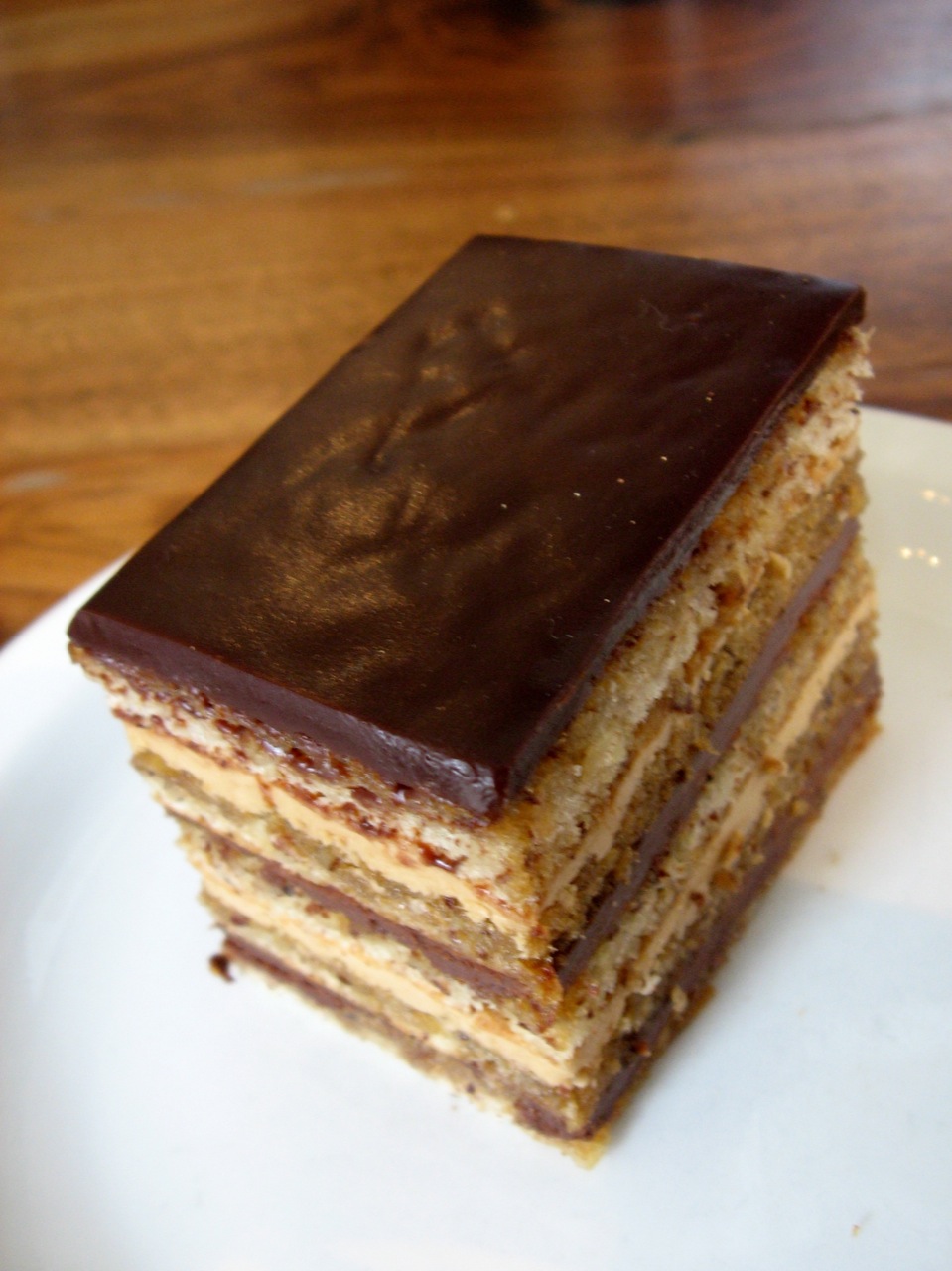
Opera cake
In its own language: Gâteau opéra
French cake of almond sponge, coffee syrup, ganache and chocolate glaze
Opera cake is a French dessert made of thin layers of almond sponge cake soaked in coffee syrup, with ganache and coffee buttercream between each layer, finished with a chocolate glaze. Its layered look is said to resemble the levels of an opera house. It is served as a sweet treat, often in patisseries.
- Made with almond sponge soaked in coffee syrup
- Layers of ganache and coffee buttercream
- Finished with a chocolate glaze
- Named for its resemblance to opera house tiers
- Sometimes decorated with edible gold leaf
What is Opera cake?
Opera cake is a multi-layered French dessert built from thin sheets of almond sponge cake, which is called Joconde in French. Each layer of sponge is soaked with coffee syrup or sometimes Grand Marnier, a type of orange liqueur. Between these layers are rich chocolate ganache and coffee-flavoured French buttercream. The whole cake is finished with a smooth chocolate glaze. Sometimes, edible gold leaf is used as decoration. The cake is rectangular, with clearly visible, even layers.
Where does Opera cake come from?
Opera cake comes from France and was popularized by the Dalloyau pâtisserie. Its exact origin is debated. Cyriaque Gavillon claimed to have created it at Dalloyau in 1955, and his wife Andrée Gavillon is said to have named it after the Opéra Garnier in Paris. Another pastry chef, Gaston Lenôtre, also claimed to have invented the cake in 1960. The name refers to the cake’s layered appearance, which is thought to resemble the tiers of an opera house.
How is Opera cake made?
To make opera cake, thin almond sponge cakes are baked and then soaked with coffee syrup or sometimes Grand Marnier. These are stacked with alternating layers of chocolate ganache and coffee-flavoured buttercream. Once assembled, the cake is covered with a glossy chocolate glaze. The finished cake is often trimmed to show off its neat layers, and sometimes decorated with gold leaf for a touch of elegance.
How and when is Opera cake eaten?
Opera cake is usually served as a dessert or a sweet treat in French patisseries. It is sliced into neat rectangles or squares to highlight its layers. The cake is enjoyed for its combination of coffee and chocolate flavours, and its delicate, moist texture. It is not tied to any specific meal or occasion, but is eaten whenever a refined dessert is desired.
Kinds of Opera cake
The classic opera cake uses almond sponge, coffee syrup, ganache, and coffee buttercream. Some versions swap the coffee syrup for Grand Marnier, adding a hint of orange. Presentation may vary, with some cakes topped with edible gold leaf. While the basic structure remains the same, small changes in flavouring or decoration are common among pastry chefs.
What Opera cake means
Opera cake is considered an elaborate and elegant French dessert, often found in high-end patisseries. Its layered appearance and refined flavours make it a symbol of French pastry skill. The cake’s name and design are linked to the cultural importance of opera in France, particularly the Opéra Garnier. It is sometimes used to showcase pastry technique and presentation.
Questions people ask about Opera cake
What is opera cake made of?
Opera cake is made from layers of almond sponge cake (Joconde), coffee syrup or Grand Marnier, chocolate ganache, coffee-flavoured buttercream, and a chocolate glaze.
Where does opera cake come from?
Opera cake comes from France. It was popularized by the Dalloyau pâtisserie, though its exact creator is disputed.
Why is it called opera cake?
The name comes from the cake’s layered look, which is said to resemble the levels or tiers of an opera house.
Is opera cake always made with coffee?
Traditional opera cake uses coffee syrup to soak the sponge and coffee-flavoured buttercream, but some versions use Grand Marnier for a different flavour.
How is opera cake served?
Opera cake is sliced into neat rectangles or squares to show its layers and is often served as a dessert in patisseries.
Good reading and sources
The facts on this page come from the Wikipedia article "Opera cake", written by its contributors and used under the CC BY-SA 4.0 licence, and from its Wikidata record (CC0). Thali rewrote the text in its own words, with AI assistance, and compares every page with the article to make sure no passage is copied. It may be reused under the same CC BY-SA 4.0 licence with a link back.
It may contain mistakes, and it is not dietary or allergy advice: recipes differ from cook to cook. If something is wrong, tell us. Last refreshed 2026-10-03.
More from France
All the food of France Ice cream
🇺🇸 United States and 5 moreA frozen dessert made from sweetened, flavoured milk or cream
Sweet or dessert, Snacks
Ice cream
🇺🇸 United States and 5 moreA frozen dessert made from sweetened, flavoured milk or cream
Sweet or dessert, Snacks
 Candy
🇺🇸 United States and 5 moreSmall sweet treats made mainly from sugar or sweeteners
Sweet or dessert, Snacks
Candy
🇺🇸 United States and 5 moreSmall sweet treats made mainly from sugar or sweeteners
Sweet or dessert, Snacks
 CroissantVegetarian
🇫🇷 France and 5 moreA crescent-shaped, flaky pastry made from layered yeast dough and butter
Pie or savoury pastry, Breakfast, Tea time
CroissantVegetarian
🇫🇷 France and 5 moreA crescent-shaped, flaky pastry made from layered yeast dough and butter
Pie or savoury pastry, Breakfast, Tea time
 French toast
🇫🇷 France and 5 moreBread soaked in egg and milk, pan-fried and served sweet or savoury
Main dish, Breakfast, Snacks
French toast
🇫🇷 France and 5 moreBread soaked in egg and milk, pan-fried and served sweet or savoury
Main dish, Breakfast, Snacks
Its cousins elsewhere
All sweets and desserts Boston cream pieVegetarian
🇺🇸 United States and 1 moreLayered sponge cake with custard and chocolate glaze from Massachusetts
Sweet or dessert
Boston cream pieVegetarian
🇺🇸 United States and 1 moreLayered sponge cake with custard and chocolate glaze from Massachusetts
Sweet or dessert
 Nanaimo barVegetarian
🇨🇦 CanadaNo-bake Canadian bar with a crumb base, custard icing, and chocolate top
Sweet or dessert
Nanaimo barVegetarian
🇨🇦 CanadaNo-bake Canadian bar with a crumb base, custard icing, and chocolate top
Sweet or dessert
 Chocolate
🇨🇮 Ivory Coast and 5 moreA sweet or bitter food made from processed cocoa beans, enjoyed in many forms worldwide
Sweet or dessert, Snacks
Halvaحَلَاوَة
🇮🇷 Iran and 5 moreDense sweet made from seeds, grains, or vegetables, found across Asia, Africa, and Europe
Sweet or dessert, Snacks, Tea time
Chocolate
🇨🇮 Ivory Coast and 5 moreA sweet or bitter food made from processed cocoa beans, enjoyed in many forms worldwide
Sweet or dessert, Snacks
Halvaحَلَاوَة
🇮🇷 Iran and 5 moreDense sweet made from seeds, grains, or vegetables, found across Asia, Africa, and Europe
Sweet or dessert, Snacks, Tea time