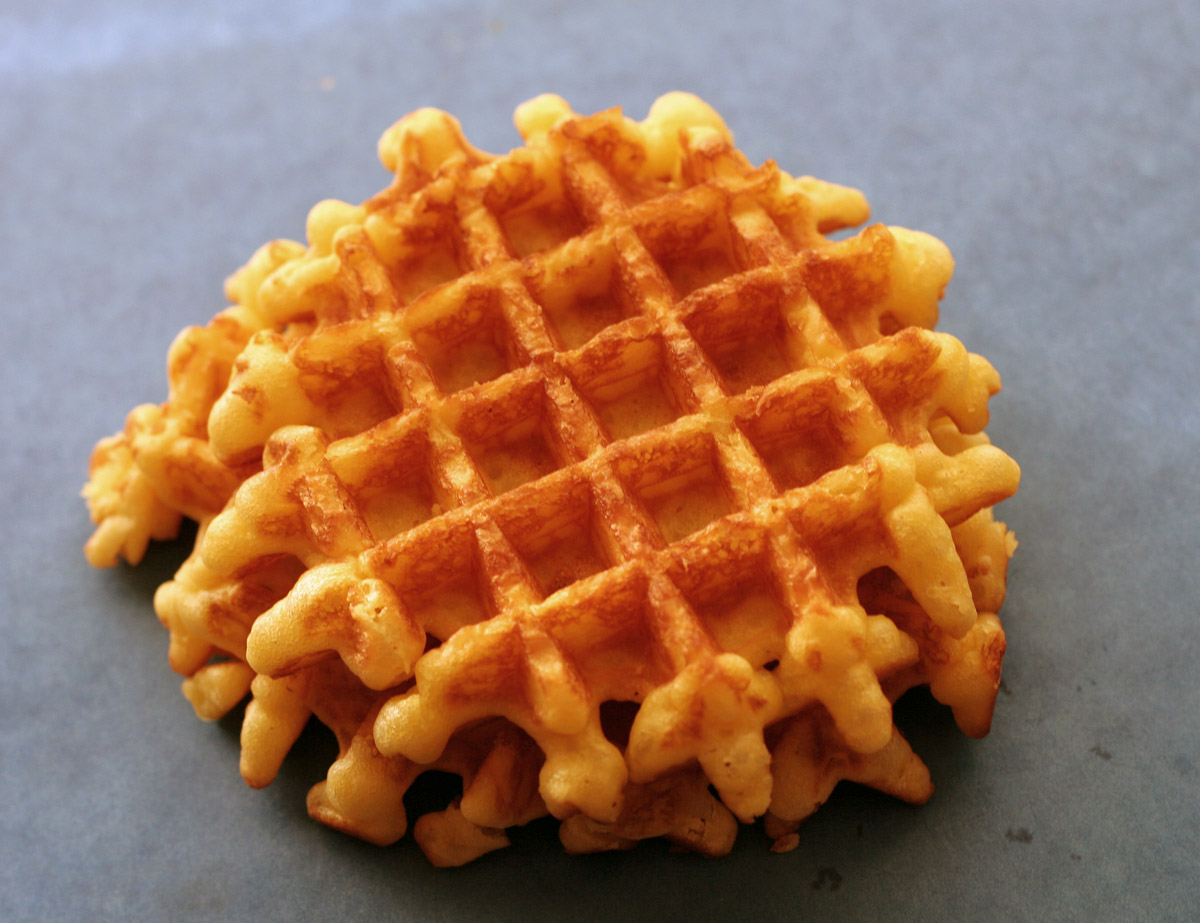
Waffle
Batter or dough baked between two gridded metal plates
A waffle is a Western European pastry made from batter or dough cooked in a patterned iron. With origins tracing back to medieval wafer irons in France and Belgium, it is commonly eaten hot as a sweet snack or dessert.
- Early waffles evolved from thin medieval communion wafers baked on handled irons.
- Belgium produces more than a dozen distinct regional waffle varieties.
- The earliest recipe featuring yeast was published in sixteenth-century Antwerp.
- King Charles IX of France enacted laws in 1560 to stop street fights between rival bakers.
What is Waffle?
A waffle is a crisp, indented pastry made by cooking batter or prepared dough between two heavy sculpted plates. The surface pattern creates a raised grid of pockets across both sides. Early historical formulas were simple mixtures of flour and water or wine, but contemporary recipes rely on rich batters of wheat flour, eggs, butter, milk, and sweetener. Some styles use runny liquids leavened with beaten egg whites or baker's yeast, while others call for yeast-risen brioche dough studded with dense sugar crystals. Freshly baked waffles smell of toasted grains, browned butter, and caramel, with a delicate crunch on the ridges yielding to a tender, steamy interior.
Where does Waffle come from?
Waffles descend from ancient Greek flat cakes cooked between hot metal plates and medieval church communion wafers. In Western Europe, makers of thin secular wafers called oublies established their own trade guild in Paris by 1270. During the late fourteenth century, an anonymous French household guide recorded the earliest known waffle recipes, combining eggs, wine, and flour without leavening. By the fifteenth and sixteenth centuries, Belgian and French artisans developed deeper rectangular irons engraved with grid patterns. The first documented recipe using beer yeast appeared in sixteenth-century Antwerp, producing the airy, raised structure associated with modern European waffles.
How is Waffle made?
A waffle begins with mixing flour, liquid, and eggs into either a pourable batter or a pliable, kneaded dough. The cook heats a two-sided waffle iron over a heat source or electric element and coats the metal surfaces with fat. The mixture is placed directly in the center, and the hinged cover is closed firmly to spread the batter into every indent. Trapped steam causes the leavening to expand rapidly while direct contact with the hot iron browns the outer crust. Once both sides turn crisp and golden brown, the iron opens and the pastry is lifted out while still hot.


How and when is Waffle eaten?
Waffles are served freshly baked from the iron, though commercial precooked versions may be reheated from chilled or frozen packages. People eat them warm directly by hand as street food or plated at a table. In historical European dining, delicate sweetened wafers featured as dessert pastries for wealthy households. Modern street vendors hand them to walkers plain or dressed with sweet additions such as fruit, melted chocolate, syrups, or powdered sugar. They are widely enjoyed for afternoon tea, sweet snacking between meals, and breakfast.
Kinds of Waffle
Regional styles vary according to batter consistency and iron design. Brussels waffles feature light, airy batters baked in large rectangular grids with clean squared edges. Flemish waffles, also called Gaufres de Lille, date to the eighteenth century and rely on beer yeast, whipped egg whites, and heavy butter. Liège waffles use a denser, yeast-risen brioche dough mixed with coarse pearl sugar that partially melts on the hot iron. Other varieties include Dutch stroopwafels filled with spiced syrup, German Bergische waffles, and versions flavored with spices, coffee, or melted chocolate.
What Waffle means
Sixteenth-century Netherlandish painters such as Pieter Bruegel documented waffle baking at village celebrations and domestic hearths. In sixteenth-century France, waffle vendors grew so contentious that royal decrees forced them to keep four yards of distance from one another. In North America, Dutch settlers introduced waffle gatherings called wafel frolics during the eighteenth century. By the twentieth century, commercial electric irons and ready-made dry mixes transformed waffles from an artisanal street specialty into a common homemade staple.
Questions people ask about Waffle
What is a waffle made of?
A waffle is made from a batter or dough based on wheat flour, liquid such as milk or water, eggs, and fat like butter. Many traditional versions include leavening agents like beer yeast or whipped egg whites, along with sugar and sweet spices.
Where did waffles come from?
Waffles developed in medieval Western Europe, particularly in regions that are now France and Belgium. They descended from thin communion wafers and secular street pastries called oublies, taking on their distinctive gridded shape in the fifteenth century.
How does a Brussels waffle differ from a Liège waffle?
Brussels waffles are made with a light, thin batter cooked into a crisp, deep rectangular grid. Liège waffles are prepared from a richer, yeast-leavened brioche dough embedded with coarse sugar crystals that caramelize in the iron.
Good reading and sources
The facts on this page come from the Wikipedia article "Waffle", written by its contributors and used under the CC BY-SA 4.0 licence, and from its Wikidata record (CC0). EveryThali rewrote the text in its own words, with AI assistance, and compares every page with the article to make sure no passage is copied. It may be reused under the same CC BY-SA 4.0 licence with a link back.
It may contain mistakes, and it is not dietary or allergy advice: recipes differ from cook to cook. If something is wrong, tell us. Last refreshed 2026-10-04.
More from Belgium
All the food of Belgium Chocolate
🇨🇮 Ivory Coast and 5 moreA sweet or bitter food made from processed cocoa beans, enjoyed in many forms worldwide
Sweet or dessert, Snacks
Chocolate
🇨🇮 Ivory Coast and 5 moreA sweet or bitter food made from processed cocoa beans, enjoyed in many forms worldwide
Sweet or dessert, Snacks
 French friesVeganpommes frites
🇫🇷 France and 5 moreDeep-fried strips of potato, served hot and salted
Street food, Lunch, Dinner
French friesVeganpommes frites
🇫🇷 France and 5 moreDeep-fried strips of potato, served hot and salted
Street food, Lunch, Dinner
 Doner kebab
🇹🇷 Turkey and 5 moreMeat roasted on a vertical spit, sliced and served in bread or on a plate
Main dish, Lunch, Dinner
Doner kebab
🇹🇷 Turkey and 5 moreMeat roasted on a vertical spit, sliced and served in bread or on a plate
Main dish, Lunch, Dinner
 Steak tartareMeat
🇫🇷 France and 5 moreRaw minced beef, seasoned and often topped with a raw egg yolk
Main dish, Lunch, Dinner
Steak tartareMeat
🇫🇷 France and 5 moreRaw minced beef, seasoned and often topped with a raw egg yolk
Main dish, Lunch, Dinner
Its cousins elsewhere
All pies and savoury pastries Egg tartVegetarian蛋撻
🇨🇳 China and 5 moreA small pastry tart with a sweet egg custard filling, found in Cantonese cuisine
Pie or savoury pastry, Snacks, Tea time
Halvaحَلَاوَة
🇮🇷 Iran and 5 moreDense sweet made from seeds, grains, or vegetables, found across Asia, Africa, and Europe
Sweet or dessert, Snacks, Tea time
Egg tartVegetarian蛋撻
🇨🇳 China and 5 moreA small pastry tart with a sweet egg custard filling, found in Cantonese cuisine
Pie or savoury pastry, Snacks, Tea time
Halvaحَلَاوَة
🇮🇷 Iran and 5 moreDense sweet made from seeds, grains, or vegetables, found across Asia, Africa, and Europe
Sweet or dessert, Snacks, Tea time
 Chocolate brownieVegetarianBrownie
🇺🇸 United States and 2 moreDense chocolate squares baked as a bar, often served warm or with toppings
Sweet or dessert, Snacks, Tea time
Chocolate brownieVegetarianBrownie
🇺🇸 United States and 2 moreDense chocolate squares baked as a bar, often served warm or with toppings
Sweet or dessert, Snacks, Tea time
 Pumpkin pieVegetarian
🇺🇸 United States and 1 moreSweet pie with spiced pumpkin custard in a pastry shell, served for autumn holidays
Sweet or dessert
Pumpkin pieVegetarian
🇺🇸 United States and 1 moreSweet pie with spiced pumpkin custard in a pastry shell, served for autumn holidays
Sweet or dessert