
Doner kebab
Meat roasted on a vertical spit, sliced and served in bread or on a plate
Doner kebab is a Turkish dish where seasoned meat is cooked on a vertical rotisserie and thinly sliced as it cooks. It can be served in bread as a sandwich or wrap, or on a plate, often with salad, vegetables, and sauces. The sandwich form became popular in 1970s Berlin and has since spread worldwide as a fast food and street food.
- Meat is cooked on a vertical rotisserie and sliced thin as it cooks
- The sandwich form was popularized in 1970s Berlin by Turkish immigrants
- Can be served in bread, wraps, or on a plate with salad and sauces
- Inspired dishes like shawarma, gyros, and al pastor
- Annual sales in Germany reach billions of euros
What is Doner kebab?
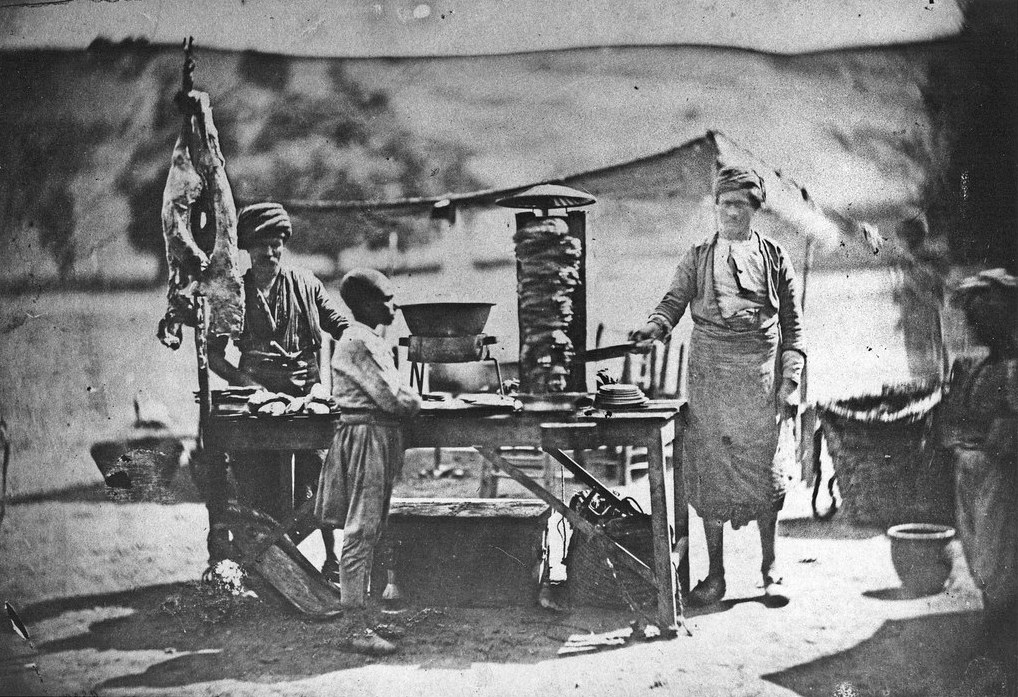
Doner kebab is made by stacking seasoned slices of meat, usually lamb, beef, or chicken, into a cone shape on a vertical spit. As the meat turns and cooks beside a heat source, thin shavings are sliced off for serving. The meat is often served in bread—such as pita, lavash, or a bun—or on a plate, accompanied by salad, vegetables like tomato, lettuce, cabbage, onion, and sometimes pickled cucumber or chili. Sauces are commonly added. The dish is known for its savory, spiced meat and the balance of fresh and tangy accompaniments.
Where does Doner kebab come from?
The technique of roasting meat on a vertical spit began in the Ottoman Empire in the 19th century, with Bursa often named as the birthplace. The method was a shift from earlier horizontal rotisseries. The sandwich or wrap form of doner kebab emerged in 1970s West Berlin, created by Turkish immigrants and quickly became a popular fast food. The doner kebab has influenced and given rise to similar dishes, such as shawarma in the Arab world, gyros in Greece, and al pastor in Mexico.
How is Doner kebab made?
To make doner kebab, slices of seasoned meat are stacked tightly on a vertical spit, forming a large cone. The spit rotates slowly next to a vertical heating element, cooking the outer layer. As the meat cooks, thin slices are shaved off with a long knife. The sliced meat can be served in bread or wraps, or on a plate, often with salad, vegetables, and a choice of sauces. In some versions, the wrap is grilled after rolling to crisp it up.



How and when is Doner kebab eaten?
Doner kebab is eaten as a main meal or snack, often bought from street vendors or kebab shops. It can be eaten on the go, especially in sandwich or wrap form, or served on a plate with accompaniments. In many countries, it is a popular late-night food, especially after social outings. It is commonly served with salad, vegetables, and sauces, and sometimes with fries either on the side or inside the bread.
Kinds of Doner kebab
Regional versions abound. In Turkey, doner is served in wraps (dürüm), over rice (pilavüstü), or atop pide bread as İskender kebap with tomato sauce and butter. In Germany, the Berlin-style doner features abundant salad and sauces in pita. France has the 'sandwich grec', often with fries. The Netherlands has kapsalon, fries topped with doner meat, cheese, and salad. Vegetarian and poultry versions are also common.
What Doner kebab means
Doner kebab is a symbol of Turkish culinary heritage and has become a staple fast food in many European countries, especially Germany, where it rivals burgers in popularity. In Turkey, certain versions like İskender kebap are associated with specific cities and family-run restaurants. The dish has inspired similar foods worldwide and is recognized as an everyday, accessible meal. Turkey has sought EU recognition for döner as a traditional specialty.
Questions people ask about Doner kebab
What is doner kebab made of?
Doner kebab is made from seasoned meat, typically lamb, beef, or chicken, stacked on a vertical spit. It is served with bread or flatbread, salad, vegetables, and sauces.
Where does doner kebab come from?
Doner kebab originated in Turkey in the 19th century, with the vertical rotisserie technique developed in Bursa. The sandwich form was popularized in Berlin, Germany, in the 1970s.
How is doner kebab served?
It can be served as a sandwich in pita or flatbread, as a wrap, or on a plate with accompaniments like salad, vegetables, and sauces. In some places, it is also served with fries.
Is doner kebab always made with lamb?
No, while lamb is traditional, beef and chicken are also widely used. In some countries, turkey or vegetarian versions are available.
What are some popular variations of doner kebab?
Variations include İskender kebap in Turkey, Berlin-style doner with lots of salad and sauces, French 'sandwich grec', and Dutch kapsalon with fries, cheese, and salad.
Good reading and sources
- Encyclopaedia BritannicaArticle
- The halal snack pack: a fast track to a heart attack? Or worse?The Guardian, Article
- Doner kebab 'inventor' Kadir Nurman dies in BerlinBBC, Article
The facts on this page come from the Wikipedia article "Doner kebab", written by its contributors and used under the CC BY-SA 4.0 licence, and from its Wikidata record (CC0). Thali rewrote the text in its own words, with AI assistance, and compares every page with the article to make sure no passage is copied. It may be reused under the same CC BY-SA 4.0 licence with a link back.
It may contain mistakes, and it is not dietary or allergy advice: recipes differ from cook to cook. If something is wrong, tell us. Last refreshed 2026-10-03.
More from Turkey
All the food of Turkey Kebabكَبَاب
🇹🇷 Turkey and 5 moreGrilled or roasted meat, often on skewers, found across the Middle East and beyond
Main dish, Lunch, Dinner
Kebabكَبَاب
🇹🇷 Turkey and 5 moreGrilled or roasted meat, often on skewers, found across the Middle East and beyond
Main dish, Lunch, Dinner
 Pilaf
🇺🇿 Uzbekistan and 5 moreRice cooked in stock with spices, meat or vegetables, with each grain kept separate
Main dish, Lunch, Dinner
Pilaf
🇺🇿 Uzbekistan and 5 moreRice cooked in stock with spices, meat or vegetables, with each grain kept separate
Main dish, Lunch, Dinner
 Moussakaμουσακάς
🇬🇷 Greece and 5 moreBaked casserole of eggplant or potato, often layered with meat and sauce
Main dish, Lunch, Dinner
Moussakaμουσακάς
🇬🇷 Greece and 5 moreBaked casserole of eggplant or potato, often layered with meat and sauce
Main dish, Lunch, Dinner
 Freekehفريكة
🇵🇸 Palestine and 5 moreRoasted green durum wheat grains, a staple across the eastern Mediterranean
Main dish, Lunch, Dinner
Freekehفريكة
🇵🇸 Palestine and 5 moreRoasted green durum wheat grains, a staple across the eastern Mediterranean
Main dish, Lunch, Dinner
Its cousins elsewhere
All main dishes AsadoMeat
🇦🇷 Argentina and 4 moreBarbecued meats cooked over open fire, central to gatherings in Argentina and Uruguay
Main dish, Lunch, Dinner
AsadoMeat
🇦🇷 Argentina and 4 moreBarbecued meats cooked over open fire, central to gatherings in Argentina and Uruguay
Main dish, Lunch, Dinner
 PachamancaMeat
🇵🇪 Peru and 1 moreAndean meats and vegetables slow-cooked with hot stones in an earthen oven
Main dish, Lunch, Dinner
PachamancaMeat
🇵🇪 Peru and 1 moreAndean meats and vegetables slow-cooked with hot stones in an earthen oven
Main dish, Lunch, Dinner
 Tamaletamal
🇲🇽 Mexico and 5 moreCorn dough filled and steamed in a leaf wrapper, with many regional fillings
Main dish, Breakfast, Lunch
Tamaletamal
🇲🇽 Mexico and 5 moreCorn dough filled and steamed in a leaf wrapper, with many regional fillings
Main dish, Breakfast, Lunch
 ĆevapiMeatћевапи
🇧🇦 Bosnia and Herzegovina and 5 moreGrilled minced meat rolls served with flatbread and onions in Southeast Europe
Main dish, Lunch, Dinner
ĆevapiMeatћевапи
🇧🇦 Bosnia and Herzegovina and 5 moreGrilled minced meat rolls served with flatbread and onions in Southeast Europe
Main dish, Lunch, Dinner