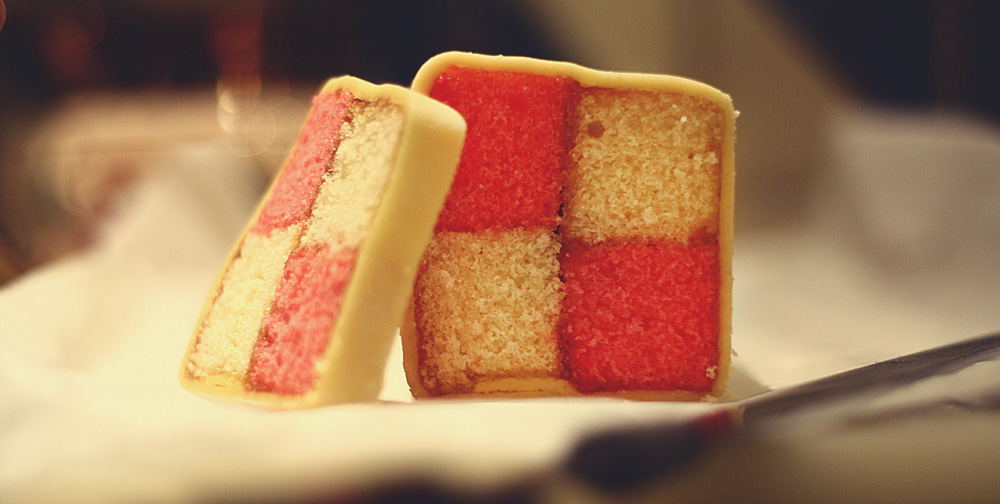
Battenberg cake
Chequered pink and yellow sponge cake wrapped in marzipan
Battenberg cake is a British dessert made from pink and yellow sponge squares joined with jam and wrapped in marzipan. Its cross-section shows a checkerboard pattern. This cake is linked to England and is often served as a sweet treat with tea.
- Features a pink and yellow checkerboard pattern inside
- Held together with jam and wrapped in marzipan
- Named after the German town of Battenberg
- Older versions sometimes had up to 25 squares
- Inspired the name for chequered markings on UK emergency vehicles
What is Battenberg cake?
Battenberg cake is a light sponge cake from England, instantly recognised by its pink and yellow squares arranged in a checkerboard pattern. The squares are joined with a layer of jam and the whole cake is covered in marzipan, a sweet almond paste. When sliced, the cake reveals its neat, colourful interior. The sponge itself is soft and airy, while the marzipan adds a sweet, nutty flavour and a smooth finish.
Where does Battenberg cake come from?
The cake comes from England, but its beginnings are not fully known. Several names have been used for similar cakes, including Domino Cake and Neapolitan Roll, in late 19th-century recipes. Some say it was created to celebrate the marriage of Princess Victoria and Prince Louis of Battenberg in 1884, though this is not certain. The name refers to a German town and noble family. Early recipes sometimes had many more squares than the four seen today. The four-panel version likely became standard when large bakeries began making it for easier production.
How is Battenberg cake made?
To make Battenberg cake, bakers prepare two sponge cakes, one coloured pink and the other left plain. Each is cut into strips, which are then arranged to form a checkerboard when viewed from the end. Jam is used to stick the pieces together. Once assembled, the cake is wrapped in a layer of marzipan, which is smoothed around the outside before slicing.


How and when is Battenberg cake eaten?
Battenberg cake is commonly enjoyed as a sweet snack or with afternoon tea. It is sliced to show off the checkerboard pattern and served in small portions. The cake is not tied to any particular festival or holiday, but is a familiar sight in British bakeries and homes. It is usually eaten at room temperature.
Kinds of Battenberg cake
Older recipes sometimes used more than four squares, with some cakes showing up to 25 panels. Over time, the four-square version became the norm, likely because it was easier for commercial bakeries to produce. The cake has also been known by other names, such as Domino Cake and Neapolitan Roll, but the basic idea of coloured sponge and marzipan remains the same.
What Battenberg cake means
Battenberg cake stands out in British baking for its playful look and association with teatime. Its checkerboard design has even inspired the name for the bright patterns on emergency vehicles in the UK, known as Battenburg markings. The cake is not linked to any religious or festive event, but is a well-loved classic in England.
Questions people ask about Battenberg cake
What is Battenberg cake made of?
It is made from pink and yellow sponge cake, joined with jam, and covered in marzipan. The main ingredients are flour, jam, and marzipan.
Where does Battenberg cake come from?
Battenberg cake originated in England and is a part of British baking tradition.
Why does Battenberg cake have a checkerboard pattern?
The cake is assembled from strips of differently coloured sponge, arranged so that when sliced, it shows a checkerboard of pink and yellow squares.
Is Battenberg cake vegetarian?
Yes, Battenberg cake is vegetarian as it contains no meat or fish, but it does include flour, jam, and marzipan.
When is Battenberg cake usually eaten?
It is often served as a sweet treat with tea or as a snack, rather than for a specific festival or holiday.
Good reading and sources
- Battenberg cake on WikipediaEncyclopedia
- More photos on Wikimedia CommonsPhotos
- Wikidata recordOpen data
The facts on this page come from the Wikipedia article "Battenberg cake", written by its contributors and used under the CC BY-SA 4.0 licence, and from its Wikidata record (CC0). Thali rewrote the text in its own words, with AI assistance, and compares every page with the article to make sure no passage is copied. It may be reused under the same CC BY-SA 4.0 licence with a link back.
It may contain mistakes, and it is not dietary or allergy advice: recipes differ from cook to cook. If something is wrong, tell us. Last refreshed 2026-10-03.
More from the United Kingdom
All the food of the United Kingdom Ice cream
🇺🇸 United States and 5 moreA frozen dessert made from sweetened, flavoured milk or cream
Sweet or dessert, Snacks
Ice cream
🇺🇸 United States and 5 moreA frozen dessert made from sweetened, flavoured milk or cream
Sweet or dessert, Snacks
 Candy
🇺🇸 United States and 5 moreSmall sweet treats made mainly from sugar or sweeteners
Sweet or dessert, Snacks
Candy
🇺🇸 United States and 5 moreSmall sweet treats made mainly from sugar or sweeteners
Sweet or dessert, Snacks
 French toast
🇫🇷 France and 5 moreBread soaked in egg and milk, pan-fried and served sweet or savoury
Main dish, Breakfast, Snacks
French toast
🇫🇷 France and 5 moreBread soaked in egg and milk, pan-fried and served sweet or savoury
Main dish, Breakfast, Snacks
 Pancake
🇺🇸 United States and 5 moreFlat cakes made from batter, cooked on a griddle or pan and served sweet or savoury
Main dish, Breakfast, Snacks
Pancake
🇺🇸 United States and 5 moreFlat cakes made from batter, cooked on a griddle or pan and served sweet or savoury
Main dish, Breakfast, Snacks
Its cousins elsewhere
All sweets and desserts MarquesitaVegetarian
🇲🇽 MexicoCrisp rolled crepe from Yucatán with sweet and salty fillings
Sweet or dessert, Snacks
Halvaحَلَاوَة
🇮🇷 Iran and 5 moreDense sweet made from seeds, grains, or vegetables, found across Asia, Africa, and Europe
Sweet or dessert, Snacks, Tea time
MarquesitaVegetarian
🇲🇽 MexicoCrisp rolled crepe from Yucatán with sweet and salty fillings
Sweet or dessert, Snacks
Halvaحَلَاوَة
🇮🇷 Iran and 5 moreDense sweet made from seeds, grains, or vegetables, found across Asia, Africa, and Europe
Sweet or dessert, Snacks, Tea time
 JalebiVegetarian
🇮🇳 India and 6 moreDeep-fried spirals of batter soaked in syrup, enjoyed across Asia and Africa
Pie or savoury pastry, Breakfast, Snacks
JalebiVegetarian
🇮🇳 India and 6 moreDeep-fried spirals of batter soaked in syrup, enjoyed across Asia and Africa
Pie or savoury pastry, Breakfast, Snacks
 KhabeesVeganالخبيص
🇦🇪 United Arab Emirates and 5 moreA sweet breakfast dish of flour, oil, cardamom and saffron from the Gulf region
Sweet or dessert, Breakfast
KhabeesVeganالخبيص
🇦🇪 United Arab Emirates and 5 moreA sweet breakfast dish of flour, oil, cardamom and saffron from the Gulf region
Sweet or dessert, Breakfast