
Bolo Fiado
In its own language: බොලෝ ෆියාඩෝ
Sri Lankan layered pastry cake filled with sweet cashews and rose water
Bolo fiado is a traditional Sri Lankan sweet made of delicate pastry stacked with a rich filling of minced cashews, sugar syrup, and fragrant rose water. Originating during the Portuguese colonial era, it remains closely associated with the island's Burgher community.
- Introduced to coastal Sri Lanka by Portuguese arrivals during the sixteenth century
- Name combines the Portuguese words for cake and layered leaves
- Features alternating tiers of rich pastry and crushed cashews scented with rose water
- Documented in Hilda Deutrom's historic 1929 Ceylon Daily News Cookery Book
What is Bolo Fiado?
Bolo fiado is a Sri Lankan multi-layered cake built from sweet sheets of pastry alternating with a fragrant nut filling. In structure and appearance, it resembles a substantial mille-feuille or a large Danish pastry. The rich dough is tender and flaky, while the internal layers are packed with crushed cashew nuts, sugar, and floral rose water. A smooth icing flavoured with vanilla extract commonly coats or decorates the finished confection. Sliced into portions, the dessert reveals distinct strata of golden crust and aromatic filling, balancing the crispness of folded pastry with the soft, chewy texture of sweetened nuts.
Where does Bolo Fiado come from?
The cake traces back to the sixteenth century, an era when Portuguese forces governed maritime provinces across Sri Lanka. Colonists introduced their baking traditions to the island, where the preparation gradually evolved into a distinct regional specialty. Its title reflects this ancestry: in Portuguese, bolo signifies cake, while folhado refers to leafy or sheet-like layers. Over generations, the Burgher community, descendants of European settlers, preserved and adapted the recipe. One of the earliest published English records of bolo fiado appears in the Ceylon Daily News Cookery Book, compiled by Hilda Deutrom and printed in 1929.
How is Bolo Fiado made?
Bakers begin by preparing a rich shortcrust dough using wheat flour, softened butter, water, sugar, and egg yolks. This dough is repeatedly worked and folded to produce multiple flaky tiers. For the filling, cashews, known locally as cadju, are combined with sugar water and scented with rose water. The prepared nutty mixture is spread across thin sheets of rolled dough, which are stacked atop one another in alternating bands. Once layered and baked through, the cake is finished with vanilla icing before being divided into individual servings.
Kinds of Bolo Fiado
While the classic preparation relies strictly on cashew nuts, bakers sometimes enrich or alter the filling with other traditional confectionery elements. Candied or crystallised ash pumpkin, locally termed puhul dosi, provides a translucent, tender bite when folded into the filling. Other cooks mix in sweet dried raisins or ground warming spices to create extra aromatic depth between the pastry sheets.
Questions people ask about Bolo Fiado
Where does bolo fiado come from?
Bolo fiado comes from Sri Lanka. Portuguese settlers brought the original concept to coastal regions during the sixteenth century, after which the Burgher community preserved and adapted it into an island specialty.
What is bolo fiado made of?
It is made from a shortcrust pastry of flour, butter, water, egg yolks, and sugar. Between the pastry sheets lies a filling of sugar, rose water, and cashews, often topped with vanilla icing.
What does the name bolo fiado mean?
The name stems from the Portuguese language, where bolo translates to cake and folhado means layered like leaves or sheets, describing the pastry's stacked structure.
Are there different versions of the filling?
Yes. Beyond the standard cashew and rose water mixture, some recipes incorporate dried raisins, fragrant spices, or crystallised ash pumpkin, known locally in Sri Lanka as puhul dosi.
Good reading and sources
The facts on this page come from the Wikipedia article "Bolo fiado", written by its contributors and used under the CC BY-SA 4.0 licence, and from its Wikidata record (CC0). EveryThali rewrote the text in its own words, with AI assistance, and compares every page with the article to make sure no passage is copied. It may be reused under the same CC BY-SA 4.0 licence with a link back.
It may contain mistakes, and it is not dietary or allergy advice: recipes differ from cook to cook. If something is wrong, tell us. Last refreshed 2026-10-04.
More from Sri Lanka
All the food of Sri Lanka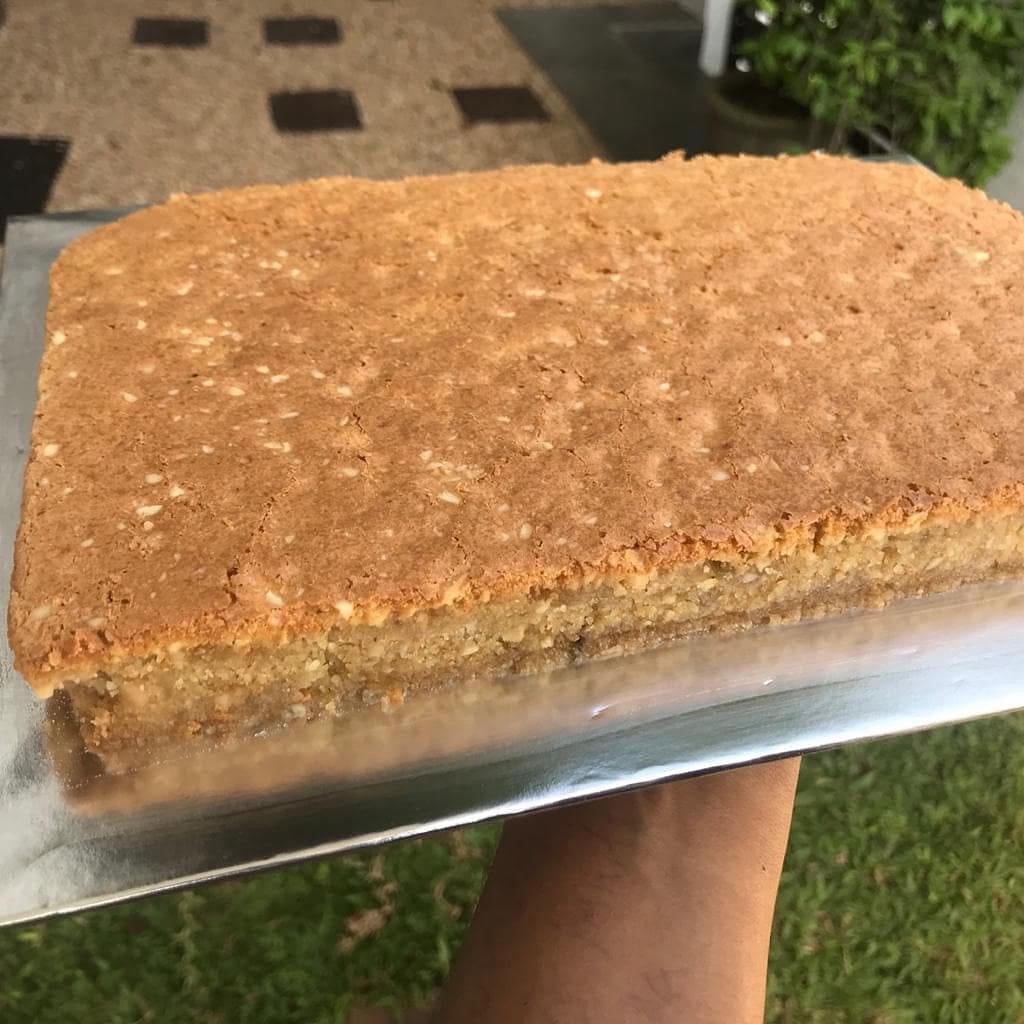 Love cakeVegetarian
🇱🇰 Sri LankaSri Lankan semolina cake with cashews, pumpkin preserve, and aromatic spices
Sweet or dessert
Love cakeVegetarian
🇱🇰 Sri LankaSri Lankan semolina cake with cashews, pumpkin preserve, and aromatic spices
Sweet or dessert
 ModakVegetarian
🇮🇳 India and 5 moreA sweet dumpling with coconut and jaggery, offered in Hindu and Buddhist rituals
Sweet or dessert, Snacks
ModakVegetarian
🇮🇳 India and 5 moreA sweet dumpling with coconut and jaggery, offered in Hindu and Buddhist rituals
Sweet or dessert, Snacks
Its cousins elsewhere
All sweets and desserts SachertorteVegetarian
🇦🇹 Austria and 1 moreAustrian chocolate sponge cake with apricot jam and a glossy chocolate glaze
Sweet or dessert, Tea time, Snacks
SachertorteVegetarian
🇦🇹 Austria and 1 moreAustrian chocolate sponge cake with apricot jam and a glossy chocolate glaze
Sweet or dessert, Tea time, Snacks
 Chocolate brownieVegetarianBrownie
🇺🇸 United States and 2 moreDense chocolate squares baked as a bar, often served warm or with toppings
Sweet or dessert, Snacks, Tea time
Chocolate brownieVegetarianBrownie
🇺🇸 United States and 2 moreDense chocolate squares baked as a bar, often served warm or with toppings
Sweet or dessert, Snacks, Tea time
 Apple pieVegetarian
🇬🇧 United Kingdom and 5 moreA baked pie with apple filling and pastry crust, served hot or cold
Sweet or dessert, Snacks
Apple pieVegetarian
🇬🇧 United Kingdom and 5 moreA baked pie with apple filling and pastry crust, served hot or cold
Sweet or dessert, Snacks
 PanettoneVegetarian
🇮🇹 Italy and 2 moreTall, sweet Italian bread with candied fruit, eaten at Christmas and New Year
Sweet or dessert, Breakfast, Tea time
PanettoneVegetarian
🇮🇹 Italy and 2 moreTall, sweet Italian bread with candied fruit, eaten at Christmas and New Year
Sweet or dessert, Breakfast, Tea time