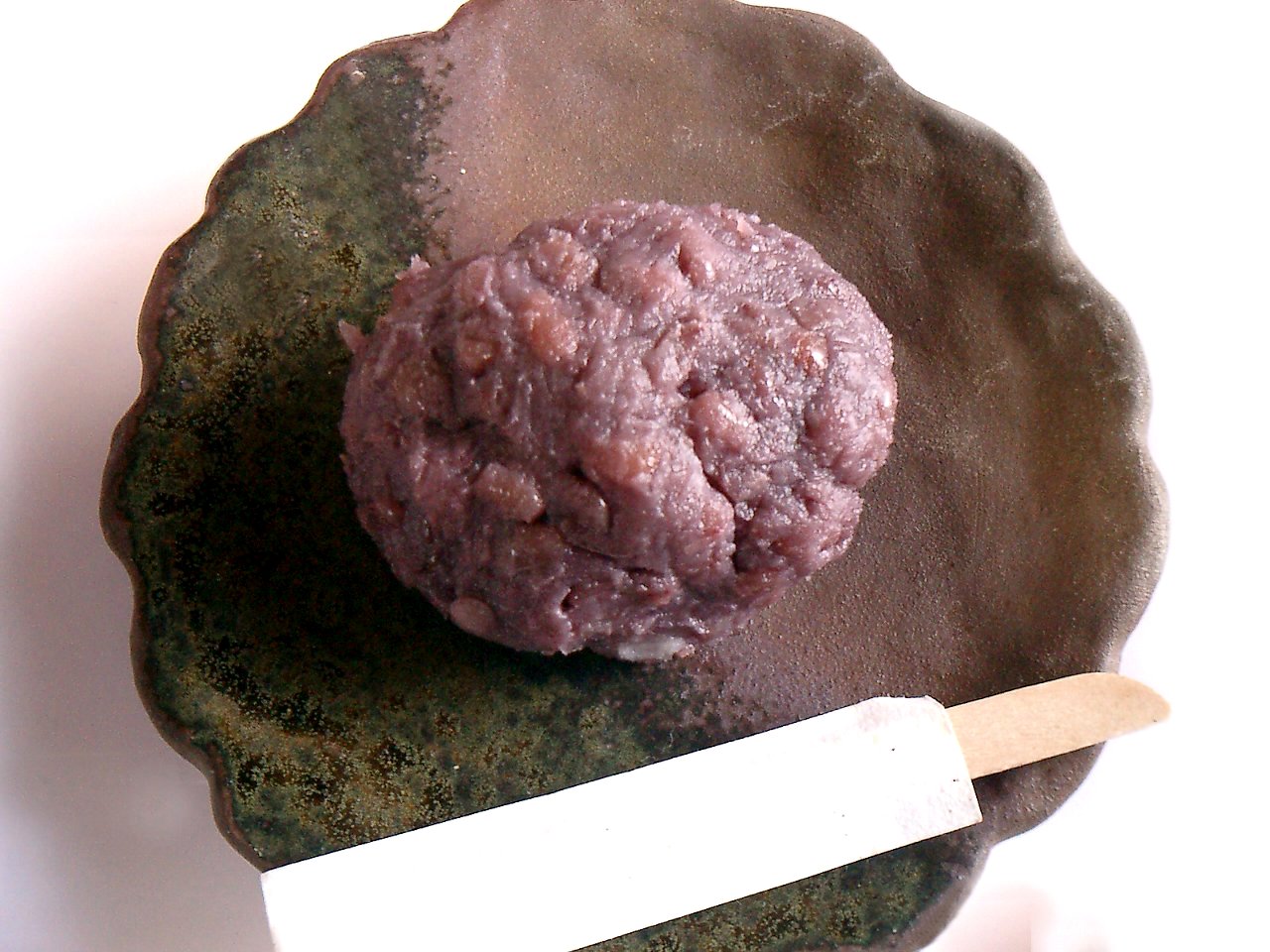
Botamochi
In its own language: ぼたもち or 牡丹餅
Sweet rice balls covered with red bean paste, eaten during spring and autumn in Japan
Botamochi is a Japanese sweet made from glutinous rice and sweet red bean paste, shaped into balls and coated by hand. It is closely tied to the spring and autumn Higan, when it is offered as sacred food. The treat is also called ohagi in autumn, and sometimes features a coating of soy flour.
- Made from glutinous rice and sweet red bean paste
- Eaten during spring and autumn Higan festivals in Japan
- Also called ohagi, especially in autumn
- Sometimes dusted with roasted soy flour
- Name linked to seasonal flowers: peony and bush clover
What is Botamochi?
Botamochi is a traditional Japanese confection, or wagashi, made by forming balls of cooked glutinous rice—sometimes mixed with regular short-grain rice—and covering them with a thick layer of sweet azuki (red bean) paste. The rice gives a chewy, slightly sticky texture, while the red bean paste is smooth and sweet. The treat is simple in appearance: rounded, with a glossy, dark reddish-brown coating from the beans. Sometimes, especially in autumn, a dusting of soy flour is added for extra flavor and color.
Where does Botamochi come from?
The sweet is linked to the Heian period, where a similar dish called kaimochi appears in old Japanese literature. The names botamochi and ohagi are thought to come from the flowers botan (peony) and hagi (bush clover), which bloom in spring and autumn, reflecting the times when the sweet is made and eaten. Over time, botamochi became the spring name and ohagi the autumn one, though the two are nearly identical.
How is Botamochi made?
To make botamochi, glutinous rice—sometimes mixed with a smaller amount of regular rice—is soaked and then cooked until soft. The rice is shaped into balls by hand. Each ball is then wrapped in a thick layer of sweetened red bean paste, which is made from boiled and mashed azuki beans. In some versions, especially those called ohagi, the finished sweet is rolled in roasted soy flour after the bean paste is applied.

How and when is Botamochi eaten?
Botamochi is most often eaten during the spring and autumn Higan, a Buddhist period when families honor their ancestors. It is offered at household altars or graves and then shared among family members, often with tea. Outside of these times, it can be enjoyed as a snack or with afternoon tea, but its strongest association remains with these seasonal festivals.
Kinds of Botamochi
The main variation is called ohagi, which is made in autumn and may use a slightly different texture of red bean paste. Some recipes for both botamochi and ohagi call for a coating of roasted soy flour on the outside. The differences between the two are subtle and mostly tied to the season and the name used.
What Botamochi means
Botamochi is more than a sweet; it is a symbol of seasonal change and family remembrance in Japan. Its connection to Higan gives it a role in religious and ancestral rites. The proverb 'Tana kara botamochi'—meaning a lucky break—shows its place in everyday language. The sweet’s round shape has also inspired designs in Japanese pottery.
Questions people ask about Botamochi
What is botamochi made of?
Botamochi is made from glutinous rice, sometimes mixed with short-grain rice, and is covered with a thick layer of sweet red bean paste made from azuki beans.
Where does botamochi come from?
Botamochi comes from Japan and has roots in the Heian period, where a similar sweet called kaimochi is mentioned in historical texts.
When is botamochi usually eaten?
It is most commonly eaten during the spring and autumn Higan periods, which are times for honoring ancestors in Japan.
What is the difference between botamochi and ohagi?
Botamochi and ohagi are nearly the same sweet, but botamochi is the name used in spring and ohagi in autumn. Ohagi may sometimes have a different texture of red bean paste or a coating of soy flour.
Is botamochi vegan?
Yes, botamochi is vegan as it is made from rice and sweetened red bean paste, with no animal products.
Good reading and sources
The facts on this page come from the Wikipedia article "Botamochi", written by its contributors and used under the CC BY-SA 4.0 licence, and from its Wikidata record (CC0). Thali rewrote the text in its own words, with AI assistance, and compares every page with the article to make sure no passage is copied. It may be reused under the same CC BY-SA 4.0 licence with a link back.
It may contain mistakes, and it is not dietary or allergy advice: recipes differ from cook to cook. If something is wrong, tell us. Last refreshed 2026-10-03.
More from Japan
All the food of Japan Ice cream
🇺🇸 United States and 5 moreA frozen dessert made from sweetened, flavoured milk or cream
Sweet or dessert, Snacks
Ice cream
🇺🇸 United States and 5 moreA frozen dessert made from sweetened, flavoured milk or cream
Sweet or dessert, Snacks
 KabochaVeganカボチャ
🇯🇵 Japan and 5 moreA sweet, dense winter squash with edible skin, used in Japanese and Asian cooking
Main dish, Lunch, Dinner
KabochaVeganカボチャ
🇯🇵 Japan and 5 moreA sweet, dense winter squash with edible skin, used in Japanese and Asian cooking
Main dish, Lunch, Dinner
 Cheesecake
🇬🇷 Greece and 5 moreA chilled dessert of sweetened soft cheese on a crumb or pastry base
Sweet or dessert, Snacks
Cheesecake
🇬🇷 Greece and 5 moreA chilled dessert of sweetened soft cheese on a crumb or pastry base
Sweet or dessert, Snacks
 MochiVegan餅
🇯🇵 JapanJapanese rice cake made by pounding glutinous rice into a sticky, chewy mass
Sweet or dessert
MochiVegan餅
🇯🇵 JapanJapanese rice cake made by pounding glutinous rice into a sticky, chewy mass
Sweet or dessert
Its cousins elsewhere
All sweets and desserts Chocolate
🇨🇮 Ivory Coast and 5 moreA sweet or bitter food made from processed cocoa beans, enjoyed in many forms worldwide
Sweet or dessert, Snacks
Chocolate
🇨🇮 Ivory Coast and 5 moreA sweet or bitter food made from processed cocoa beans, enjoyed in many forms worldwide
Sweet or dessert, Snacks
 Candy
🇺🇸 United States and 5 moreSmall sweet treats made mainly from sugar or sweeteners
Sweet or dessert, Snacks
Candy
🇺🇸 United States and 5 moreSmall sweet treats made mainly from sugar or sweeteners
Sweet or dessert, Snacks
 Doughnut
🇺🇸 United States and 5 moreSweet fried or baked rings or balls, often glazed or filled
Sweet or dessert, Breakfast, Snacks
Doughnut
🇺🇸 United States and 5 moreSweet fried or baked rings or balls, often glazed or filled
Sweet or dessert, Breakfast, Snacks
 TiramisuVegetariantiramisù
🇮🇹 ItalyCoffee-soaked ladyfingers layered with mascarpone cream and cocoa powder
Sweet or dessert
TiramisuVegetariantiramisù
🇮🇹 ItalyCoffee-soaked ladyfingers layered with mascarpone cream and cocoa powder
Sweet or dessert