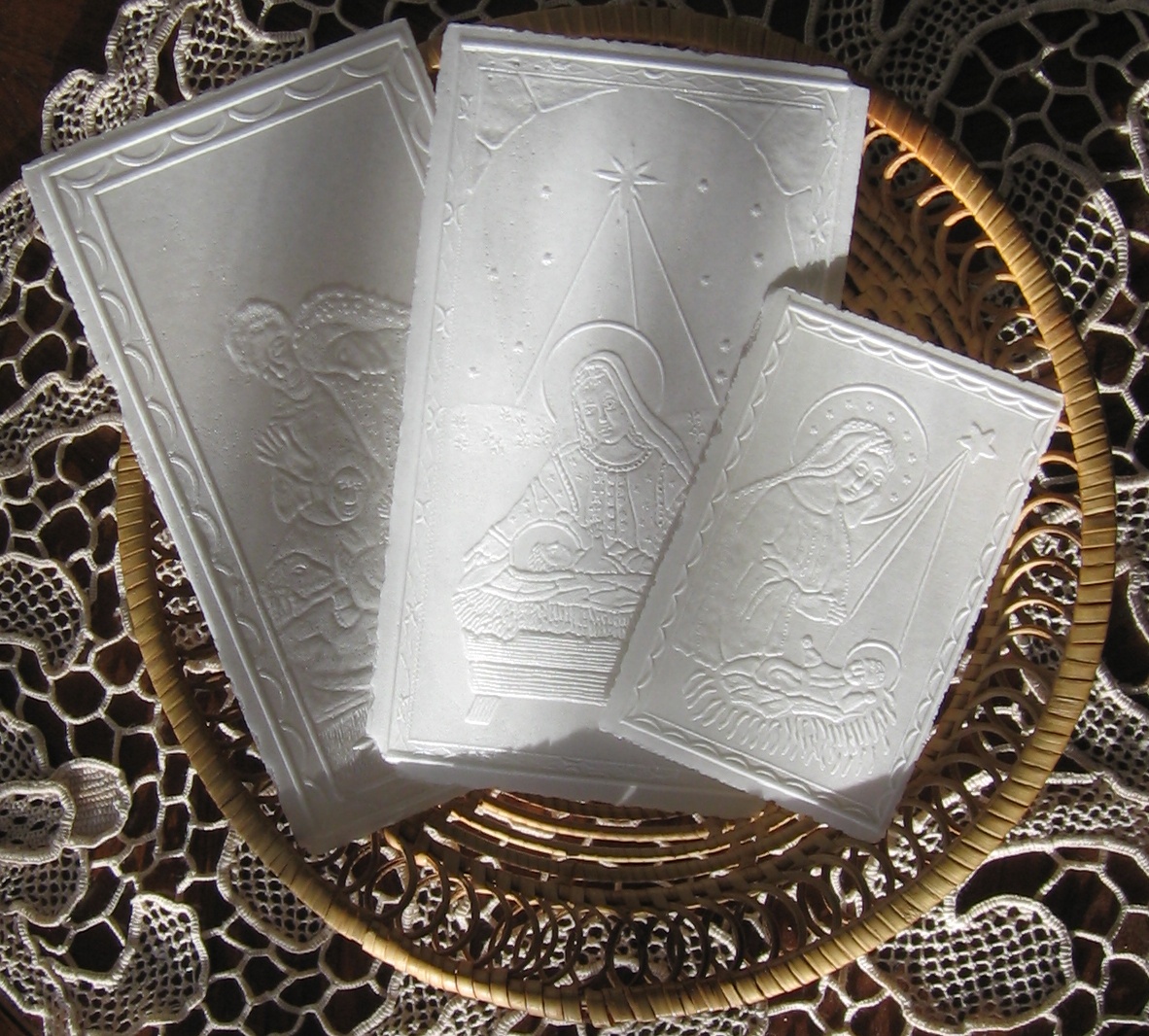
Christmas wafer
Thin, embossed wheat wafers shared at Christmas in Poland and Lithuania
Christmas wafer is a thin, rectangular, unleavened bread made from wheat flour and water, shared before the Christmas Eve meal in Poland, Lithuania, and parts of Central Europe. The wafers are embossed with religious images and symbolize family unity and forgiveness. The custom is central to Catholic Christmas traditions in these regions.
- Made from only wheat flour and water, with no yeast or flavorings
- Embossed with Nativity and Christmas religious images
- Shared before the Christmas Eve meal as a symbol of unity
- Tradition dates back to at least the 10th century in Poland
- Also used as decorations or sent with greeting cards
What is Christmas wafer?
A Christmas wafer is a very thin, rectangular piece of unleavened bread, made only from wheat flour and water. It is usually white and embossed with images related to the Nativity, such as the Virgin Mary, baby Jesus, or the Star of Bethlehem. The wafer is crisp and delicate, similar in texture to the bread used for the Eucharist in Catholic Mass. It has a plain, neutral taste and is not sweetened or flavored. These wafers are not eaten as a snack or meal but are shared as part of a ritual before the Christmas Eve dinner.
Where does Christmas wafer come from?
The custom of sharing Christmas wafers began in Poland as early as the 10th century and later spread to Lithuania, Slovakia, and other parts of Central Europe. It is rooted in early Christian traditions and is seen as a non-sacramental echo of the sharing of the Eucharist. The tradition became widespread in the Polish–Lithuanian Commonwealth by the 17th century and was especially important among the Polish nobility. In the 19th century, during times of national hardship, the ritual took on patriotic meaning as families wished for Poland's independence. Today, it remains a cherished part of Christmas celebrations.
How is Christmas wafer made?
Christmas wafers are prepared by mixing wheat flour and water into a smooth batter. The batter is poured onto special wafer irons, which press and bake the mixture into thin, crisp sheets. While still warm, the wafers are embossed with religious images, often using engraved plates or molds. The finished wafers are cut into rectangles and carefully packed to prevent breaking. They are not seasoned or sweetened, keeping their taste simple and neutral.
How and when is Christmas wafer eaten?
The sharing of the Christmas wafer takes place before the Christmas Eve meal, known as Wigilia in Poland and Kūčios in Lithuania. The family gathers around the table, and the eldest member breaks off a piece of the wafer, passing it to others with wishes for health and happiness. Each person exchanges pieces and good wishes with every other family member. In Lithuania, a plate with wafers is set in the center, and the head of the family offers a wafer to each person. The ritual emphasizes unity, forgiveness, and remembrance of absent loved ones.
Kinds of Christmas wafer
In Lithuania, the wafer is called kalėdaitis and may also be known by other names depending on the region, such as plotkelė or Dievo pyragai. The ritual is similar but may include different greetings or responses. In some parts of Poland and Central Europe, colored wafers are used for decorations or sent with greeting cards to family members who are far away. The custom has also been adopted by Polish communities around the world, sometimes extending beyond family to include friends or colleagues.
What Christmas wafer means
The Christmas wafer is considered one of the oldest and most meaningful Polish Christmas traditions. It symbolizes family unity, forgiveness, and the hope of being together in the coming year. The ritual is deeply tied to Catholic faith and is practiced by families of Polish and Lithuanian heritage worldwide. In times of national struggle, sharing the wafer became a symbol of hope and solidarity. The wafers are sometimes used as Christmas tree ornaments or sent to absent loved ones as a sign of remembrance.
When Christmas wafer is on the table
Questions people ask about Christmas wafer
What is a Christmas wafer made of?
It is made from wheat flour and water, without yeast or added flavorings. The dough is baked into thin, crisp sheets and embossed with religious images.
Where does the Christmas wafer tradition come from?
The tradition began in Poland in the 10th century and later spread to Lithuania, Slovakia, and other parts of Central Europe. It is especially important in Catholic Christmas celebrations.
How is the Christmas wafer used during Christmas?
Before the Christmas Eve meal, family members break and share pieces of the wafer with each other, exchanging wishes for health and happiness. This ritual symbolizes unity and forgiveness.
What does the Christmas wafer look like?
It is a thin, rectangular, white wafer, usually embossed with images related to the Nativity, such as the Virgin Mary, baby Jesus, or the Star of Bethlehem.
Is the Christmas wafer sweet or flavored?
No, it has a plain, neutral taste. It is not sweetened or flavored and is not meant to be eaten as a snack or dessert.
Good reading and sources
- Christmas wafer on WikipediaEncyclopedia
- More photos on Wikimedia CommonsPhotos
- Wikidata recordOpen data
The facts on this page come from the Wikipedia article "Christmas wafer", written by its contributors and used under the CC BY-SA 4.0 licence, and from its Wikidata record (CC0). Thali rewrote the text in its own words, with AI assistance, and compares every page with the article to make sure no passage is copied. It may be reused under the same CC BY-SA 4.0 licence with a link back.
It may contain mistakes, and it is not dietary or allergy advice: recipes differ from cook to cook. If something is wrong, tell us. Last refreshed 2026-10-03.
More from Poland
All the food of Poland CroissantVegetarian
🇫🇷 France and 5 moreA crescent-shaped, flaky pastry made from layered yeast dough and butter
Pie or savoury pastry, Breakfast, Tea time
CroissantVegetarian
🇫🇷 France and 5 moreA crescent-shaped, flaky pastry made from layered yeast dough and butter
Pie or savoury pastry, Breakfast, Tea time
 Pancake
🇺🇸 United States and 5 moreFlat cakes made from batter, cooked on a griddle or pan and served sweet or savoury
Main dish, Breakfast, Snacks
Pancake
🇺🇸 United States and 5 moreFlat cakes made from batter, cooked on a griddle or pan and served sweet or savoury
Main dish, Breakfast, Snacks
 Apple pieVegetarian
🇬🇧 United Kingdom and 5 moreA baked pie with apple filling and pastry crust, served hot or cold
Sweet or dessert, Snacks
Apple pieVegetarian
🇬🇧 United Kingdom and 5 moreA baked pie with apple filling and pastry crust, served hot or cold
Sweet or dessert, Snacks
Its cousins elsewhere
All breads PitaVegan
🇪🇬 Egypt and 5 moreRound, leavened flatbread baked from wheat flour, common across the Middle East and Mediterranean
Bread
PuriVegan
🇮🇳 India and 2 moreUnleavened wheat flatbread, deep-fried until puffed and golden
Bread, Breakfast, Snacks
PitaVegan
🇪🇬 Egypt and 5 moreRound, leavened flatbread baked from wheat flour, common across the Middle East and Mediterranean
Bread
PuriVegan
🇮🇳 India and 2 moreUnleavened wheat flatbread, deep-fried until puffed and golden
Bread, Breakfast, Snacks
 SimitVegan
🇹🇷 Turkey and 5 moreRing-shaped bread with a sesame seed crust, sold by street vendors
Bread, Breakfast, Snacks
SimitVegan
🇹🇷 Turkey and 5 moreRing-shaped bread with a sesame seed crust, sold by street vendors
Bread, Breakfast, Snacks