
Coca
Catalan pastry with sweet or savoury toppings, eaten open or filled
Coca is a pastry from Catalonia and nearby regions, made with a dough that can be sweet or savoury. It is shaped flat and topped or filled with ingredients like vegetables, meats, fruits, or nuts. Cocas are eaten both at festive times and as everyday food, with many regional and seasonal varieties.
- Coca can be sweet or savoury, open or filled
- It is traditional in Catalonia, Valencia, Andorra, and French Catalonia
- Sweet cocas are eaten at Saint John's Eve and Kings’ day
- Toppings range from vegetables and sausage to fruit and nuts
- Algerian coca is a filled version with onions and peppers
What is Coca?
Coca is a flat pastry from Catalan-speaking regions, made with a base dough that can be either sweet or savoury. The sweet dough uses eggs and sugar, while the savoury kind is made with yeast and salt. Toppings or fillings vary widely: coastal areas often use vegetables and fish, while inland versions may include fruit, nuts, cheese, or meat. Cocas can be open, with ingredients on top, or closed, with fillings inside. Sizes range from small hand-held pieces to large, shareable trays. Some combine sweet and savoury elements, such as meat with fruit.
Where does Coca come from?
Coca has roots in Catalonia, Valencia, the Balearic Islands, Andorra, and French Catalonia. The word 'coca' comes from a Dutch term dating back to the Carolingian Empire, sharing origins with 'cake' and 'Kuchen'. Its form and preparation are part of a broader Mediterranean tradition of flatbreads and pastries, with similar dishes found in Italy, Algeria, and France. Over time, coca became a staple in both festive and everyday meals, adapting to local ingredients and customs.
How is Coca made?
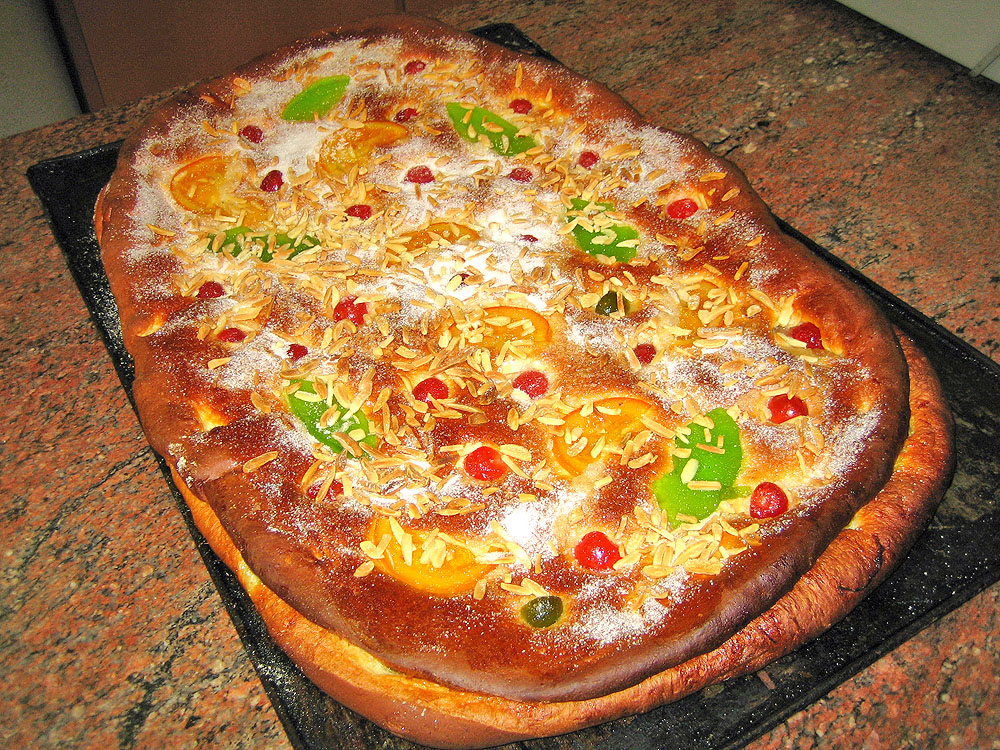
To make coca, a dough is prepared—sweet versions include eggs and sugar, while savoury ones use yeast and salt. The dough is rolled flat and either left open for toppings or folded over fillings. Sweet cocas may be topped with candied fruit, nuts, or cream, while savoury ones often feature vegetables, sausage, fish, or cheese. Some are baked as thin, crisp sheets, others as soft, spongy cakes. The finished pastry can be cut into pieces for sharing or made as individual portions.

How and when is Coca eaten?
Coca is enjoyed throughout the year, both for special occasions and as an everyday treat. In Catalonia, it is closely tied to holidays such as Saint John's Eve, Easter, and Christmas. Some varieties are named for saints and eaten on their feast days. Coca can be eaten as a snack, at picnics, or as part of a meal, and is often bought from bakeries or made at home. In some regions, it is served with hot chocolate or shared at gatherings.
Kinds of Coca
There are many regional and seasonal types of coca. Sweet cocas include those with cream, candied fruit, or nuts, like the Coca de Sant Joan or Coca de crema. Savoury versions use local vegetables, meats, or fish, such as Coca de recapte or Coca de trempó. Some are thin and crisp, others soft and spongy. In Algeria, coca is a closed pastry filled with onions, peppers, and spices. Each area adapts the base to local tastes and ingredients.
What Coca means
Coca is deeply woven into Catalan and Valencian culture, symbolizing both tradition and celebration. It is a staple at festivals and family gatherings, and some versions are linked to specific holidays or saints. The pastry is seen as a food for everyone, rich or poor, and is a basic part of the local cuisine. Its presence at major holidays and its many forms reflect the diversity and unity of the region’s food traditions.
When Coca is on the table
Questions people ask about Coca
What is coca made of?
Coca is made from a dough that can be sweet, with eggs and sugar, or savoury, with yeast and salt. It is topped or filled with ingredients like vegetables, meats, fruits, nuts, cheese, or fish.
Where does coca come from?
Coca originates from Catalonia and is also traditional in Valencia, the Balearic Islands, Andorra, and French Catalonia. It is part of the wider Mediterranean tradition of flat pastries.
Are there different types of coca?
Yes, there are many varieties. Some are sweet, topped with candied fruit or nuts, while others are savoury, with vegetables, sausage, or fish. Cocas can be open-faced or filled.
When is coca usually eaten?
Coca is eaten both as an everyday food and during festivals. Special types are made for holidays like Saint John's Eve, Easter, Christmas, and Kings’ day.
Is coca always sweet?
No, coca can be either sweet or savoury. The dough and toppings or fillings change depending on the type and region.
Good reading and sources
- Coca (pastry) on WikipediaEncyclopedia
- More photos on Wikimedia CommonsPhotos
- Wikidata recordOpen data
The facts on this page come from the Wikipedia article "Coca (pastry)", written by its contributors and used under the CC BY-SA 4.0 licence, and from its Wikidata record (CC0). Thali rewrote the text in its own words, with AI assistance, and compares every page with the article to make sure no passage is copied. It may be reused under the same CC BY-SA 4.0 licence with a link back.
It may contain mistakes, and it is not dietary or allergy advice: recipes differ from cook to cook. If something is wrong, tell us. Last refreshed 2026-10-03.
More from Spain
All the food of Spain Hot chocolate
🇲🇽 Mexico and 5 moreA warm drink made from chocolate or cocoa, milk or water, and sugar
Drink, Breakfast, Snacks
Hot chocolate
🇲🇽 Mexico and 5 moreA warm drink made from chocolate or cocoa, milk or water, and sugar
Drink, Breakfast, Snacks
 MarzipanVegetarian
🇩🇪 Germany and 5 moreSweet almond paste shaped or used in cakes, especially at Christmas and weddings
Sweet or dessert, Snacks, Tea time
MarzipanVegetarian
🇩🇪 Germany and 5 moreSweet almond paste shaped or used in cakes, especially at Christmas and weddings
Sweet or dessert, Snacks, Tea time
 Cheesecake
🇬🇷 Greece and 5 moreA chilled dessert of sweetened soft cheese on a crumb or pastry base
Sweet or dessert, Snacks
Cheesecake
🇬🇷 Greece and 5 moreA chilled dessert of sweetened soft cheese on a crumb or pastry base
Sweet or dessert, Snacks
 Churrochurros
🇪🇸 Spain and 5 moreRidged, deep-fried dough sticks often eaten hot with chocolate or coffee
Sweet or dessert, Breakfast, Snacks
Churrochurros
🇪🇸 Spain and 5 moreRidged, deep-fried dough sticks often eaten hot with chocolate or coffee
Sweet or dessert, Breakfast, Snacks
Its cousins elsewhere
All pies and savoury pastries Pirozhkiпирожки
🇷🇺 Russia and 5 moreYeast-leavened buns filled with sweet or savory fillings, baked or fried
Pie or savoury pastry, Lunch, Dinner
Pirozhkiпирожки
🇷🇺 Russia and 5 moreYeast-leavened buns filled with sweet or savory fillings, baked or fried
Pie or savoury pastry, Lunch, Dinner
 Pirogпирог
🇷🇺 Russia and 5 moreA baked pie with sweet or savory filling, common in Eastern Europe
Pie or savoury pastry
Pirogпирог
🇷🇺 Russia and 5 moreA baked pie with sweet or savory filling, common in Eastern Europe
Pie or savoury pastry
 Fatayerفطائر
🇱🇧 Lebanon and 5 moreSmall Levantine pies with savoury fillings, baked in various shapes
Pie or savoury pastry, Snacks, Lunch
Fatayerفطائر
🇱🇧 Lebanon and 5 moreSmall Levantine pies with savoury fillings, baked in various shapes
Pie or savoury pastry, Snacks, Lunch
 Pastel
🇧🇷 Brazil and 5 moreA name for many pastries, pies, and filled snacks across Latin America and beyond
Pie or savoury pastry, Snacks, Lunch
Pastel
🇧🇷 Brazil and 5 moreA name for many pastries, pies, and filled snacks across Latin America and beyond
Pie or savoury pastry, Snacks, Lunch