
Dovga
In its own language: Dovğа
Azerbaijani yogurt and herb soup, served warm or chilled
Dovga is a soup from Azerbaijan made with yogurt, herbs like dill, coriander, mint, and spinach, and sometimes rice or chickpeas. It is served at weddings between meat courses to aid digestion, and can be enjoyed warm in winter or cold in summer.
- Dovga is a yogurt and herb soup from Azerbaijan
- Traditionally served at weddings between meat courses
- Main herbs include dill, coriander, mint, and spinach
- Can be served warm in winter or cold in summer
- Sometimes includes rice, chickpeas, or meatballs
What is Dovga?
Dovga is a soup built around yogurt and fresh herbs, especially dill, coriander, mint, and spinach. The base is creamy and tangy from the yogurt, with a green flecked look from the herbs and spinach. Some versions add rice, chickpeas, or even small meatballs, but the main focus is always the mix of dairy and greens. The soup may be served hot or cold, depending on the season. Its taste is refreshing, slightly sour from the yogurt, and aromatic from the herbs.
Where does Dovga come from?
Dovga comes from Azerbaijan, where it is a traditional part of the cuisine. It is especially known as a wedding soup, served between courses of meat to help with digestion. The ingredients and exact preparation can change with the seasons and from one region to another. While dovga is most closely linked to Azerbaijan, similar yogurt and herb soups are found in neighboring countries, such as Iran and Armenia.
How is Dovga made?
To make dovga, yogurt is mixed with flour and sometimes egg to help it keep a smooth texture when heated. Herbs like dill, coriander, mint, and spinach are chopped and added to the yogurt base. Rice or chickpeas may be included for extra substance. The soup is gently cooked, taking care not to let it curdle. It can be served hot, especially in winter, or chilled for summer meals.
How and when is Dovga eaten?
Dovga is traditionally served at Azerbaijani weddings, brought out between meat dishes to refresh the palate and aid digestion. It is also enjoyed as a light soup at other times, either on its own or as part of a meal. In summer, it is often served cold, making it a cooling dish, while in winter it is served warm for comfort.
Kinds of Dovga
The herbs in dovga can change with the seasons and local tastes. Some cooks add rice or chickpeas, while others include small meatballs, though the classic version is vegetarian. The soup may be thicker or thinner depending on the amount of yogurt and flour used. Similar soups exist in Iran and Armenia, each with their own twist.
What Dovga means
Dovga holds a special place in Azerbaijani celebrations, especially at weddings. Its role as a digestive soup between meat courses is a long-standing custom. The dish is also a symbol of hospitality and the use of fresh local herbs. Its flexibility—served hot or cold—shows its place in daily and festive life.
Questions people ask about Dovga
What is dovga made of?
Dovga is made from yogurt mixed with herbs like dill, coriander, mint, and spinach. Some versions include rice, chickpeas, or small meatballs, but the main ingredients are always yogurt and herbs.
Where does dovga come from?
Dovga comes from Azerbaijan and is a traditional part of Azerbaijani cuisine. It is also found in similar forms in neighboring countries.
Is dovga served hot or cold?
Dovga can be served either hot or cold. It is often served warm in winter and chilled in summer, depending on the season.
When is dovga usually eaten?
Dovga is traditionally served at weddings between meat courses to help with digestion, but it can also be eaten as a light soup at other times.
Is dovga vegetarian?
The classic version of dovga is vegetarian, made mainly from yogurt and herbs. Some variations may include meatballs, but these are less common.
Good reading and sources
The facts on this page come from the Wikipedia article "Dovga", written by its contributors and used under the CC BY-SA 4.0 licence, and from its Wikidata record (CC0). Thali rewrote the text in its own words, with AI assistance, and compares every page with the article to make sure no passage is copied. It may be reused under the same CC BY-SA 4.0 licence with a link back.
It may contain mistakes, and it is not dietary or allergy advice: recipes differ from cook to cook. If something is wrong, tell us. Last refreshed 2026-10-03.
More from Azerbaijan
All the food of Azerbaijan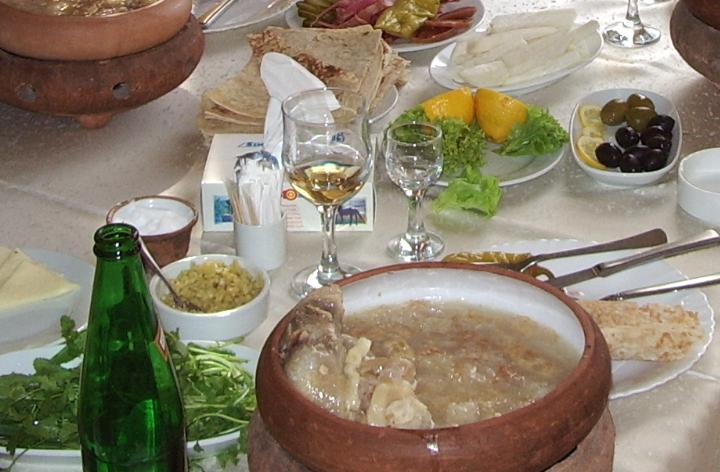 KhashMeatխաշ
🇦🇲 Armenia and 5 moreA rich stew of slow-cooked cow or sheep parts, eaten across the Caucasus and Middle East
Stew or curry, Breakfast
KhashMeatխաշ
🇦🇲 Armenia and 5 moreA rich stew of slow-cooked cow or sheep parts, eaten across the Caucasus and Middle East
Stew or curry, Breakfast
 PitiMeat
🇦🇿 Azerbaijan and 3 moreMutton and chickpea stew slow-cooked in a sealed crock
Stew or curry, Lunch, Dinner
PitiMeat
🇦🇿 Azerbaijan and 3 moreMutton and chickpea stew slow-cooked in a sealed crock
Stew or curry, Lunch, Dinner
 Ash-e doogh
🇮🇷 Iran and 2 moreIranian soup of yogurt, herbs and sometimes meatballs, served hot
Soup
Ash-e doogh
🇮🇷 Iran and 2 moreIranian soup of yogurt, herbs and sometimes meatballs, served hot
Soup
 Pilaf
🇺🇿 Uzbekistan and 5 moreRice cooked in stock with spices, meat or vegetables, with each grain kept separate
Main dish, Lunch, Dinner
Pilaf
🇺🇿 Uzbekistan and 5 moreRice cooked in stock with spices, meat or vegetables, with each grain kept separate
Main dish, Lunch, Dinner
Its cousins elsewhere
All soups Hariraالحريرة
🇲🇦 Morocco and 3 moreNorth African soup of tomato, legumes, herbs and spices, often served during Ramadan
Soup, Dinner, Supper
Hariraالحريرة
🇲🇦 Morocco and 3 moreNorth African soup of tomato, legumes, herbs and spices, often served during Ramadan
Soup, Dinner, Supper
 Avgolemonoαυγολέμονο
🇬🇷 Greece and 4 moreGreek soup or sauce thickened with egg and lemon
Soup, Lunch, Dinner
Avgolemonoαυγολέμονο
🇬🇷 Greece and 4 moreGreek soup or sauce thickened with egg and lemon
Soup, Lunch, Dinner
 Cold beet soupVegetarian
🇱🇹 Lithuania and 4 moreA chilled soup of beetroot, kefir and cucumber, popular in Eastern Europe during summer
Soup, Lunch, Dinner
Cold beet soupVegetarian
🇱🇹 Lithuania and 4 moreA chilled soup of beetroot, kefir and cucumber, popular in Eastern Europe during summer
Soup, Lunch, Dinner
 BissaraVeganبصارة
🇪🇬 Egypt and 1 moreCreamy fava bean purée with herbs, served as a dip or soup
Soup, Breakfast, Lunch
BissaraVeganبصارة
🇪🇬 Egypt and 1 moreCreamy fava bean purée with herbs, served as a dip or soup
Soup, Breakfast, Lunch