
Greek salad
In its own language: Χωριάτικη σαλάτα
Tomato, cucumber, onion, feta and olives with olive oil and oregano
Greek salad is a classic dish from Greece made with tomato, cucumber, onion, feta cheese, and olives, dressed with olive oil, salt, oregano, and sometimes lemon juice. It is often eaten as a light meal or side, especially in the warmer months, and is closely tied to Greek rural life.
- Traditional Greek salad has no lettuce
- Feta is served in large pieces, not crumbled
- Kalamata olives are the usual choice
- Common in both Greece and Cyprus
- Green bell pepper or capers may be added
What is Greek salad?
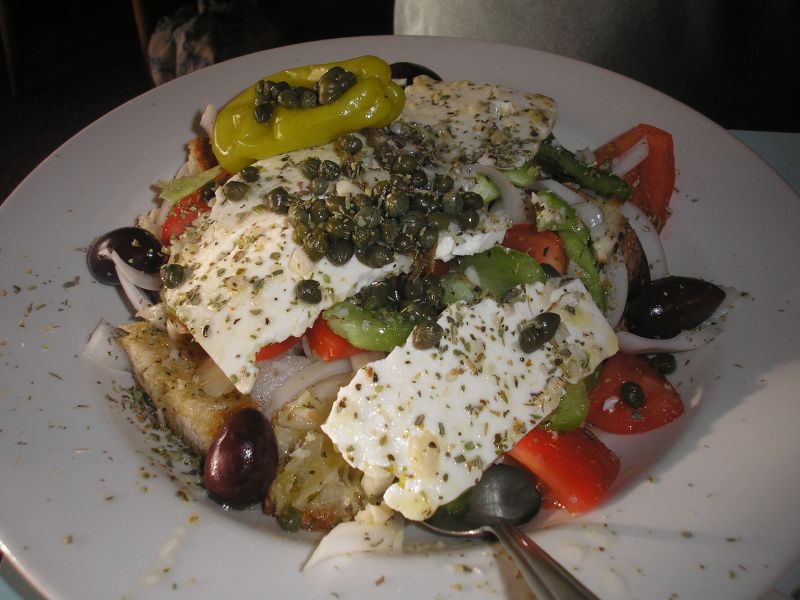
Greek salad is a mix of chunky pieces of ripe tomato, cucumber, onion, and olives, usually Kalamata olives. Feta cheese, a crumbly white cheese made from sheep's or goat's milk, is added in blocks or large pieces. The salad is dressed simply with olive oil, salt, and oregano, and sometimes a splash of lemon juice. Some versions include green bell pepper or caper berries. The ingredients are left in large, rustic pieces, giving the salad a colourful, fresh look. The taste is bright and savoury, with the saltiness of the feta and olives balanced by the juicy vegetables.
Where does Greek salad come from?
Greek salad, known in Greece as χωριάτικη σαλάτα (horiatiki or choriatiki), meaning 'village salad', is rooted in Greek rural life. Its ingredients reflect what a Greek farmer might have on hand, making it a symbol of rustic, everyday food. The salad is a staple of Greek cuisine and is also found in Cyprus. While the exact date of origin is not given, its association with simple, local produce points to a long tradition.
How is Greek salad made?
To make Greek salad, large pieces of tomato, cucumber, and onion are combined with olives and blocks of feta cheese. The salad is seasoned with salt and dried oregano, and generously dressed with olive oil. Sometimes lemon juice is added for extra brightness. In some regions, green bell pepper or caper berries are included. The salad is not tossed heavily; instead, the ingredients are layered or arranged, keeping their shapes distinct.



How and when is Greek salad eaten?
Greek salad is commonly eaten as a light meal or as a side dish with lunch or dinner. It is especially popular in the warmer months, when tomatoes and cucumbers are at their best. The salad is often served with bread and can be part of a larger spread of Greek dishes. It is not tied to any particular festival or religious occasion, but is a regular feature of everyday meals.
Kinds of Greek salad
Outside Greece, Greek salad often includes lettuce, which is not part of the traditional version. In the United States, it may also have peperoncini, bell peppers, radishes, dolmades, anchovies, or even potato salad, depending on the region. In Cyprus, a similar salad includes parsley and capers. The original Greek salad remains distinct for its lack of lettuce and focus on a few fresh ingredients.
What Greek salad means
Greek salad is seen as a symbol of Greek rural life and is often imagined as a farmer's meal. It is a staple in Greek cuisine and widely recognized abroad, though adaptations outside Greece can differ from the original. The dish reflects the importance of fresh, local produce in Greek food culture and is a common part of daily meals, especially in summer.
Questions people ask about Greek salad
What is Greek salad made of?
Greek salad is made with tomato, cucumber, onion, feta cheese, olives (often Kalamata), olive oil, salt, oregano, and sometimes lemon juice. Some versions add green bell pepper or caper berries.
Where does Greek salad come from?
Greek salad comes from Greece and is also common in Cyprus. It is a staple of Greek cuisine and reflects the ingredients found in rural Greek life.
Does Greek salad have lettuce?
Traditional Greek salad does not have lettuce. Versions outside Greece, especially in the United States, often add lettuce, but the original keeps to tomatoes, cucumber, onion, olives, and feta.
Is Greek salad vegetarian?
Yes, Greek salad is vegetarian. It contains no meat or fish, but does include feta cheese, which is made from sheep's or goat's milk.
How is Greek salad served?
Greek salad is usually served as a side dish or light meal, often with bread. The ingredients are left in large pieces and dressed simply with olive oil, salt, and oregano.
Good reading and sources
The facts on this page come from the Wikipedia article "Greek salad", written by its contributors and used under the CC BY-SA 4.0 licence, and from its Wikidata record (CC0). Thali rewrote the text in its own words, with AI assistance, and compares every page with the article to make sure no passage is copied. It may be reused under the same CC BY-SA 4.0 licence with a link back.
It may contain mistakes, and it is not dietary or allergy advice: recipes differ from cook to cook. If something is wrong, tell us. Last refreshed 2026-10-03.
More from Greece
All the food of Greece FavaVeganφάβα
🇬🇷 GreeceGreek split pea purée served warm or cold as a dip or spread
Sauce, pickle or ferment, Lunch, Dinner
FavaVeganφάβα
🇬🇷 GreeceGreek split pea purée served warm or cold as a dip or spread
Sauce, pickle or ferment, Lunch, Dinner
 TzatzikiVegetarianτζατζίκι
🇬🇷 Greece and 5 moreStrained yogurt mixed with cucumber, garlic and herbs, served cold as a dip or sauce
Sauce, pickle or ferment, Lunch, Dinner
TzatzikiVegetarianτζατζίκι
🇬🇷 Greece and 5 moreStrained yogurt mixed with cucumber, garlic and herbs, served cold as a dip or sauce
Sauce, pickle or ferment, Lunch, Dinner
 Baba ghanoushVeganبابا غنوج
🇪🇬 Egypt and 5 moreRoasted eggplant mashed with tahini, olive oil, and lemon juice, served as a dip
Salad or side, Snacks
Baba ghanoushVeganبابا غنوج
🇪🇬 Egypt and 5 moreRoasted eggplant mashed with tahini, olive oil, and lemon juice, served as a dip
Salad or side, Snacks
 TaramasalataFish or seafoodταραμοσαλάτα
🇬🇷 Greece and 5 moreFish roe blended with oil, lemon and bread or potato, served as a meze spread
Sauce, pickle or ferment, Snacks
TaramasalataFish or seafoodταραμοσαλάτα
🇬🇷 Greece and 5 moreFish roe blended with oil, lemon and bread or potato, served as a meze spread
Sauce, pickle or ferment, Snacks
Its cousins elsewhere
All salads and sides Çoban salatasıVegan
🇹🇷 TurkeyTurkish salad of chopped tomato, cucumber, pepper, onion and parsley
Salad or side
Çoban salatasıVegan
🇹🇷 TurkeyTurkish salad of chopped tomato, cucumber, pepper, onion and parsley
Salad or side
 FattoushVeganفتوش
🇱🇧 Lebanon and 6 moreLevantine salad of toasted pita, mixed greens, and vegetables
Salad or side
FattoushVeganفتوش
🇱🇧 Lebanon and 6 moreLevantine salad of toasted pita, mixed greens, and vegetables
Salad or side
 KısırVegan
🇹🇷 TurkeyTurkish salad of fine bulgur, parsley and tomato paste, served at room temperature
Salad or side, Lunch, Dinner
KısırVegan
🇹🇷 TurkeyTurkish salad of fine bulgur, parsley and tomato paste, served at room temperature
Salad or side, Lunch, Dinner
 GuacamoleVegan
🇲🇽 Mexico and 1 moreAvocado mashed with lime, salt, and herbs, served as a dip or spread
Sauce, pickle or ferment, Snacks, Lunch
GuacamoleVegan
🇲🇽 Mexico and 1 moreAvocado mashed with lime, salt, and herbs, served as a dip or spread
Sauce, pickle or ferment, Snacks, Lunch