
Padrón peppers
Small green peppers from Galicia, Spain, often fried and served as tapas
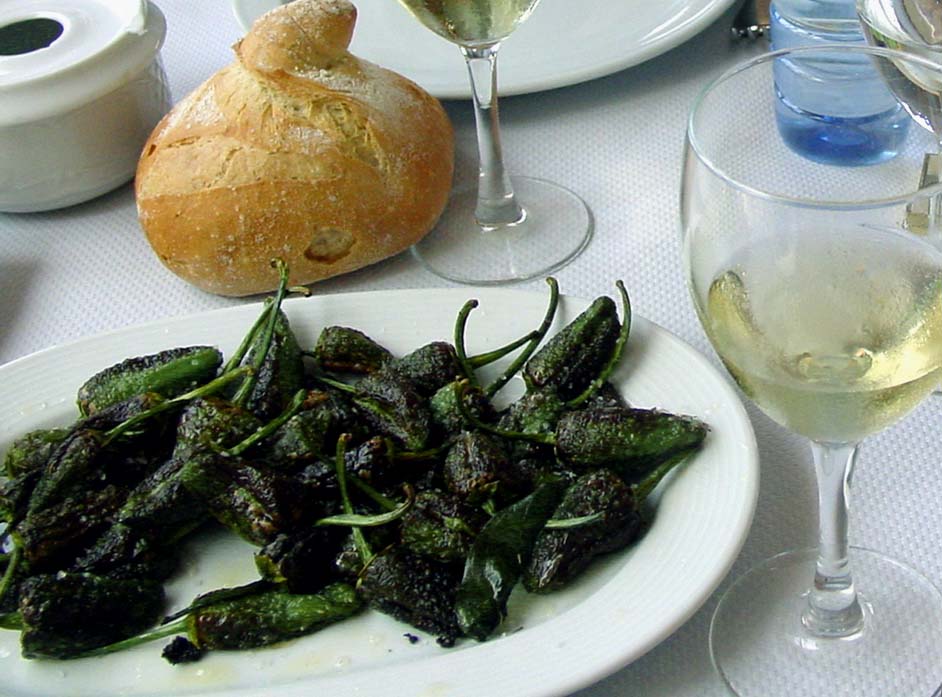
Padrón peppers are a type of small green pepper from the Padrón area in Galicia, Spain. Usually picked before ripening, they are fried in olive oil and sprinkled with coarse salt, often served as a snack or appetizer. Most are mild, but some can be unexpectedly hot.
- Most Padrón peppers are mild, but some are hot
- They are usually served fried with coarse salt
- The name 'pemento de Herbón' is protected in the EU
- Traditionally from the Padrón area in Galicia, Spain
- Stems are removed before frying in some regions
What is Padrón peppers?
Padrón peppers are small, slender green peppers, usually about 5 cm long. They are harvested before turning red, so most are mild in flavor, though a few can be surprisingly spicy. When cooked, their skin blisters and softens. The peppers are typically served hot, sprinkled with coarse salt, and sometimes accompanied by bread. Their taste is mostly gentle, but the occasional hot one adds an element of surprise.
Where does Padrón peppers come from?
This pepper variety comes from the area around Padrón in Galicia, northwestern Spain, especially the parish of Herbón. The species itself, Capsicum annuum, was first domesticated in the Americas, but the Padrón type developed locally. Since 2010, the name 'pemento de Herbón' has been protected by European law. While its roots are in Spain, the peppers are now grown in other Mediterranean regions and in the United States.
How is Padrón peppers made?
The peppers are usually picked while still green and immature. To prepare them, they are fried in olive oil until their skin blisters and the flesh softens. In Padrón and nearby areas, the stems are removed before frying to avoid bitterness, while in other places the stems are left on and used as handles for eating. After frying, the peppers are served hot and finished with a sprinkle of coarse salt.

How and when is Padrón peppers eaten?
Padrón peppers are most often enjoyed as a tapa, a small dish served in bars or at gatherings. They are eaten hot, sometimes with chunks of bread on the side. In Galicia, people may remove the stems before cooking, but elsewhere diners hold the peppers by the stem to eat them. The dish is popular as a snack or appetizer, especially in social settings.
Kinds of Padrón peppers
While the classic version is fried and salted, there are small differences in how the peppers are prepared. In Padrón, the stems are usually removed before cooking, but in other places, the stems stay on. The peppers are now grown outside Spain, including in the United States, but the protected name applies only to those from Herbón. Similar peppers, like the Japanese shishito, are prepared in much the same way.
What Padrón peppers means
Padrón peppers are closely tied to Galician food culture and are a well-known tapa across Spain. The protected designation of origin for 'pemento de Herbón' highlights their regional importance. A local saying captures their unpredictable heat, making eating them a playful experience. The dish is a staple in bars and gatherings, representing a taste of Galicia.
Questions people ask about Padrón peppers
What are Padrón peppers made of?
They are made from small green peppers, typically fried in olive oil and finished with coarse salt. Sometimes bread is served alongside.
Where do Padrón peppers come from?
They originate from the Padrón area in Galicia, in the northwest of Spain, especially the parish of Herbón.
Are Padrón peppers spicy?
Most are mild, but a few can be unexpectedly hot. The level of heat can vary from pepper to pepper.
How are Padrón peppers usually served?
They are fried in olive oil until blistered, sprinkled with coarse salt, and served hot, often as a tapa or snack.
Do Padrón peppers have a protected status?
Yes, the name 'pemento de Herbón' is protected under European Union law for peppers grown in the Herbón area.
Good reading and sources
- Padrón pepper on WikipediaEncyclopedia
- More photos on Wikimedia CommonsPhotos
- Wikidata recordOpen data
The facts on this page come from the Wikipedia article "Padrón pepper", written by its contributors and used under the CC BY-SA 4.0 licence, and from its Wikidata record (CC0). Thali rewrote the text in its own words, with AI assistance, and compares every page with the article to make sure no passage is copied. It may be reused under the same CC BY-SA 4.0 licence with a link back.
It may contain mistakes, and it is not dietary or allergy advice: recipes differ from cook to cook. If something is wrong, tell us. Last refreshed 2026-10-03.
More from Spain
All the food of Spain Churrochurros
🇪🇸 Spain and 5 moreRidged, deep-fried dough sticks often eaten hot with chocolate or coffee
Sweet or dessert, Breakfast, Snacks
Churrochurros
🇪🇸 Spain and 5 moreRidged, deep-fried dough sticks often eaten hot with chocolate or coffee
Sweet or dessert, Breakfast, Snacks
 ChorizoMeat
🇪🇸 Spain and 5 moreA seasoned pork sausage from the Iberian Peninsula, made in many regional styles
Sausage or cured food, Breakfast, Lunch
ChorizoMeat
🇪🇸 Spain and 5 moreA seasoned pork sausage from the Iberian Peninsula, made in many regional styles
Sausage or cured food, Breakfast, Lunch
 Croquette
🇫🇷 France and 5 moreA deep-fried roll with a creamy or starchy filling, coated in breadcrumbs
Street food, Snacks, Lunch
Croquette
🇫🇷 France and 5 moreA deep-fried roll with a creamy or starchy filling, coated in breadcrumbs
Street food, Snacks, Lunch
 Empanada
🇪🇸 Spain and 5 morePastry turnovers filled with meat, cheese, or vegetables, baked or fried
Pie or savoury pastry, Lunch, Dinner
Empanada
🇪🇸 Spain and 5 morePastry turnovers filled with meat, cheese, or vegetables, baked or fried
Pie or savoury pastry, Lunch, Dinner
Its cousins elsewhere
All street food ChapatiVeganचपाती
🇮🇳 India and 4 moreUnleavened flatbread cooked on a griddle and served hot with meals
Bread, Breakfast, Lunch
ChapatiVeganचपाती
🇮🇳 India and 4 moreUnleavened flatbread cooked on a griddle and served hot with meals
Bread, Breakfast, Lunch
 Chuanr串
🇨🇳 ChinaGrilled skewers of meat, seafood or vegetables from northern China
Grill or roast, Dinner, Snacks
Chuanr串
🇨🇳 ChinaGrilled skewers of meat, seafood or vegetables from northern China
Grill or roast, Dinner, Snacks
 Dabo koloVegetarianዳቦ ቆሎ
🇪🇹 Ethiopia and 2 moreSmall spiced fried dough pieces served as a snack in Ethiopia and Eritrea
Street food, Snacks
Dabo koloVegetarianዳቦ ቆሎ
🇪🇹 Ethiopia and 2 moreSmall spiced fried dough pieces served as a snack in Ethiopia and Eritrea
Street food, Snacks
 BreadfruitVegan
🇵🇭 Philippines and 4 moreLarge tropical fruit cooked as a starchy staple in many island cuisines
Main dish, Lunch, Dinner
BreadfruitVegan
🇵🇭 Philippines and 4 moreLarge tropical fruit cooked as a starchy staple in many island cuisines
Main dish, Lunch, Dinner