
Pastafrola
Shortcrust tart with a fruit or sweet filling and a lattice top
Pastafrola is a sweet tart made with a buttery shortcrust base and a layer of fruit or sweet paste, topped with a lattice of pastry. It is widely enjoyed in Argentina and Uruguay, with roots in Italy, and is often eaten in the afternoon or with mate. Fillings vary, but quince paste is especially popular.
- Shortcrust pastry tart with a lattice top
- Commonly filled with quince paste or fruit jam
- Popular in Argentina, Uruguay, and Paraguay
- Brought to South America by Italian immigrants
- Often served with mate during afternoon tea
What is Pastafrola?
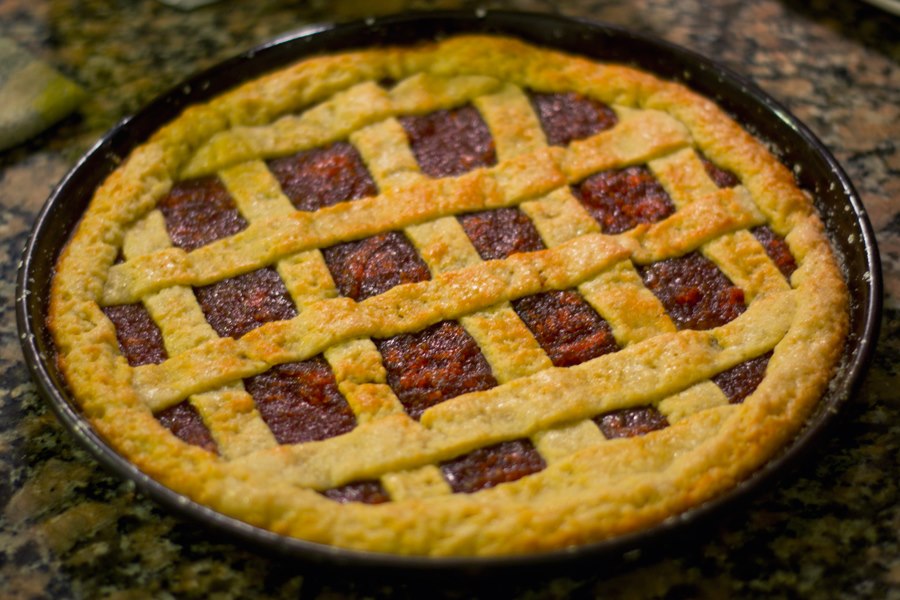
Pastafrola is a round tart made from a crumbly, buttery dough known as shortcrust pastry. The base is filled with a sweet layer, often quince paste, but sometimes other jams or spreads. Strips of pastry are arranged on top in a crisscross pattern, creating a window for the filling to show through. The finished tart is golden and slightly crisp, with a soft, sweet center.
Where does Pastafrola come from?
This dessert traces its beginnings to Italy, where a similar tart called crostata is traditional. Italian immigrants brought the recipe to South America, where it became a staple in Argentina, Uruguay, and Paraguay. The name comes from the Italian term for shortcrust pastry. Over time, local flavors and fillings were added, and the tart became a familiar treat in homes and bakeries.
How is Pastafrola made?
To make pastafrola, a dough is prepared with flour, butter, sugar, eggs, lemon zest, and baking powder. The dough is pressed into a round pan and spread with a layer of sweet filling, such as quince paste or jam. Thin strips of dough are laid over the top in a lattice pattern. The tart is then baked until the crust is set and lightly browned.
How and when is Pastafrola eaten?
People often enjoy pastafrola in the afternoon, especially with mate, a traditional South American drink. It is also served as a snack or with tea. The tart is cut into wedges and can be eaten at any time of day. In Greece, it is sometimes eaten in the morning. It is a common homemade treat and also found in pastry shops.
Kinds of Pastafrola
While quince paste is a classic filling, some versions use sweet potato paste, caramel spread, guava, or strawberry preserves. The Greek version tends to use fruit jam. The shape is usually round, but the filling and the thickness of the lattice can differ from one household or bakery to another.
What Pastafrola means
Pastafrola is part of daily life in Argentina and Uruguay, often linked to family gatherings and afternoon breaks. Its Italian roots are remembered, but it has become a symbol of local baking. The tart is not tied to a specific holiday, but its presence is felt in both home kitchens and cafes.
Questions people ask about Pastafrola
What is pastafrola made of?
Pastafrola is made from a shortcrust pastry dough with flour, butter, sugar, eggs, lemon zest, and baking powder. The filling is usually quince paste, but other jams or sweet pastes can be used.
Where does pastafrola come from?
Pastafrola originated in Italy and became popular in Argentina, Uruguay, and Paraguay after being brought by Italian immigrants.
What does pastafrola look like?
It is a round tart with a golden, crumbly crust and a layer of sweet filling. The top is decorated with strips of pastry arranged in a lattice pattern.
When is pastafrola usually eaten?
It is commonly enjoyed in the afternoon with mate or tea, but can be eaten at any time of day.
Are there different fillings for pastafrola?
Yes, besides quince paste, some versions use sweet potato paste, caramel spread, guava, or strawberry preserves.
Good reading and sources
The facts on this page come from the Wikipedia article "Pastafrola", written by its contributors and used under the CC BY-SA 4.0 licence, and from its Wikidata record (CC0). EveryThali rewrote the text in its own words, with AI assistance, and compares every page with the article to make sure no passage is copied. It may be reused under the same CC BY-SA 4.0 licence with a link back.
It may contain mistakes, and it is not dietary or allergy advice: recipes differ from cook to cook. If something is wrong, tell us. Last refreshed 2026-10-05.
More from Argentina
All the food of Argentina CroissantVegetarian
🇫🇷 France and 5 moreA crescent-shaped, flaky pastry made from layered yeast dough and butter
Pie or savoury pastry, Breakfast, Tea time
CroissantVegetarian
🇫🇷 France and 5 moreA crescent-shaped, flaky pastry made from layered yeast dough and butter
Pie or savoury pastry, Breakfast, Tea time
 Pie
🇬🇧 United Kingdom and 5 moreA baked dish with a pastry crust and sweet or savoury filling
Main dish, Lunch, Dinner
Pie
🇬🇧 United Kingdom and 5 moreA baked dish with a pastry crust and sweet or savoury filling
Main dish, Lunch, Dinner
 PanettoneVegetarian
🇮🇹 Italy and 2 moreTall, sweet Italian bread with candied fruit, eaten at Christmas and New Year
Sweet or dessert, Breakfast, Tea time
PanettoneVegetarian
🇮🇹 Italy and 2 moreTall, sweet Italian bread with candied fruit, eaten at Christmas and New Year
Sweet or dessert, Breakfast, Tea time
 Empanada
🇪🇸 Spain and 5 morePastry turnovers filled with meat, cheese, or vegetables, baked or fried
Pie or savoury pastry, Lunch, Dinner
Empanada
🇪🇸 Spain and 5 morePastry turnovers filled with meat, cheese, or vegetables, baked or fried
Pie or savoury pastry, Lunch, Dinner
Its cousins elsewhere
All sweets and desserts Red velvet cakeVegetarian
🇺🇸 United States and 1 moreA red-hued layer cake with cream cheese or ermine icing
Sweet or dessert
Red velvet cakeVegetarian
🇺🇸 United States and 1 moreA red-hued layer cake with cream cheese or ermine icing
Sweet or dessert
 Doughnut
🇺🇸 United States and 5 moreSweet fried or baked rings or balls, often glazed or filled
Sweet or dessert, Breakfast, Snacks
Doughnut
🇺🇸 United States and 5 moreSweet fried or baked rings or balls, often glazed or filled
Sweet or dessert, Breakfast, Snacks
 Crêpe
🇫🇷 FranceThin French pancakes, served sweet or savoury with a range of fillings
Main dish, Breakfast, Lunch
Crêpe
🇫🇷 FranceThin French pancakes, served sweet or savoury with a range of fillings
Main dish, Breakfast, Lunch
 Cinnamon rollVegetarian
🇸🇪 Sweden and 4 moreA sweet rolled bun with cinnamon and sugar, baked and often topped with icing
Sweet or dessert, Breakfast, Tea time
Cinnamon rollVegetarian
🇸🇪 Sweden and 4 moreA sweet rolled bun with cinnamon and sugar, baked and often topped with icing
Sweet or dessert, Breakfast, Tea time