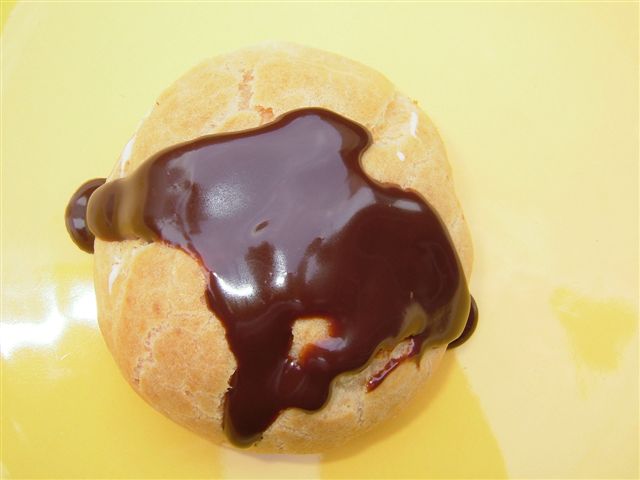
Profiterole
Small French choux pastry puffs filled with cream or ice cream
Profiteroles are small, round pastries made from choux dough, filled with whipped cream, custard, pastry cream, or ice cream. Originating in France, they are often topped with chocolate sauce, caramel, or powdered sugar and served as a dessert, but savory versions also exist.
- Profiteroles are made from choux pastry filled with cream or ice cream.
- Sweet versions are topped with chocolate sauce, caramel, or powdered sugar.
- Savory profiteroles were once common as soup garnishes.
- Croquembouche, a tower of caramel-glazed profiteroles, is served at weddings.
- Japan's Shu-cream is a popular adaptation of the French original.
What is Profiterole?
A profiterole is a small, round pastry made from choux dough, which puffs up when baked to create a hollow center. The pastry is filled with something creamy, such as whipped cream, custard, pastry cream, or ice cream. Sweet profiteroles are often finished with a drizzle of chocolate sauce, a coating of caramel, or a dusting of powdered sugar. The outside is crisp and light, while the inside is soft and creamy. Savory versions, filled with cheese or pureed meats, also exist.
Where does Profiterole come from?
The word 'profiterole' has been used in French cooking since the 16th century. Early profiteroles were small bread rolls filled with savory mixtures like sweetbreads, truffles, or poultry, and sometimes served in soup. The modern version, made with choux pastry, appeared in the 19th century. Choux pastry itself was developed in France between the 17th and 19th centuries, with contributions from pastry chefs like Jean Avice and Antoine Carême. The legend that choux pastry was invented for Catherine de' Medici is a later invention.
How is Profiterole made?
To make profiteroles, choux pastry dough is piped or spooned into small balls and baked until puffed and hollow. Once cooled, the puffs are filled by injecting cream or ice cream with a piping bag or by slicing off the top and filling them before replacing the lid. Sweet profiteroles may be topped with chocolate ganache, caramel, or powdered sugar, and sometimes decorated with fruit or extra cream. Savory versions use fillings like cheese or pureed meats.


How and when is Profiterole eaten?
Profiteroles are usually served as a dessert or sweet snack. They can be enjoyed plain or with toppings such as chocolate sauce, caramel, or whipped cream. In France and Italy, profiteroles filled and glazed with caramel are stacked into a croquembouche for weddings and Christmas. In Gibraltar, they appear at important celebrations. In the US, large cream puffs are popular at fairs, and in Japan, 'Shu-cream' is a common treat.
Kinds of Profiterole
There are both sweet and savory profiteroles. Sweet versions may be filled with whipped cream, custard, pastry cream, or ice cream, and topped with chocolate, caramel, or powdered sugar. Savory profiteroles, once common as soup garnishes, are filled with cheese or pureed meats. In Hawaii, 'coco puffs' are filled with chocolate custard and topped with a special frosting. Japan's 'Shu-cream' is a popular local adaptation.
What Profiterole means
Profiteroles are a classic French dessert and feature in festive displays like croquembouche at weddings and Christmas. They are also used in the St. Honoré cake. In the US, cream puffs are a fairground favorite, especially in Wisconsin. In Japan, Shu-cream has become a beloved sweet. The pastry's adaptability has made it popular in several countries, and its French roots are widely recognized.
When Profiterole is on the table
Questions people ask about Profiterole
What are profiteroles made of?
Profiteroles are made from choux pastry, which is a light dough that puffs up when baked. They are filled with whipped cream, custard, pastry cream, or ice cream, and often topped with chocolate sauce, caramel, or powdered sugar.
Where do profiteroles come from?
Profiteroles originated in France, where they have been known since at least the 16th century. The modern choux pastry version appeared in the 19th century.
Are profiteroles always sweet?
No, while most profiteroles are sweet and filled with cream or ice cream, savory versions exist. These can be filled with cheese or pureed meats and were once used as garnishes for soups.
What is the difference between a profiterole and a cream puff?
In the US and Canada, 'cream puff' is the common name for profiteroles. Some sources note that profiteroles are usually smaller than cream puffs.
How are profiteroles served at celebrations?
In France and Italy, profiteroles are stacked and glazed with caramel to make a croquembouche, which is often served at weddings and during Christmas.
Good reading and sources
The facts on this page come from the Wikipedia article "Profiterole", written by its contributors and used under the CC BY-SA 4.0 licence, and from its Wikidata record (CC0). EveryThali rewrote the text in its own words, with AI assistance, and compares every page with the article to make sure no passage is copied. It may be reused under the same CC BY-SA 4.0 licence with a link back.
It may contain mistakes, and it is not dietary or allergy advice: recipes differ from cook to cook. If something is wrong, tell us. Last refreshed 2026-10-05.
More from France
All the food of France Ice cream
🇺🇸 United States and 5 moreA frozen dessert made from sweetened, flavoured milk or cream
Sweet or dessert, Snacks
Ice cream
🇺🇸 United States and 5 moreA frozen dessert made from sweetened, flavoured milk or cream
Sweet or dessert, Snacks
 Candy
🇺🇸 United States and 5 moreSmall sweet treats made mainly from sugar or sweeteners
Sweet or dessert, Snacks
Candy
🇺🇸 United States and 5 moreSmall sweet treats made mainly from sugar or sweeteners
Sweet or dessert, Snacks
 CroissantVegetarian
🇫🇷 France and 5 moreA crescent-shaped, flaky pastry made from layered yeast dough and butter
Pie or savoury pastry, Breakfast, Tea time
CroissantVegetarian
🇫🇷 France and 5 moreA crescent-shaped, flaky pastry made from layered yeast dough and butter
Pie or savoury pastry, Breakfast, Tea time
 French toast
🇫🇷 France and 5 moreBread soaked in egg and milk, pan-fried and served sweet or savoury
Main dish, Breakfast, Snacks
French toast
🇫🇷 France and 5 moreBread soaked in egg and milk, pan-fried and served sweet or savoury
Main dish, Breakfast, Snacks
Its cousins elsewhere
All pies and savoury pastries Egg tartVegetarian蛋撻
🇨🇳 China and 5 moreA small pastry tart with a sweet egg custard filling, found in Cantonese cuisine
Pie or savoury pastry, Snacks, Tea time
Egg tartVegetarian蛋撻
🇨🇳 China and 5 moreA small pastry tart with a sweet egg custard filling, found in Cantonese cuisine
Pie or savoury pastry, Snacks, Tea time
 Boston cream pieVegetarian
🇺🇸 United States and 1 moreLayered sponge cake with custard and chocolate glaze from Massachusetts
Sweet or dessert
Boston cream pieVegetarian
🇺🇸 United States and 1 moreLayered sponge cake with custard and chocolate glaze from Massachusetts
Sweet or dessert
 QottabVegetarianقطاب
🇮🇷 IranDeep-fried Iranian pastry filled with almond, sugar and cardamom
Pie or savoury pastry, Snacks, Tea time
QottabVegetarianقطاب
🇮🇷 IranDeep-fried Iranian pastry filled with almond, sugar and cardamom
Pie or savoury pastry, Snacks, Tea time
 Cruller
🇺🇸 United States and 5 moreDeep-fried twisted or ring-shaped pastry, often topped with sugar or icing
Pie or savoury pastry, Breakfast, Snacks
Cruller
🇺🇸 United States and 5 moreDeep-fried twisted or ring-shaped pastry, often topped with sugar or icing
Pie or savoury pastry, Breakfast, Snacks