
Youtiao
In its own language: 油條
Long, golden-brown strips of deep-fried dough eaten across East and Southeast Asia
Youtiao is a long, deep-fried strip of wheat flour dough, lightly salted and golden brown, first made in China and now found in many East and Southeast Asian cuisines. It is most often eaten at breakfast, paired with rice congee, soy milk, or coffee, and goes by many local names. The dough is usually pulled into two joined strips before frying, making it easy to tear apart by hand.
- Youtiao is a deep-fried breadstick made from wheat flour dough.
- It is most often eaten at breakfast with congee, soy milk, or coffee.
- The breadstick is easy to tear apart by hand and usually served hot.
- Youtiao goes by many names, including cakwe, pathongko, and yau char kway.
- A Cantonese folk story links its shape to a protest against a historical figure.
What is Youtiao?
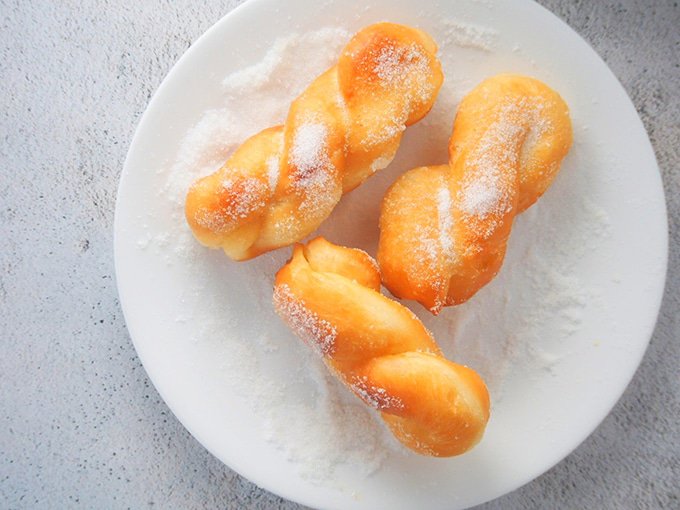
Youtiao is a long, golden-brown strip of dough, deep-fried until crisp on the outside and airy inside. It is lightly salted and easily pulled apart by hand, often appearing as two strips joined together. The dough is made from wheat flour, water, salt, oil, and a leavening agent such as yeast. Youtiao is usually served hot, and its mild flavor makes it a common companion to savory or sweet drinks and dishes. It is known by many names across Asia, reflecting its wide reach and local adaptations.
Where does Youtiao come from?
Youtiao originated in China, where it is a familiar breakfast food. In Cantonese-speaking areas, it is called yau char kway, and in northern China, guozi. The Cantonese name, meaning 'oil-fried devil,' is linked to a folk story from the Song dynasty, where the shape was said to represent a traitorous couple, deep-fried as an act of protest. Over time, youtiao spread to neighboring countries, each adopting its own name and serving style. Its basic form and method have remained consistent, but local versions have developed throughout East and Southeast Asia.
How is Youtiao made?
To make youtiao, a simple dough of wheat flour, water, salt, oil, and yeast is kneaded and left to rise. The dough is then shaped into strips, often pairing two together, and deep-fried in hot oil until they puff up and turn golden brown. The result is a light, hollow breadstick with a crisp surface. In some places, youtiao may be stuffed with fillings or wrapped in other foods, but the classic version is plain and served fresh from the fryer.



How and when is Youtiao eaten?
Youtiao is most often eaten at breakfast, either on its own or alongside rice congee, soy milk, or coffee. In China, it is sometimes stuffed into flatbread or wrapped in rice noodle rolls. Across Southeast Asia, it is dipped into sweetened condensed milk, chili sauce, or local broths. In Myanmar, it is served with steamed beans or as a side to tea. The breadstick is usually torn by hand and dipped or eaten plain, making it a popular street snack and a familiar sight at morning markets and tea shops.
Kinds of Youtiao
Different regions have developed their own versions and names for youtiao. In Indonesia, cakwe is often sliced and served with porridge or spicy sauces. In Thailand, pathongko is dipped in condensed milk or kaya, and in Singapore, sweet or savory fillings are sometimes added. Vietnam's quẩy is eaten with congee or noodle soups. There are also similar fried doughs, like tanggao (sugar cake), which is shorter and sweet, and stuffed versions found in Myanmar and Singapore.
What Youtiao means
Youtiao is woven into daily life across East and Southeast Asia, especially as a breakfast staple. Its presence at street stalls and markets marks the start of the day for many. The folk legend behind its Cantonese name adds a layer of cultural meaning in China. In several countries, youtiao is paired with traditional drinks or dishes, reflecting local tastes and customs. Its many names and adaptations show how a simple fried bread has become a shared food across cultures.
Questions people ask about Youtiao
What is youtiao made of?
Youtiao is made from a simple dough of wheat flour, water, salt, oil, and yeast. The dough is shaped into strips and deep-fried until golden and airy inside.
Where does youtiao come from?
Youtiao originated in China and is now popular in many East and Southeast Asian countries, each with its own local name and serving style.
How is youtiao usually eaten?
Youtiao is most often eaten at breakfast, paired with rice congee, soy milk, or coffee. It can also be dipped into sauces or wrapped in flatbread or rice noodles, depending on the region.
Is youtiao sweet or savory?
Youtiao is lightly salted and has a mild, savory flavor. It is usually served plain, but in some places, it may be dipped in sweetened milk or paired with sweet or savory fillings.
What are some other names for youtiao?
Youtiao is also called Chinese cruller, yau char kway, cakwe, pathongko, and fried breadstick, among other names in different countries.
Good reading and sources
The facts on this page come from the Wikipedia article "Youtiao", written by its contributors and used under the CC BY-SA 4.0 licence, and from its Wikidata record (CC0). Thali rewrote the text in its own words, with AI assistance, and compares every page with the article to make sure no passage is copied. It may be reused under the same CC BY-SA 4.0 licence with a link back.
It may contain mistakes, and it is not dietary or allergy advice: recipes differ from cook to cook. If something is wrong, tell us. Last refreshed 2026-10-03.
More from China
All the food of China Chuanr串
🇨🇳 ChinaGrilled skewers of meat, seafood or vegetables from northern China
Grill or roast, Dinner, Snacks
Chuanr串
🇨🇳 ChinaGrilled skewers of meat, seafood or vegetables from northern China
Grill or roast, Dinner, Snacks
 Tofu skin roll
🇨🇳 ChinaTofu skin wrapped around a savoury filling, served steamed or fried as dim sum
Main dish, Lunch, Dinner
Tofu skin roll
🇨🇳 ChinaTofu skin wrapped around a savoury filling, served steamed or fried as dim sum
Main dish, Lunch, Dinner
Its cousins elsewhere
All street food Bagel
🇵🇱 Poland and 2 moreRing-shaped bread roll, boiled then baked for a dense, chewy texture
Bread, Breakfast, Lunch
Bagel
🇵🇱 Poland and 2 moreRing-shaped bread roll, boiled then baked for a dense, chewy texture
Bread, Breakfast, Lunch
 FrybreadVegetarian
🇺🇸 United StatesFlat, deep-fried bread made by Native Americans with flour, water, and fat
Bread, Snacks, Lunch
FrybreadVegetarian
🇺🇸 United StatesFlat, deep-fried bread made by Native Americans with flour, water, and fat
Bread, Snacks, Lunch
 Lángos
🇭🇺 Hungary and 5 moreHungarian deep-fried flatbread, often topped with cheese or sour cream
Bread, Breakfast, Snacks
Lángos
🇭🇺 Hungary and 5 moreHungarian deep-fried flatbread, often topped with cheese or sour cream
Bread, Breakfast, Snacks
 Obwarzanek krakowskiVegetarian
🇵🇱 PolandBraided ring bread from Kraków, boiled then baked and sold from street carts
Bread, Snacks, Breakfast
Obwarzanek krakowskiVegetarian
🇵🇱 PolandBraided ring bread from Kraków, boiled then baked and sold from street carts
Bread, Snacks, Breakfast