Crawls and food tours
The street chaat crawl
An evening walk between Indian street stalls for chaat: crisp, sour, sweet and spicy snacks made to order and eaten standing.
Presented by ClearTrust Free for cooks, travellers and the curious.
Chaat is a family of savoury snacks sold from carts and small shops across South Asia. Each one layers something crisp with yoghurt, chutneys, spice and a squeeze of lime. Few people eat only one. The usual way is to walk a market lane and stop at several stalls, each known for a single item.
What it is
The word chaat comes from a Hindi verb meaning to lick or to taste. The snacks share a pattern more than a recipe. There is a base that is fried or boiled, such as a hollow puri, a potato patty, puffed rice or a lentil dumpling. Over it go tamarind chutney, green coriander and mint chutney, yoghurt, raw onion, and a sour spice mix called chaat masala. The result is sweet, sour, hot, salty and crunchy in one mouthful.
Where it comes from
Chaat is most closely tied to the cities of the northern plains, above all Delhi, Lucknow, Varanasi and Agra. Stories about its origin in the Mughal court are popular but hard to verify. Each region has since made its own. Mumbai is known for bhelpuri and sev puri on the beach at Chowpatty, and for pav bhaji. Kolkata calls its filled puris phuchka. Delhi calls them golgappa. The fillings and the spiced water change from city to city.
How it works
Stalls open in the late afternoon and are busiest after dark. Each vendor makes a small range. You say what you want and how hot you want it. The vendor assembles it in front of you in seconds and hands it over on a leaf plate or a paper dish. Filled puris are served one at a time, straight into your hand, until you say stop. You pay at the end, by the plate or by the number of pieces.
How to do it
- Choose a busy stall. High turnover means fresh food.
- Start with one plate of filled puris, eaten whole in one bite.
- Tell the vendor your spice level: less, medium or full.
- Move to another stall for a yoghurt chaat or a potato patty.
- Finish with something sweet, such as kulfi or a jalebi.
Good manners
- Eat each filled puri at once. It goes soft in seconds.
- Stay near the cart while eating and hand back steel plates.
- If you are new to street food, pick stalls that use bottled or filtered water.
What is eaten
 PanipuriCrisp hollow puris filled with spiced potato and dipped in tangy, flavoured water
 Bhel puriPuffed rice snack tossed with chutneys, sev and crisp puris, sold on Mumbai streets
 Aloo tikkiPotato cutlets spiced and fried, served hot with chutneys
 Papri chaatCrisp wafers topped with potatoes, chickpeas, yoghurt and tangy chutneys
 Sev puriCrispy puris topped with potatoes, chickpeas, chutneys and crunchy sev
 Pav bhajiSpiced mashed vegetable curry served with buttered bread rolls
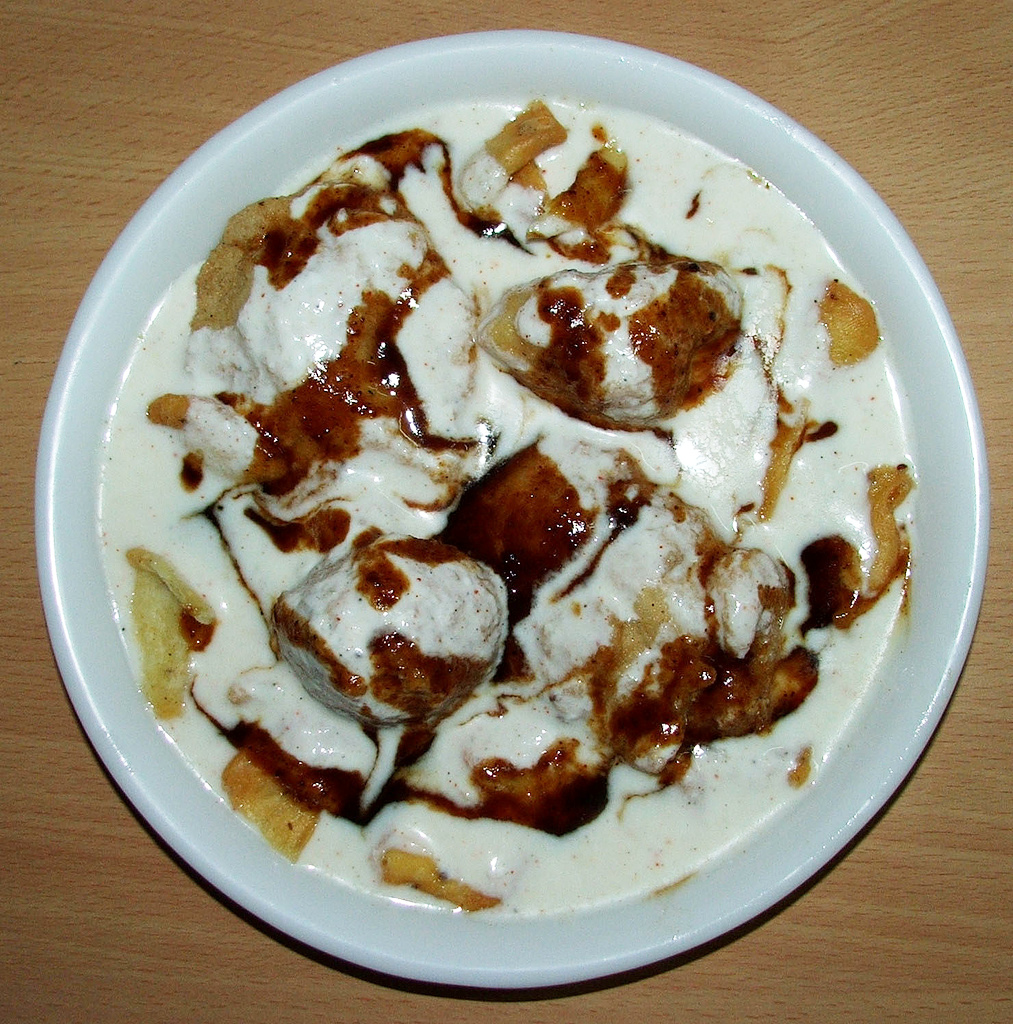
 Dahi vadaLentil fritters soaked in spiced yogurt and served as a cold snack
 Vada pavDeep-fried spiced potato fritter in a bread bun, served with chutney and chilli
Sources and further reading
Original text by the Thali desk, written with AI assistance and checked against the sources above. Customs vary from place to place. If we have something wrong, tell us.
Photo credits on this page
The small pictures above come from Wikimedia Commons under free licences. Some are cropped to fit.
- Vada pav: Kaushiki Prabhudesai, CC BY-SA 4.0, source
- Panipuri: Teena Sometimes, CC BY-SA 4.0, source
- Bhel puri: stu_spivack, CC BY-SA 2.0, source
- Aloo tikki: Raveesh Vyas, CC BY-SA 2.0, source
- Sev puri: https://www.flickr.com/photos/feastguru_kirti/, CC BY-SA 2.0, source
- Papri chaat: Ravi Talwar, CC BY-SA 4.0, source
- Pav bhaji: Rishika Palvankar, CC BY 2.0, source
- Dahi vada: Mdsmds0, CC BY-SA 4.0, source