Daily meals and habits
Couscous Friday
The North African custom of gathering after Friday midday prayers to share one large dish of couscous with meat and vegetables.
Presented by ClearTrust Free for cooks, travellers and the curious.
In Morocco, Algeria and Tunisia, Friday is the day of congregational prayer and the day for couscous. The family gathers at home after the mosque and eats from one wide dish in the centre of the table. Part of the meal is often sent to neighbours or to those in need. On other days the centre of the table is more likely to be a tagine.
What it is
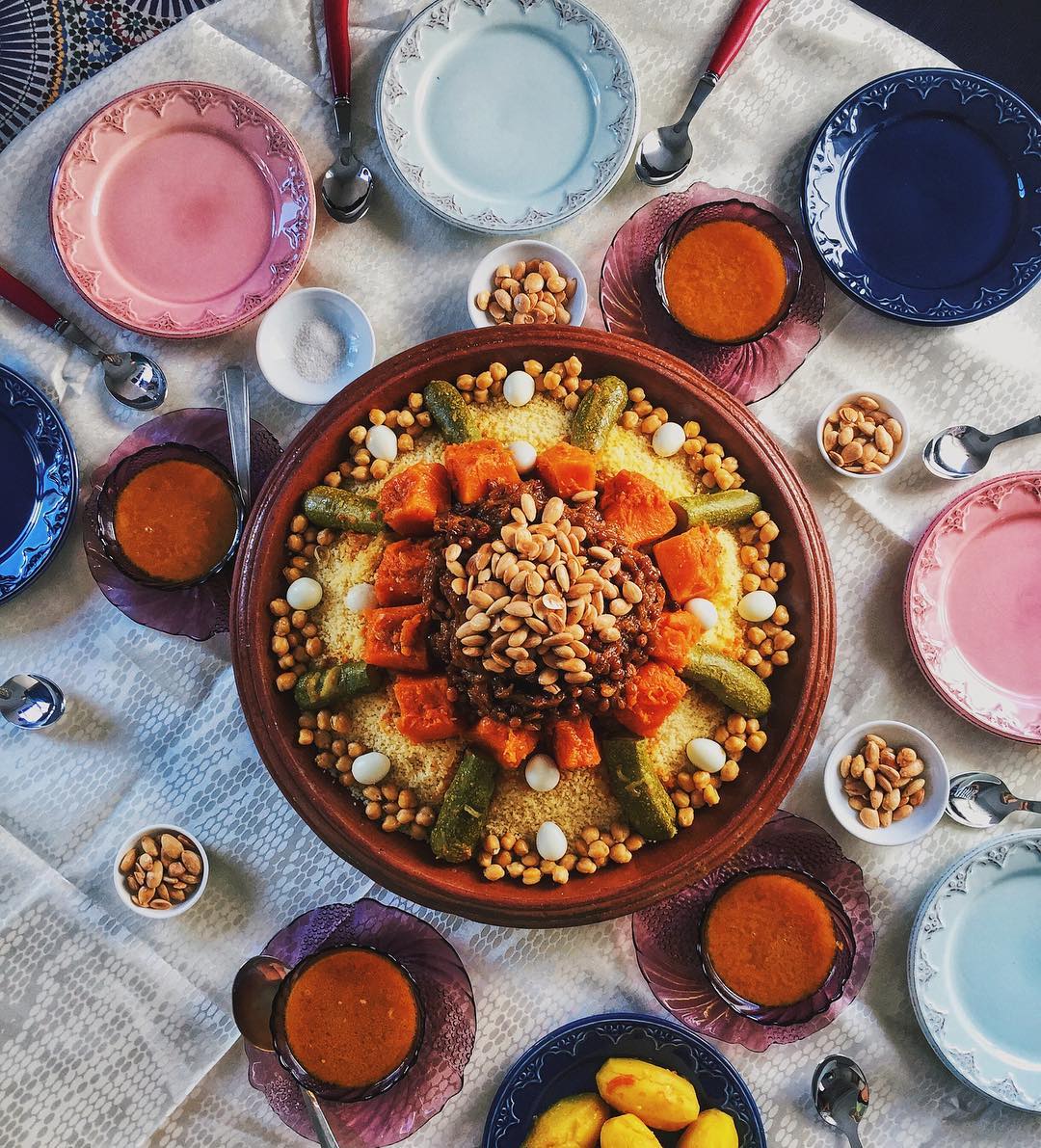
Couscous is tiny granules of rolled semolina, steamed two or three times over a simmering stew until light. It is heaped on a large round platter. Meat, usually lamb, beef or chicken, is placed in a hollow at the top, and vegetables are arranged over the slope: carrot, turnip, courgette, pumpkin, cabbage and chickpeas. Broth is poured over to moisten it. A sweet topping of caramelised onions and raisins is a Moroccan favourite. Buttermilk is the traditional drink.
Shared heritage
Couscous is the common dish of the Maghreb and is closely tied to the Amazigh, or Berber, peoples of the region. Each country and each town has its own version, with fish on the Tunisian coast and with dried meat or sweet butter and cinnamon elsewhere. In 2020 Algeria, Mauritania, Morocco and Tunisia jointly placed the knowledge and practices of making and eating couscous on the UNESCO list of intangible heritage.
How it works
The cook starts early, because rolling and steaming take time. The meal is served after the midday prayer, at about one or two. Everyone sits round the dish and eats from the section in front of them. Traditionally the right hand is used, pressing a little couscous and vegetable into a ball. Spoons are equally common now. The host breaks up the meat and pushes the best pieces toward guests. Restaurants in Morocco often serve couscous only on Fridays.
How to do it
- Wash your hands before sitting at the table.
- Wait for the host to say bismillah before starting.
- Eat from your own side of the dish, with a spoon or your right hand.
- Let the host share out the meat from the centre.
- Drink buttermilk or water with it, and take mint tea afterwards.
Good manners
- Do not reach across the dish or dig toward the centre.
- Use only your right hand for eating.
- When the host urges more food on you, accept a little. Praise the cook.
What is eaten
 TajineNorth African stew slow-cooked in a cone-lidded clay pot
 HariraNorth African soup of tomato, legumes, herbs and spices, often served during Ramadan
 PastillaNorth African pie with layers of thin pastry and a savory or sweet filling
 RfissaMoroccan chicken and lentils served over torn flatbread with spices
Also part of it, and being written: Tfaya, Méchoui, Leben.
Sources and further reading
- Couscous on Wikipedia
- UNESCO Intangible Cultural Heritage: Knowledge, know-how and practices pertaining to the production and consumption of couscous
Original text by the Thali desk, written with AI assistance and checked against the sources above. Customs vary from place to place. If we have something wrong, tell us.
Photo credits on this page
The small pictures above come from Wikimedia Commons under free licences. Some are cropped to fit.
- Rfissa: Mokhtaroo, CC BY-SA 3.0, source
- Pastilla: kochtopf, CC BY-SA 2.0, source
- Harira: وهراني, CC BY-SA 3.0, source
- Tajine: Bawdeep2010, CC BY-SA 4.0, source