Daily meals and habits
Dabbawalas and the tiffin
Mumbai's lunch delivery system: home-cooked meals in stacked steel boxes, carried by hand, bicycle and train to office desks every working day.
Presented by ClearTrust Free for cooks, travellers and the curious.
In Mumbai many office workers eat a hot lunch cooked that morning in their own kitchen. It is brought to them by a dabbawala, literally a person with a box. A few thousand dabbawalas collect lunch boxes from homes, sort them at railway stations, deliver them across the city by noon and return the empties by evening.

What it is
Tiffin is an Indian English word for a light meal or packed lunch. The box, called a dabba or tiffin carrier, is a stack of round steel containers held by a clasp. One tier holds rice, one bread, one a vegetable dish, one dal or curry. The system exists because commuters leave home too early for lunch to be ready, trains are too crowded to carry it, and many people prefer food cooked at home to suit their own diet and religious rules.
How the system works
Each dabbawala collects boxes from a set of homes in mid morning and takes them by bicycle or on foot to the nearest suburban station. There the boxes are sorted by destination, loaded on crates and carried in the luggage compartments of the trains. They are sorted again at the arrival station and handed to the men who cover each office district. Every box carries a painted code of colours, letters and numbers showing its origin, its destination station and the building and floor.
The people
The service began in the late nineteenth century and is run as a cooperative. Most dabbawalas come from the same rural communities in the hills near Pune and many are followers of the Varkari devotional tradition. They wear a white cotton cap. Members are partners, not employees, and earn roughly equal shares. Their accuracy, achieved with no computers and little formal schooling, has been studied by business schools and logistics companies around the world.
How to do it
- Watch the sorting outside Churchgate station in Mumbai at about half past eleven on a weekday.
- Stand well back. The men are working against the clock.
- To try a tiffin lunch yourself, order from a tiffin service that delivers home-style meals.
- Open the tiers and lay them out. Eat bread with the dry dish and rice with the dal.
Good manners
- Do not stop or delay a dabbawala for a photo.
- Have the empty box ready at the agreed time. One late box holds up the chain.
- Rinse the tiers before returning them.
What is eaten
 ChapatiUnleavened flatbread cooked on a griddle and served hot with meals
 DalSoupy dish made from split lentils, peas or beans, a staple across South Asia
 BhajiSpiced vegetable fritters from the Indian subcontinent, often sold as street snacks
 PilafRice cooked in stock with spices, meat or vegetables, with each grain kept separate
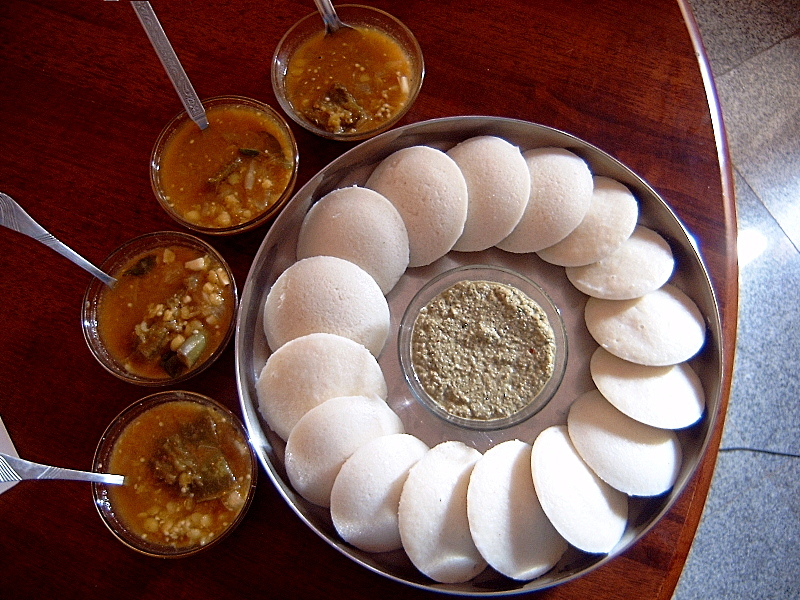 IdliSteamed cakes of fermented rice and lentil batter from South India and Sri Lanka
 UpmaA soft, savoury porridge made from roasted semolina or rice flour
 Flattened riceRice grains flattened into flakes, used in sweet and savoury dishes across Asia
Also part of it, and being written: Thepla.
Sources and further reading
Original text by the Thali desk, written with AI assistance and checked against the sources above. Customs vary from place to place. If we have something wrong, tell us.
Photo credits on this page
The small pictures above come from Wikimedia Commons under free licences. Some are cropped to fit.
- Idli: Soumya dey at English Wikipedia, CC BY-SA 3.0, source
- Upma: Intodustin, CC BY-SA 4.0, source
- Pilaf: Mizu basyo at Japanese Wikipedia, CC BY-SA 3.0, source
- Chapati: Roland zh, CC BY-SA 3.0, source
- Dal: Bhaskaranaidu, CC BY-SA 3.0, source
- Flattened rice: Sanjay Acharya, aka Sanjay ach at en.wikipedia, CC BY-SA 3.0, source
- Bhaji: balu, CC BY 2.0, source