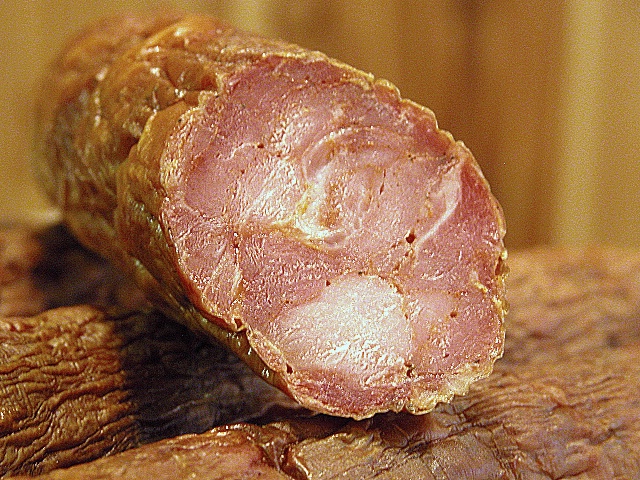
Andouille
Smoked pork sausage with wine, onion and garlic, first made in France
Andouille is a smoked sausage from France, made mainly with pork, onion, wine, garlic and black pepper. It is especially linked to Brittany and Normandy, and has a strong scent and grey color. In Louisiana, USA, a Cajun version uses similar ingredients but is double-smoked and coarser. Andouille is eaten as part of meals or used to flavor dishes.
- Made with pork, onion, wine, garlic and black pepper
- French versions use chitterlings and tripe
- Cajun andouille is double-smoked and coarser
- LaPlace, Louisiana is famous for its Cajun andouille
- Andouille de Vire has a protected name in the EU
What is Andouille?
Andouille is a type of sausage that starts with pork, often including chitterlings (intestines) and tripe (stomach lining). Onion, wine, garlic and black pepper are mixed in for flavor. The sausage is smoked, giving it a grey color and a strong, distinct smell. In France, it is usually firm and sliced, while in Louisiana, the Cajun version is coarser and double-smoked. The taste is rich, meaty and savory, with a pronounced smokiness and a hint of wine and spice.
Where does Andouille come from?
Andouille began in France, with roots in regions like Brittany and Normandy. The sausage uses parts of the pig that are less commonly eaten, such as chitterlings and tripe, along with seasonings and wine. Over time, different French towns developed their own styles, like those from Guémené-sur-Scorff and Vire. The sausage later became part of Cajun cooking in Louisiana, brought by French settlers. There is also a similar sausage in Italy, called 'nduja, which may have been inspired by andouille.
How is Andouille made?
To make andouille, pork meat, chitterlings and sometimes tripe are cleaned and chopped. Onion, garlic, black pepper and wine are added, and the mixture is stuffed into a casing. The sausage is then smoked, sometimes more than once, to deepen the flavor and preserve it. The French versions tend to be dense and tightly packed, while the Cajun style in Louisiana is chunkier and heavily smoked.

How and when is Andouille eaten?
Andouille can be served on its own, sliced as part of a meal, or used to add flavor to stews, soups and other dishes. In France, it is often eaten cold or at room temperature, sometimes with bread or mustard. In Louisiana, it is a key ingredient in Cajun recipes like gumbo and jambalaya. The sausage is enjoyed both as an everyday food and as part of regional cooking traditions.
Kinds of Andouille
French andouille differs by region, with towns like Guémené-sur-Scorff and Vire known for their own recipes. Some versions use the whole digestive tract, while others focus on certain parts. The Cajun andouille of Louisiana is coarser, with more garlic and a heavier smoke flavor. Italian 'nduja is a spreadable sausage that likely traces its origins to andouille.
What Andouille means
Andouille holds a special place in both French and Cajun food culture. In France, certain types are linked to specific towns and have official recognition. In Louisiana, the town of LaPlace is known for its andouille and calls itself the "Andouille Capital of the World." The sausage is a symbol of local pride and culinary heritage in both places.
Questions people ask about Andouille
What is andouille made of?
Andouille is made from pork, often including chitterlings and tripe, along with onion, wine, garlic and black pepper.
Where does andouille come from?
Andouille originated in France, especially in Brittany and Normandy, and later became popular in Louisiana, USA.
How is andouille different in France and Louisiana?
French andouille is usually firm, grey and made with chitterlings and tripe, while Cajun andouille from Louisiana is coarser, double-smoked, and uses similar seasonings.
How is andouille eaten?
It can be sliced and served on its own, added to dishes like gumbo and jambalaya, or eaten with bread and mustard.
Does andouille have any special status?
Andouille de Vire from France is officially recognized and protected under European law.
Good reading and sources
The facts on this page come from the Wikipedia article "Andouille", written by its contributors and used under the CC BY-SA 4.0 licence, and from its Wikidata record (CC0). Thali rewrote the text in its own words, with AI assistance, and compares every page with the article to make sure no passage is copied. It may be reused under the same CC BY-SA 4.0 licence with a link back.
It may contain mistakes, and it is not dietary or allergy advice: recipes differ from cook to cook. If something is wrong, tell us. Last refreshed 2026-10-03.
More from France
All the food of France Nem chuaMeat
🇻🇳 Vietnam and 2 moreFermented pork, garlic and chili, wrapped in leaves and eaten cold
Sausage or cured food, Snacks
Nem chuaMeat
🇻🇳 Vietnam and 2 moreFermented pork, garlic and chili, wrapped in leaves and eaten cold
Sausage or cured food, Snacks
 MerguezMeatمرقاز
🇩🇿 Algeria and 1 moreSpicy fresh sausage of lamb or beef from North Africa
Sausage or cured food
MerguezMeatمرقاز
🇩🇿 Algeria and 1 moreSpicy fresh sausage of lamb or beef from North Africa
Sausage or cured food
 CharcuterieMeat
🇫🇷 FranceFrench tradition of cured, cooked, and preserved meats, often from pork
Sausage or cured food
CharcuterieMeat
🇫🇷 FranceFrench tradition of cured, cooked, and preserved meats, often from pork
Sausage or cured food
Its cousins elsewhere
All sausages and cured foods Chả lụaMeat
🇻🇳 VietnamVietnamese pork sausage steamed in banana leaves
Sausage or cured food
Chả lụaMeat
🇻🇳 VietnamVietnamese pork sausage steamed in banana leaves
Sausage or cured food
 TocinoMeat
🇵🇭 Philippines and 5 moreCured or fried pork enjoyed in Spain, the Philippines, and the Caribbean
Main dish, Breakfast, Lunch
TocinoMeat
🇵🇭 Philippines and 5 moreCured or fried pork enjoyed in Spain, the Philippines, and the Caribbean
Main dish, Breakfast, Lunch
 BoereworsMeat
🇿🇦 South Africa and 4 moreSouthern African sausage made from coarsely ground meat and spices
Sausage or cured food, Lunch, Dinner
BoereworsMeat
🇿🇦 South Africa and 4 moreSouthern African sausage made from coarsely ground meat and spices
Sausage or cured food, Lunch, Dinner
 Sai krok IsanMeatไส้กรอกอีสาน
🇹🇭 Thailand and 1 moreFermented pork and rice sausage from northeastern Thailand
Sausage or cured food, Snacks
Sai krok IsanMeatไส้กรอกอีสาน
🇹🇭 Thailand and 1 moreFermented pork and rice sausage from northeastern Thailand
Sausage or cured food, Snacks