
Chả lụa
Vietnamese pork sausage steamed in banana leaves
Chả lụa is a Vietnamese sausage made by pounding lean pork into a paste, seasoning it, and steaming it inside banana leaves. It is a common addition to dishes like bánh mì and xôi, and is enjoyed across Vietnam at many meals.
- Made by steaming pork paste in banana leaves
- Eaten in bánh mì, xôi, and other Vietnamese dishes
- Variants include beef, fried, and cinnamon-flavored types
- Known as moo yor in Thai cuisine
What is Chả lụa?
Chả lụa is a smooth-textured sausage from Vietnam, shaped into a log and wrapped in banana leaves before cooking. The main ingredient is pork, which is pounded into a fine paste and mixed with seasonings. The banana leaf covering gives the sausage a subtle aroma and helps keep it moist during steaming. The finished sausage is pale and firm, with a mild, savory flavor and a hint of pepper and garlic.
Where does Chả lụa come from?
Chả lụa is rooted in Vietnamese cooking, where it has long been a familiar food. Its name means 'banana leaf pork sausage,' reflecting both its main ingredient and the traditional way it is prepared. The practice of wrapping meat in leaves and steaming it is widespread in Southeast Asia, and chả lụa stands out as a staple in Vietnamese meals.
How is Chả lụa made?
To make chả lụa, lean pork is pounded until it forms a sticky paste. This paste is seasoned with garlic, black pepper, fish sauce, and potato starch. The mixture is then shaped and tightly wrapped in banana leaves, which are tied to hold their shape. The wrapped sausage is steamed until it is fully cooked, then sliced for serving.


How and when is Chả lụa eaten?
Chả lụa is eaten in many ways throughout Vietnam. It is often sliced and served as part of a meal, or added to dishes like bánh mì (a Vietnamese sandwich), bánh cuốn (steamed rice rolls), or xôi (sticky rice). Its mild flavor makes it a versatile ingredient, and it is enjoyed at home, in restaurants, and at street food stalls.
Kinds of Chả lụa
There are several types of chả lụa. Chả bì includes shredded pork skin for extra texture. Chả bò is made with beef and herbs. Chả chiên skips the banana leaf and is deep-fried instead of steamed. Chả quế is a fried version flavored with cinnamon. Chả Huế features more garlic and whole black peppercorns. In Thailand, a similar sausage called moo yor is popular.
What Chả lụa means
Chả lụa is a familiar sight at Vietnamese tables and is used in a variety of everyday dishes. Its preparation and use reflect local tastes and cooking traditions. The sausage is also found in neighboring countries, showing its influence beyond Vietnam.
Questions people ask about Chả lụa
What is chả lụa made of?
Chả lụa is made from lean pork that is pounded into a paste, then mixed with garlic, black pepper, fish sauce, and potato starch. The mixture is wrapped in banana leaves and steamed.
Where does chả lụa come from?
Chả lụa comes from Vietnam, where it is a common sausage found in many traditional dishes and meals.
How is chả lụa usually eaten?
It is often sliced and served in dishes like bánh mì (Vietnamese sandwich), bánh cuốn (steamed rice rolls), or xôi (sticky rice), and can also be eaten on its own.
Are there different types of chả lụa?
Yes, there are several variants, such as chả bì with pork skin, chả bò made from beef, chả chiên which is deep-fried, and chả quế with cinnamon.
Is chả lụa found outside Vietnam?
A similar sausage known as moo yor is popular in Thai cuisine, showing that chả lụa has spread beyond Vietnam.
Good reading and sources
The facts on this page come from the Wikipedia article "Chả lụa", written by its contributors and used under the CC BY-SA 4.0 licence, and from its Wikidata record (CC0). Thali rewrote the text in its own words, with AI assistance, and compares every page with the article to make sure no passage is copied. It may be reused under the same CC BY-SA 4.0 licence with a link back.
It may contain mistakes, and it is not dietary or allergy advice: recipes differ from cook to cook. If something is wrong, tell us. Last refreshed 2026-10-03.
More from Vietnam
All the food of Vietnam Nem chuaMeat
🇻🇳 Vietnam and 2 moreFermented pork, garlic and chili, wrapped in leaves and eaten cold
Sausage or cured food, Snacks
Nem chuaMeat
🇻🇳 Vietnam and 2 moreFermented pork, garlic and chili, wrapped in leaves and eaten cold
Sausage or cured food, Snacks
 MortadellaMeat
🇮🇹 Italy and 5 moreLarge Italian sausage of finely ground pork and cubes of fat, often with pepper or pistachio
Sausage or cured food, Lunch, Dinner
MortadellaMeat
🇮🇹 Italy and 5 moreLarge Italian sausage of finely ground pork and cubes of fat, often with pepper or pistachio
Sausage or cured food, Lunch, Dinner
 CoffeeVegan
🇾🇪 Yemen and 5 moreA dark, bitter drink made by brewing roasted coffee beans
Drink, Breakfast, Snacks
TofuVegan豆腐
🇨🇳 China and 5 moreSoft white blocks made by curdling soy milk and pressing the curds
Main dish
CoffeeVegan
🇾🇪 Yemen and 5 moreA dark, bitter drink made by brewing roasted coffee beans
Drink, Breakfast, Snacks
TofuVegan豆腐
🇨🇳 China and 5 moreSoft white blocks made by curdling soy milk and pressing the curds
Main dish
Its cousins elsewhere
All sausages and cured foods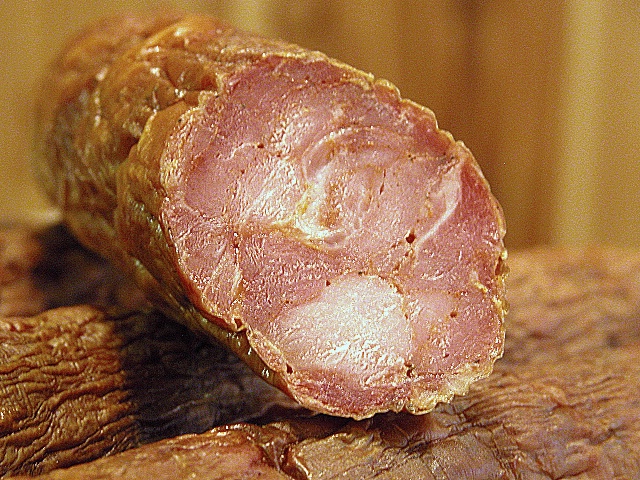 AndouilleMeat
🇫🇷 France and 1 moreSmoked pork sausage with wine, onion and garlic, first made in France
Sausage or cured food
AndouilleMeat
🇫🇷 France and 1 moreSmoked pork sausage with wine, onion and garlic, first made in France
Sausage or cured food
 Carniolan sausageMeatkranjska klobasa
🇸🇮 Slovenia and 3 moreA smoked pork sausage from Slovenia, often served in pairs
Sausage or cured food
Carniolan sausageMeatkranjska klobasa
🇸🇮 Slovenia and 3 moreA smoked pork sausage from Slovenia, often served in pairs
Sausage or cured food
 Longaniza
🇪🇸 Spain and 5 moreA seasoned sausage with many regional styles across Spain, Latin America, and the Philippines
Sausage or cured food, Breakfast, Lunch
Longaniza
🇪🇸 Spain and 5 moreA seasoned sausage with many regional styles across Spain, Latin America, and the Philippines
Sausage or cured food, Breakfast, Lunch
 ChorizoMeat
🇪🇸 Spain and 5 moreA seasoned pork sausage from the Iberian Peninsula, made in many regional styles
Sausage or cured food, Breakfast, Lunch
ChorizoMeat
🇪🇸 Spain and 5 moreA seasoned pork sausage from the Iberian Peninsula, made in many regional styles
Sausage or cured food, Breakfast, Lunch