
Cachopo
Breaded veal fillets stuffed with ham and cheese, fried and served hot
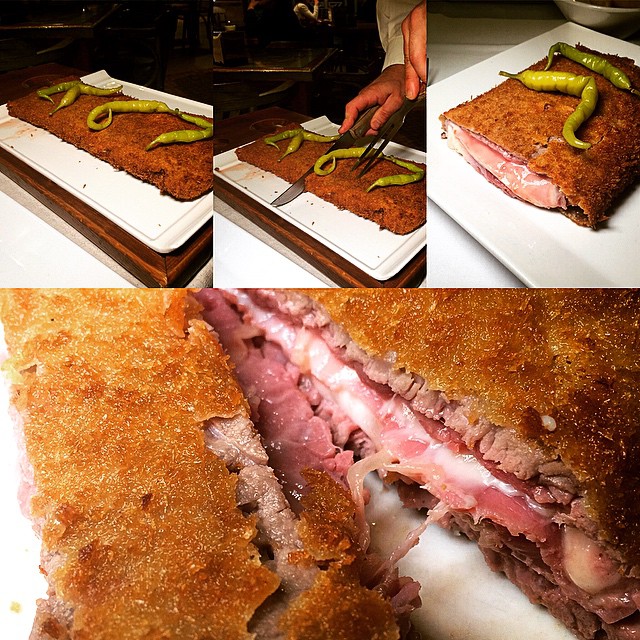
Cachopo is a specialty from Asturias in northern Spain. It is made by sandwiching cheese and Serrano ham between two large veal fillets, then breading and frying the whole stack. The dish is served hot, often with fried potatoes and sometimes peppers or mushrooms. Variations use other meats or fillings.
- Made with two veal fillets stuffed with ham and cheese
- Breaded and fried until crisp and golden
- Often served with fried potatoes, peppers, or mushrooms
- Earliest mention dates to the early 1700s
- Variations use chicken, pork, fish, or different fillings
What is Cachopo?
Cachopo is a hearty dish from Asturias, a region in northern Spain. It is made by layering cheese and slices of Serrano ham between two large pieces of veal. The whole stack is coated in flour, dipped in egg, then covered with breadcrumbs before being fried until golden. The result is a crisp exterior with a melting, savoury filling. It is usually served with fried potatoes, and sometimes garnished with peppers or mushrooms.
Where does Cachopo come from?
The earliest known mention of cachopo comes from the early eighteenth century, noted by doctor Gaspar Casal. It is a dish closely linked to Asturian cooking, where it has become a regional classic. While its exact origins are not detailed, it has long been a part of local tradition and is now a well-known specialty in Asturias.
How is Cachopo made?
To make cachopo, two large veal fillets are used as the outer layers. Slices of Serrano ham and cheese are placed between them, forming a kind of sandwich. This is then dusted with flour, dipped in beaten egg, and coated in breadcrumbs. The assembled cachopo is fried in oil until the outside is crisp and the cheese inside has melted. It is typically served hot, straight from the pan.
How and when is Cachopo eaten?
Cachopo is usually eaten as a main course, often at lunch or dinner. It is served hot and commonly comes with fried potatoes, known locally as patatas fritas. Sometimes, it is garnished with sautéed peppers or mushrooms. The dish is enjoyed in homes and restaurants across Asturias, and is considered a filling, satisfying meal.
Kinds of Cachopo
There are many variations of cachopo. Some use fish instead of veal for the outer layers. Others substitute chicken or pork, and the fillings can include seafood, other meats, mushrooms, cheese, or vegetables. These adaptations allow for different tastes and dietary preferences, but the basic idea of a stuffed, breaded, and fried cutlet remains the same.
What Cachopo means
Cachopo is a point of pride in Asturian cuisine. It is a dish that represents the region’s love of hearty, filling food. While it is eaten year-round and not tied to any particular festival or holiday, it is a popular choice in local restaurants and is often recommended to visitors wanting to try traditional Asturian fare.
Questions people ask about Cachopo
What is cachopo made of?
Cachopo is made from two large veal fillets with cheese and Serrano ham sandwiched between them. The stack is breaded with flour, egg, and breadcrumbs, then fried until golden.
Where does cachopo come from?
Cachopo is a traditional dish from Asturias, a region in northern Spain. It has been part of Asturian cuisine since at least the early eighteenth century.
How is cachopo served?
Cachopo is served hot, usually as a main course. It often comes with fried potatoes and may be garnished with peppers or mushrooms.
Are there different types of cachopo?
Yes, there are many variations. Some use chicken, pork, or fish instead of veal, and fillings can include seafood, other meats, mushrooms, cheese, or vegetables.
Is cachopo always made with meat?
The classic version uses veal, but some variations use other meats or fish. Fillings can also include vegetables or mushrooms along with cheese.
Good reading and sources
- Cachopo (dish) on WikipediaEncyclopedia
- More photos on Wikimedia CommonsPhotos
- Wikidata recordOpen data
The facts on this page come from the Wikipedia article "Cachopo (dish)", written by its contributors and used under the CC BY-SA 4.0 licence, and from its Wikidata record (CC0). Thali rewrote the text in its own words, with AI assistance, and compares every page with the article to make sure no passage is copied. It may be reused under the same CC BY-SA 4.0 licence with a link back.
It may contain mistakes, and it is not dietary or allergy advice: recipes differ from cook to cook. If something is wrong, tell us. Last refreshed 2026-10-03.
More from Spain
All the food of Spain Paella
🇪🇸 Spain and 1 moreRice cooked with meat, seafood or vegetables in a wide shallow pan from Valencia
Main dish, Lunch
Paella
🇪🇸 Spain and 1 moreRice cooked with meat, seafood or vegetables in a wide shallow pan from Valencia
Main dish, Lunch
 Oxtail stewMeat
🇮🇹 Italy and 4 moreStew made with oxtail, found in many world cuisines
Stew or curry, Lunch, Dinner
Oxtail stewMeat
🇮🇹 Italy and 4 moreStew made with oxtail, found in many world cuisines
Stew or curry, Lunch, Dinner
 MolleteVegetarian
🇲🇽 Mexico and 6 moreOpen-faced Mexican sandwich with refried beans and melted cheese
Bread, Breakfast, Snacks
MolleteVegetarian
🇲🇽 Mexico and 6 moreOpen-faced Mexican sandwich with refried beans and melted cheese
Bread, Breakfast, Snacks
 TocinoMeat
🇵🇭 Philippines and 5 moreCured or fried pork enjoyed in Spain, the Philippines, and the Caribbean
Main dish, Breakfast, Lunch
TocinoMeat
🇵🇭 Philippines and 5 moreCured or fried pork enjoyed in Spain, the Philippines, and the Caribbean
Main dish, Breakfast, Lunch
Its cousins elsewhere
All main dishes Gözleme
🇹🇷 TurkeyTurkish flatbread turnover filled with meat, cheese, or vegetables
Main dish, Breakfast, Lunch
Gözleme
🇹🇷 TurkeyTurkish flatbread turnover filled with meat, cheese, or vegetables
Main dish, Breakfast, Lunch
 Huevos motuleños
🇲🇽 Mexico and 2 moreEggs on tortillas with black beans, cheese, and toppings from Yucatán
Main dish, Breakfast
Huevos motuleños
🇲🇽 Mexico and 2 moreEggs on tortillas with black beans, cheese, and toppings from Yucatán
Main dish, Breakfast
 Pancake
🇺🇸 United States and 5 moreFlat cakes made from batter, cooked on a griddle or pan and served sweet or savoury
Main dish, Breakfast, Snacks
Pancake
🇺🇸 United States and 5 moreFlat cakes made from batter, cooked on a griddle or pan and served sweet or savoury
Main dish, Breakfast, Snacks
 Pelmeniпельмени
🇷🇺 RussiaRussian dumplings filled with seasoned meat and wrapped in thin dough
Dumpling, Lunch, Dinner
Pelmeniпельмени
🇷🇺 RussiaRussian dumplings filled with seasoned meat and wrapped in thin dough
Dumpling, Lunch, Dinner