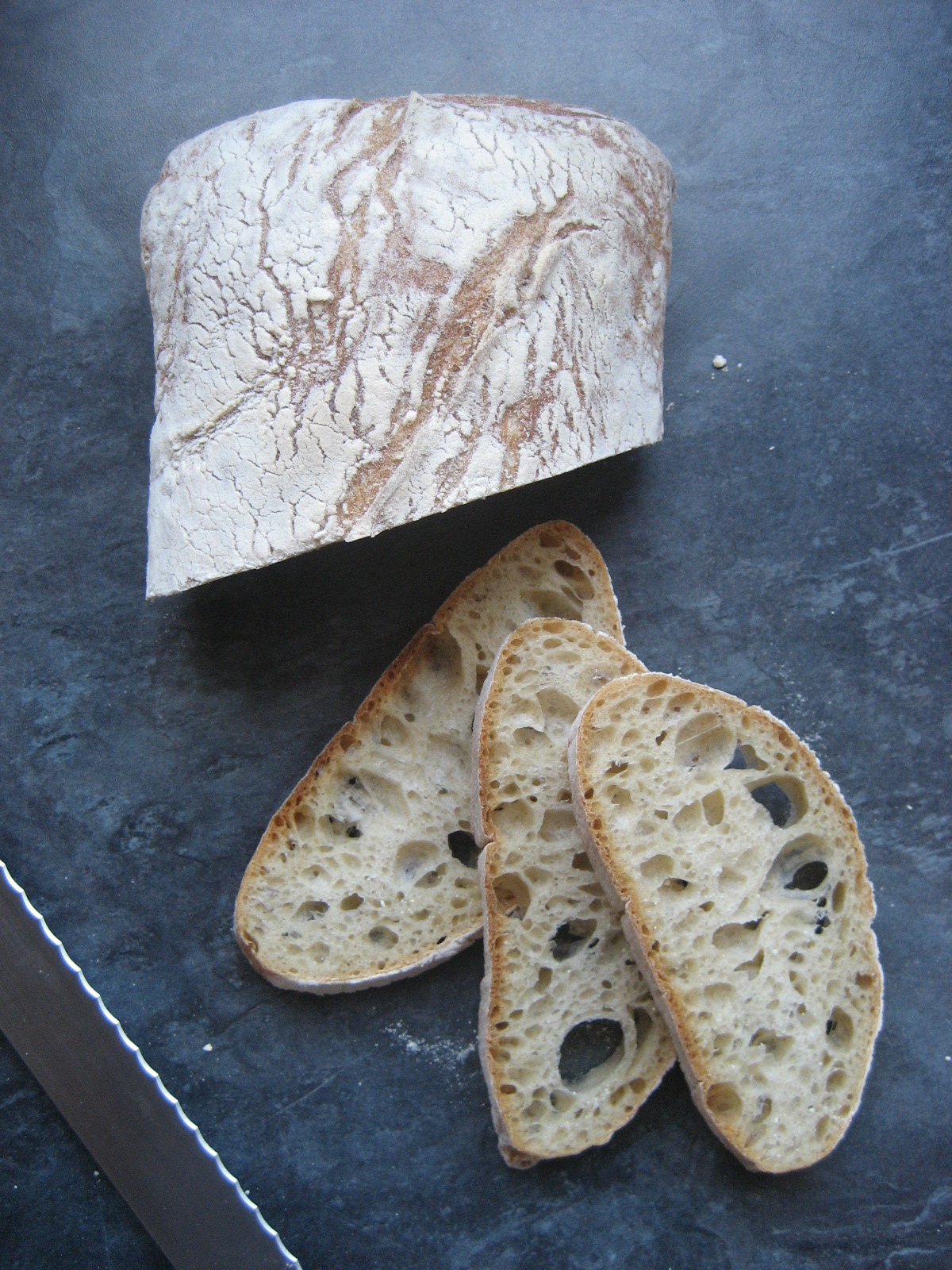
Ciabatta
Italian white bread with a chewy crumb and a crisp crust
Ciabatta is a type of Italian bread that stands out for its open, airy interior and thin, crunchy crust. It was first made in the Veneto region of Italy in the early 1980s, using wheat flour, water, yeast, and salt. The bread is now enjoyed in many places and comes in several regional versions.
- Ciabatta means 'slipper' in Italian, named for its shape
- First made in Veneto, Italy in the early 1980s
- Known for its open crumb and crisp crust
- Uses a wet, high-gluten dough for texture
- Regional versions include whole-wheat and milk-enriched types
What is Ciabatta?
Ciabatta is a loaf that is longer than it is wide, with a flat, oval shape that inspired its name, which means 'slipper' in Italian. The bread is made from a wet dough, resulting in a crumb with large, irregular holes and a chewy texture. Its crust is thin and crisp, while the inside stays soft and light. The basic dough uses wheat flour, water, yeast, and salt, with some versions including olive oil or whole-wheat flour.
Where does Ciabatta come from?
This bread was first made in the Veneto region of Italy in the early 1980s. It was developed as an answer to the growing popularity of French baguettes, which were being used for sandwiches. The creator experimented with different doughs until arriving at a recipe that produced a soft, moist interior and a crisp crust. The bread quickly spread to other parts of Italy and was later introduced to other countries.
How is Ciabatta made?
To make ciabatta, bakers use a flour with a high gluten content and mix it with water, yeast, and salt to form a very wet dough. This dough is left to ferment, which helps create the bread’s open structure. The dough is shaped into broad, flat loaves and baked at a high temperature to achieve a crunchy crust. Some versions include olive oil or use whole-wheat flour, and a starter may be used for extra flavor.
How and when is Ciabatta eaten?
Ciabatta is commonly sliced for sandwiches or served alongside meals. Its airy crumb and sturdy crust make it well-suited for holding fillings or soaking up sauces. In Italy, it is part of everyday meals and can be found in bakeries and homes. The bread is enjoyed fresh, and its texture is ideal for both savory and simple preparations.
Kinds of Ciabatta
Different regions in Italy have their own takes on ciabatta. Around Lake Como, the bread is known for a particularly crisp crust and a light, open crumb. In places like Tuscany, Umbria, and Marche, the bread can range from dense and firm to more open and crunchy. Some bakers add herbs, such as marjoram in Rome, or enrich the dough with milk or whole-wheat flour for different flavors and textures.
What Ciabatta means
Ciabatta has become a well-known bread both in Italy and abroad. Its invention was a response to changing tastes and the influence of foreign breads. The bread’s name and shape connect it to Italian daily life, and it is now a familiar sight in bakeries far beyond its region of origin. The recipe has been shared with bakers in many countries, helping to spread its popularity.
Questions people ask about Ciabatta
What is ciabatta made of?
Ciabatta is made from wheat flour or whole-wheat flour, water, yeast, and salt. Some versions also include olive oil or use a fermentation starter for extra flavor.
Where did ciabatta originate?
Ciabatta was first made in the Veneto region of Italy in the early 1980s, as a new style of bread to rival the French baguette.
What makes ciabatta different from other breads?
Ciabatta stands out for its flat, elongated shape, airy interior with large holes, and thin, crisp crust. The dough is wetter than most breads, which gives it its unique texture.
Are there different types of ciabatta?
Yes, Italian regions have their own versions. Some use whole-wheat flour, some add milk, and others season the bread with herbs like marjoram.
How is ciabatta usually eaten?
Ciabatta is often sliced for sandwiches or served as a side with meals. Its structure makes it good for holding fillings or dipping into sauces.
Good reading and sources
- The secret life of ciabattaThe Guardian, Article
- How to make ciabattaBBC, Recipe
- Library of Congress CatalogLibrary of Congress, Article
The facts on this page come from the Wikipedia article "Ciabatta", written by its contributors and used under the CC BY-SA 4.0 licence, and from its Wikidata record (CC0). EveryThali rewrote the text in its own words, with AI assistance, and compares every page with the article to make sure no passage is copied. It may be reused under the same CC BY-SA 4.0 licence with a link back.
It may contain mistakes, and it is not dietary or allergy advice: recipes differ from cook to cook. If something is wrong, tell us. Last refreshed 2026-10-05.
More from Italy
All the food of Italy PanettoneVegetarian
🇮🇹 Italy and 2 moreTall, sweet Italian bread with candied fruit, eaten at Christmas and New Year
Sweet or dessert, Breakfast, Tea time
PanettoneVegetarian
🇮🇹 Italy and 2 moreTall, sweet Italian bread with candied fruit, eaten at Christmas and New Year
Sweet or dessert, Breakfast, Tea time
 FocacciaVegetarian
🇮🇹 Italy and 1 moreItalian flatbread baked with olive oil and often herbs or salt
Bread, Breakfast, Snacks
FocacciaVegetarian
🇮🇹 Italy and 1 moreItalian flatbread baked with olive oil and often herbs or salt
Bread, Breakfast, Snacks
 Bruschetta
🇮🇹 Italy and 1 moreGrilled bread rubbed with garlic and olive oil, often topped with tomato or other ingredients
Bread, Snacks, Tea time
Bruschetta
🇮🇹 Italy and 1 moreGrilled bread rubbed with garlic and olive oil, often topped with tomato or other ingredients
Bread, Snacks, Tea time
 BreadstickVegangrissini
🇮🇹 Italy and 1 moreThin, crisp baked bread sticks from Turin, Italy
Bread, Snacks, Lunch
BreadstickVegangrissini
🇮🇹 Italy and 1 moreThin, crisp baked bread sticks from Turin, Italy
Bread, Snacks, Lunch
Its cousins elsewhere
All breads PitaVegan
🇪🇬 Egypt and 5 moreRound, leavened flatbread baked from wheat flour, common across the Middle East and Mediterranean
Bread
PitaVegan
🇪🇬 Egypt and 5 moreRound, leavened flatbread baked from wheat flour, common across the Middle East and Mediterranean
Bread
 SimitVegan
🇹🇷 Turkey and 5 moreRing-shaped bread with a sesame seed crust, sold by street vendors
Bread, Breakfast, Snacks
SimitVegan
🇹🇷 Turkey and 5 moreRing-shaped bread with a sesame seed crust, sold by street vendors
Bread, Breakfast, Snacks
 YoutiaoVegan油條
🇨🇳 China and 5 moreLong, golden-brown strips of deep-fried dough eaten across East and Southeast Asia
Street food, Breakfast, Snacks
YoutiaoVegan油條
🇨🇳 China and 5 moreLong, golden-brown strips of deep-fried dough eaten across East and Southeast Asia
Street food, Breakfast, Snacks