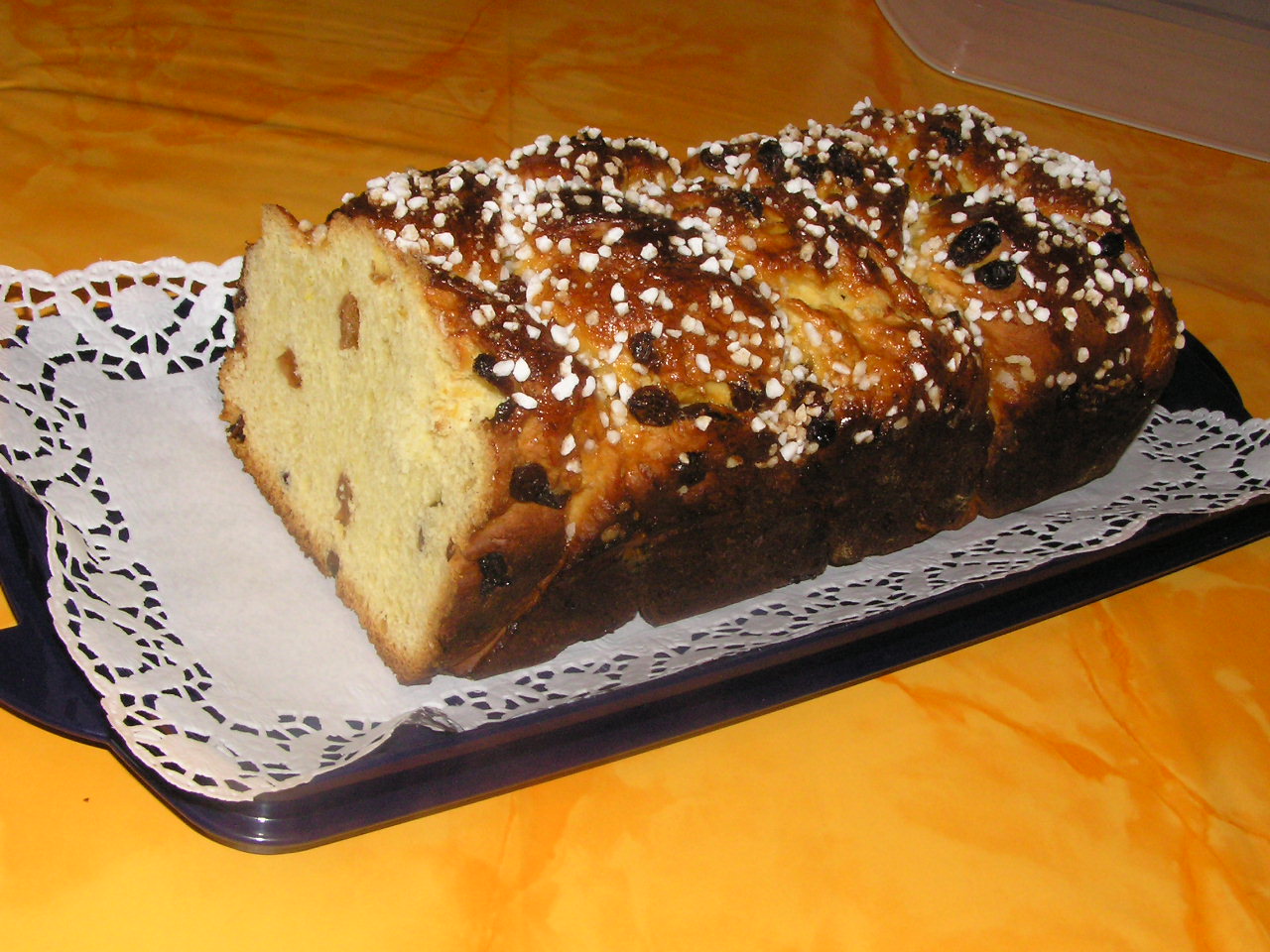
Cozonac
A sweet, enriched bread often filled with nuts or dried fruit, baked for Easter
Cozonac is a festive sweet bread from Romania, Bulgaria, Moldova, and North Macedonia, made with wheat flour, eggs, milk, butter, and sugar. It is often flavored with citrus zest, vanilla, or rum, and may include raisins or a swirl of walnut or poppy seed filling. Traditionally, it is prepared for Easter and other major holidays.
- Cozonac is a sweet bread baked for Easter in Romania, Bulgaria, and Moldova
- It is made with flour, eggs, milk, butter, sugar, and often citrus zest
- Fillings can include walnuts, poppy seeds, raisins, or cocoa
- A vegan version is made during Lent without eggs or milk
- The earliest known recipe dates to 1841 in Romania
What is Cozonac?
Cozonac is a rich, sweet bread made with a dough of wheat flour, eggs, milk, butter, and sugar. The dough is often scented with citrus peel, vanilla, or rum, and may be mixed with raisins or rolled around a filling of ground walnuts or poppy seeds. The bread is usually shaped into a loaf or braid, sometimes decorated, and baked until golden. Its texture is soft and slightly airy, with a delicate sweetness and a hint of the added flavors. Some versions are topped with poppy seeds or have a marbled swirl of cocoa or nuts inside.
Where does Cozonac come from?
Cozonac has roots in southeastern Europe, especially Romania and Bulgaria, and is closely linked to Easter and other holidays. The earliest known recipe appears in an 1841 Romanian cookbook, with later versions adding more ingredients and flavorings. The bread likely shares a family resemblance with Italian panettone, which influenced sweet breads in the region. In Bulgaria, cozonac became popular in the late 19th century, spreading through towns along the Danube. Over time, each country and region developed its own traditions and variations, making cozonac a symbol of celebration.
How is Cozonac made?
To make cozonac, wheat flour is combined with eggs, milk, butter, sugar, and yeast to form a soft, enriched dough. The dough is left to rise, then flavored with citrus zest, vanilla, or rum. Raisins or other dried fruits may be kneaded in, or the dough can be rolled out and spread with a filling of ground walnuts, poppy seeds, sugar, and sometimes cocoa or more dried fruit. The dough is then shaped, often braided or rolled, placed in a loaf pan, and baked until golden brown.


How and when is Cozonac eaten?
Cozonac is most often served during Easter and other festive times, but it can also be enjoyed as a treat with tea or coffee. In Romania and Moldova, it is baked during Holy Week, especially on Holy Thursday or Saturday. Slices are shared with family and guests, sometimes as part of a holiday breakfast or dessert. During Lent, a version without eggs or milk is made for those observing fasting traditions. The bread is eaten plain or with a spread, and its sweet, aromatic flavor makes it a favorite at gatherings.
Kinds of Cozonac
Regional versions of cozonac differ in both shape and filling. In Bulgaria, lemon zest is a common addition, while in North Macedonia, the bread may be braided and decorated, sometimes called milibrod. Romanian recipes vary by area, with some adding orange zest, hazelnuts, or rum. Some styles are filled generously with poppy seeds or walnuts, creating a swirl pattern inside. There is also a vegan version, called Cozonac de post, made without eggs or dairy for Lent.
What Cozonac means
Cozonac is a cherished part of holiday traditions in Romania, Bulgaria, Moldova, and North Macedonia. It is especially important at Easter, when families gather to bake and share the bread. The process of making cozonac is often a communal activity, passed down through generations. Its presence on the holiday table is seen as a sign of abundance and celebration. The bread is also recognized as a symbol of national and regional identity, with each community taking pride in its own style and recipe.
When Cozonac is on the table
Questions people ask about Cozonac
What is cozonac made of?
Cozonac is prepared from wheat flour, eggs, milk, butter, sugar, and yeast. It is often flavored with citrus peel, vanilla, or rum, and may include raisins or a filling of ground walnuts or poppy seeds.
Where does cozonac come from?
Cozonac is a traditional sweet bread from Romania, Bulgaria, Moldova, and North Macedonia, with roots in southeastern Europe. It has been part of holiday celebrations in these countries for generations.
When is cozonac usually eaten?
Cozonac is most commonly baked and eaten during Easter and other major holidays. In Romania and Moldova, it is prepared during Holy Week, while in Bulgaria and North Macedonia, it is also linked to Easter festivities.
Are there different types of cozonac?
Yes, cozonac varies by region and family tradition. Some versions are filled with walnuts or poppy seeds, while others include raisins, citrus zest, or cocoa. There is also a vegan version made for Lent.
Is cozonac always sweet?
Cozonac is a sweet bread by tradition, made with sugar and often enriched with dried fruit or sweet fillings. Its flavor is mild and aromatic, with a soft, tender crumb.
Good reading and sources
The facts on this page come from the Wikipedia article "Cozonac", written by its contributors and used under the CC BY-SA 4.0 licence, and from its Wikidata record (CC0). Thali rewrote the text in its own words, with AI assistance, and compares every page with the article to make sure no passage is copied. It may be reused under the same CC BY-SA 4.0 licence with a link back.
It may contain mistakes, and it is not dietary or allergy advice: recipes differ from cook to cook. If something is wrong, tell us. Last refreshed 2026-10-03.
More from Romania
All the food of Romania Turkish delightVegan
🇹🇷 Turkey and 5 moreSoft, chewy cubes of starch and sugar, often flavored or filled with nuts or fruit
Sweet or dessert, Snacks, Tea time
Pierogi
🇵🇱 Poland and 6 moreDumplings of unleavened dough filled with savory or sweet mixtures
Dumpling, Lunch, Dinner
Turkish delightVegan
🇹🇷 Turkey and 5 moreSoft, chewy cubes of starch and sugar, often flavored or filled with nuts or fruit
Sweet or dessert, Snacks, Tea time
Pierogi
🇵🇱 Poland and 6 moreDumplings of unleavened dough filled with savory or sweet mixtures
Dumpling, Lunch, Dinner
 Lángos
🇭🇺 Hungary and 5 moreHungarian deep-fried flatbread, often topped with cheese or sour cream
Bread, Breakfast, Snacks
Lángos
🇭🇺 Hungary and 5 moreHungarian deep-fried flatbread, often topped with cheese or sour cream
Bread, Breakfast, Snacks
Its cousins elsewhere
All sweets and desserts Eggnog
🇺🇸 United States and 5 moreA creamy, sweet drink of milk, eggs, sugar and spirits, served at Christmas
Drink, Snacks
Eggnog
🇺🇸 United States and 5 moreA creamy, sweet drink of milk, eggs, sugar and spirits, served at Christmas
Drink, Snacks
 Boortsog
🇰🇿 Kazakhstan and 5 moreGolden fried dough pieces from Central Asia and Mongolia, often served with tea or honey
Sweet or dessert, Snacks, Tea time
Boortsog
🇰🇿 Kazakhstan and 5 moreGolden fried dough pieces from Central Asia and Mongolia, often served with tea or honey
Sweet or dessert, Snacks, Tea time
 AnpanVegetarianあんパン
🇯🇵 JapanJapanese sweet roll filled with red bean paste or other fillings
Sweet or dessert, Snacks, Tea time
AnpanVegetarianあんパン
🇯🇵 JapanJapanese sweet roll filled with red bean paste or other fillings
Sweet or dessert, Snacks, Tea time
 Pan de muertoVegetarian
🇲🇽 Mexico and 1 moreSweet, decorated bread made for Mexico’s Day of the Dead
Sweet or dessert, Snacks, Tea time
Pan de muertoVegetarian
🇲🇽 Mexico and 1 moreSweet, decorated bread made for Mexico’s Day of the Dead
Sweet or dessert, Snacks, Tea time