
Kebab
In its own language: كَبَاب
Grilled or roasted meat, often on skewers, found across the Middle East and beyond
Kebab refers to a wide range of dishes featuring pieces or ground meat, usually grilled or roasted, and often cooked on skewers. Originating in the Middle East, kebabs are now found in many regions, with local variations using lamb, beef, chicken, fish, or even pork. They are typically served hot, sometimes with bread or rice, and can include vegetables or spices depending on the recipe.
- Kebab refers to many grilled or roasted meat dishes
- Traditionally made with lamb, but other meats are used
- Often cooked on skewers over a fire
- Served hot, with bread or rice
- Many regional versions exist across Asia and Europe
What is Kebab?
Kebab is a term for a variety of dishes centered on roasted or grilled meat. The meat may be cut into chunks or minced, and is often cooked on skewers over an open flame, though some types are baked or stewed. Lamb is the most common traditional meat, but beef, chicken, goat, fish, and even pork can be used depending on local customs and religious rules. Kebabs may include vegetables or be served with accompaniments like bread or rice. The flavor and appearance vary widely: some are spiced and juicy, others are simple grilled cubes, and some are mixed with herbs or onions.
Where does Kebab come from?
The word 'kebab' traces back to ancient languages, with roots in Arabic, Persian, and Turkish, all meaning roasted or burned meat. Early references appear in Middle Eastern and Persian texts, including a 10th-century Baghdadi cookbook. The dish spread widely with the influence of Muslim cultures, appearing in royal courts and everyday meals from Persia to India. Over centuries, kebab became a staple in many regions, each adapting it to local tastes and ingredients. Its history is closely tied to the development of grilling and roasting techniques across West and Central Asia.
How is Kebab made?
To make kebab, meat is either cut into pieces or ground and mixed with spices, onions, and sometimes herbs. The mixture or pieces are shaped onto skewers or formed into patties. Traditionally, kebabs are cooked over a charcoal fire, which gives them a distinct smoky flavor, but they can also be baked or pan-cooked. Some versions are marinated beforehand in mixtures of oil, lemon, or yogurt with spices. In Iran, kebabs are often served with rice and grilled tomatoes, while in other regions they might be wrapped in bread or served with salads and sauces.


How and when is Kebab eaten?
Kebabs are usually eaten hot, as a main course for lunch or dinner. In many countries, they are a popular street food, served with bread such as pita or lavash, or alongside rice. Accompaniments can include grilled vegetables, fresh herbs, onions, and sometimes yogurt-based sauces. In Iran, it is common to eat kebab with rice and a sprinkle of sumac, and sometimes with a raw egg yolk on top. The setting can range from casual street stalls to formal restaurants, and kebabs are enjoyed both as everyday fare and at gatherings.
Kinds of Kebab
There are many regional types of kebab. In Iran, varieties include koobideh (minced meat), barg (sliced meat), and jujeh (chicken). In Greece, similar dishes are called souvlaki or gyros, often made with pork or chicken. In China, the Uyghur chuan uses lamb or other meats with spices like cumin. The Levant features shish taouk (marinated chicken) and lahem meshwi (lamb cubes). Each region adapts the kebab to local tastes, meats, and available spices, resulting in a wide diversity of flavors and forms.
What Kebab means
Kebab has become a symbol of shared culinary heritage across the Middle East, Central Asia, and beyond. It is a common feature at social gatherings, family meals, and street markets. In Iran, chelow kabab is considered a national dish. In Greece and Germany, kebab-style sandwiches have become popular fast food. The dish reflects local customs, religious dietary laws, and historical influences, and continues to evolve as it spreads to new regions.
Questions people ask about Kebab
What is kebab made of?
Kebab is usually made from meat such as lamb, beef, chicken, goat, fish, or pork. It can be cut into pieces or ground, often mixed with onions, spices, and sometimes herbs. Some versions include vegetables or are served with bread or rice.
Where does kebab come from?
Kebab originated in the Middle East, with early references in Persian and Arabic texts. It spread across West and Central Asia, and is now found in many countries, each with its own local variations.
How is kebab cooked?
Most kebabs are grilled or roasted, often on skewers over an open flame or charcoal. Some types are baked in an oven or prepared as a stew. The cooking method depends on the specific regional style.
What are common accompaniments for kebab?
Kebabs are often served with bread such as pita or lavash, or with rice. They may come with grilled vegetables, onions, fresh herbs, and sauces like yogurt or sumac, depending on the region.
Are there vegetarian kebabs?
Traditional kebabs are made with meat, but some modern or regional versions may use vegetables or plant-based ingredients. However, the classic kebab is a meat dish.
Good reading and sources
- Encyclopaedia BritannicaArticle
- Peanut butter and satay sauceThe Guardian, Recipe
- Doner kebab 'inventor' Kadir Nurman dies in BerlinBBC, Article
The facts on this page come from the Wikipedia article "Kebab", written by its contributors and used under the CC BY-SA 4.0 licence, and from its Wikidata record (CC0). Thali rewrote the text in its own words, with AI assistance, and compares every page with the article to make sure no passage is copied. It may be reused under the same CC BY-SA 4.0 licence with a link back.
It may contain mistakes, and it is not dietary or allergy advice: recipes differ from cook to cook. If something is wrong, tell us. Last refreshed 2026-10-03.
More from Turkey
All the food of Turkey Pilaf
🇺🇿 Uzbekistan and 5 moreRice cooked in stock with spices, meat or vegetables, with each grain kept separate
Main dish, Lunch, Dinner
Pilaf
🇺🇿 Uzbekistan and 5 moreRice cooked in stock with spices, meat or vegetables, with each grain kept separate
Main dish, Lunch, Dinner
 Moussakaμουσακάς
🇬🇷 Greece and 5 moreBaked casserole of eggplant or potato, often layered with meat and sauce
Main dish, Lunch, Dinner
Moussakaμουσακάς
🇬🇷 Greece and 5 moreBaked casserole of eggplant or potato, often layered with meat and sauce
Main dish, Lunch, Dinner
 Freekehفريكة
🇵🇸 Palestine and 5 moreRoasted green durum wheat grains, a staple across the eastern Mediterranean
Main dish, Lunch, Dinner
Freekehفريكة
🇵🇸 Palestine and 5 moreRoasted green durum wheat grains, a staple across the eastern Mediterranean
Main dish, Lunch, Dinner
 MeatballMeat
🇮🇹 Italy and 5 moreGround meat shaped into balls and cooked by frying, baking, or braising in sauce
Main dish, Lunch, Dinner
MeatballMeat
🇮🇹 Italy and 5 moreGround meat shaped into balls and cooked by frying, baking, or braising in sauce
Main dish, Lunch, Dinner
Its cousins elsewhere
All main dishes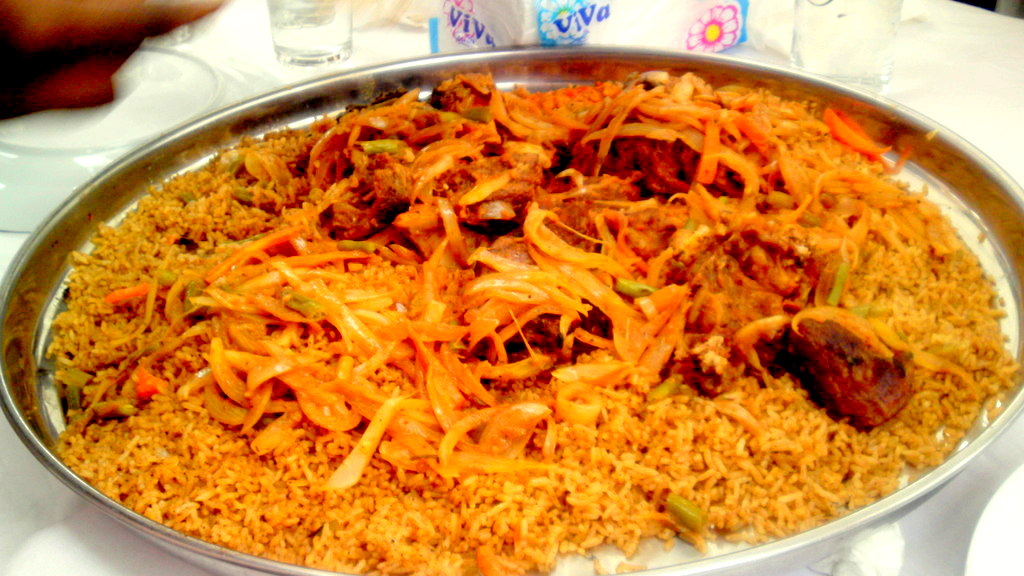 Riz grasMeat
🇧🇫 Burkina Faso and 4 moreWest African rice cooked with meat and vegetables, served hot
Main dish, Lunch, Dinner
Riz grasMeat
🇧🇫 Burkina Faso and 4 moreWest African rice cooked with meat and vegetables, served hot
Main dish, Lunch, Dinner
 Cabbage roll
🇺🇦 Ukraine and 5 moreCooked cabbage leaves wrapped around seasoned fillings, simmered or baked
Main dish, Lunch, Dinner
Cabbage roll
🇺🇦 Ukraine and 5 moreCooked cabbage leaves wrapped around seasoned fillings, simmered or baked
Main dish, Lunch, Dinner
 SouvlakiMeatσουβλάκι
🇬🇷 Greece and 1 moreGrilled meat skewers, often served in pita with salad and sauce
Main dish, Lunch, Dinner
SouvlakiMeatσουβλάκι
🇬🇷 Greece and 1 moreGrilled meat skewers, often served in pita with salad and sauce
Main dish, Lunch, Dinner