
Cabbage roll
Cooked cabbage leaves wrapped around seasoned fillings, simmered or baked
Cabbage rolls are cooked cabbage leaves filled with a mixture of meat, grains, and vegetables, then simmered or baked. Found across Central, Eastern, and Southeastern Europe and parts of Asia and North Africa, they are made with ingredients like beef, pork, rice, mushrooms, and onions. Sauces and fillings vary by region and occasion.
- Cabbage rolls are made by wrapping cooked cabbage leaves around seasoned fillings
- Popular in Central, Eastern, and Southeastern Europe, and parts of Asia
- Fillings can include meat, rice, mushrooms, and vegetables
- Sauces range from tomato-based to sour cream or lingonberry jam
- Ukrainian holubtsi are listed as intangible cultural heritage
What is Cabbage roll?
A cabbage roll is made by wrapping cooked cabbage leaves around a filling, which often includes minced meat such as beef, pork, or lamb, mixed with grains like rice or barley, onions, mushrooms, and spices. The rolls are usually simmered, baked, or steamed, and served hot, often with a sauce. Tomato-based sauces and sour cream are common in Eastern Europe, while lingonberry jam is served in Sweden and Finland. The rolls can be large or small, and the fillings and sauces change with local tastes and available ingredients.
Where does Cabbage roll come from?
The exact origin of the cabbage roll is unclear, with several Central and Eastern European cultures claiming it. It likely emerged in regions where cabbage was widely grown, as a way to stretch meat and grains. The dish has deep roots in the food traditions of countries like Ukraine, Poland, Hungary, and Romania, and has been adapted in Western Asia, China, and North Africa. Jewish communities have their own version, holishkes, eaten on Simchat Torah. Over time, cabbage rolls became a symbol of comfort and tradition in many cultures.
How is Cabbage roll made?
To make cabbage rolls, cabbage leaves are first softened by boiling or fermenting. A filling is prepared by mixing minced meat, grains (such as rice or barley), onions, mushrooms, and seasonings. The filling is placed on each leaf, which is then rolled up and tucked in. The rolls are arranged in a pot or baking dish, sometimes layered with bacon or smoked meats, and cooked slowly with a sauce—often tomato-based, but sometimes with broth or sour cream. Vegetarian versions use beans, grains, or mushrooms instead of meat.


How and when is Cabbage roll eaten?
Cabbage rolls are typically served hot for lunch or dinner. In many countries, they are a festive dish for holidays like Christmas and New Year's Eve, as well as weddings and religious celebrations. They may be accompanied by sides such as polenta, sour cream, pickled peppers, or lingonberry jam, depending on the region. In Jewish tradition, holishkes are served on Simchat Torah. The dish is enjoyed both as an everyday meal and as part of special feasts.
Kinds of Cabbage roll
Regional versions differ in fillings, sauces, and even the leaves used. In Armenia, vegetarian fillings with beans and grains are common. In the Balkans, brined cabbage leaves and smoked meats are popular. Polish gołąbki and Ukrainian holubtsi may use barley or buckwheat in place of rice. In China and Japan, seafood, tofu, and shiitake mushrooms appear in the filling, and Chinese cabbage is often used. Some places make 'lazy' versions by mixing chopped cabbage with the filling and baking it as a casserole.
What Cabbage roll means
Cabbage rolls hold a special place in the food culture of many countries, symbolizing home cooking and family gatherings. In Hungary, they are called the 'coat of arms of Hungary,' reflecting their national importance. In Ukraine, holubtsi are part of the twelve traditional dishes for Christmas Eve. Jewish communities prepare holishkes for Simchat Torah. The dish is recognized as part of Ukraine's intangible cultural heritage. It often appears in literature and film as a symbol of tradition and comfort.
When Cabbage roll is on the table
Questions people ask about Cabbage roll
What are cabbage rolls made of?
Cabbage rolls are made from cooked cabbage leaves wrapped around a filling that often includes minced meat (such as beef, pork, or lamb), rice or barley, onions, mushrooms, and spices. Vegetarian versions may use beans or grains instead of meat.
Where do cabbage rolls come from?
Cabbage rolls are traditional in Central, Eastern, and Southeastern Europe, with roots in countries like Ukraine, Poland, Hungary, and Romania. They are also found in parts of Asia and North Africa.
How are cabbage rolls cooked?
After wrapping the filling in cabbage leaves, the rolls are simmered, baked, or steamed, often in a sauce. The sauce can be tomato-based, sour cream, broth, or even a sweet-and-sour mix, depending on the region.
Are there vegetarian cabbage rolls?
Yes, vegetarian versions exist, especially in Armenia and during religious fasting periods. These may be filled with beans, lentils, grains, mushrooms, and vegetables instead of meat.
When are cabbage rolls eaten?
Cabbage rolls are eaten both as everyday food and for special occasions like Christmas, New Year's Eve, weddings, and religious holidays such as Simchat Torah in Jewish tradition.
Good reading and sources
- A weeknight dinner fit for royaltyBBC, Article
- ‘This Is the War Version’: How Gazans Are Observing Ramadan This YearEater, Article
The facts on this page come from the Wikipedia article "Cabbage roll", written by its contributors and used under the CC BY-SA 4.0 licence, and from its Wikidata record (CC0). Thali rewrote the text in its own words, with AI assistance, and compares every page with the article to make sure no passage is copied. It may be reused under the same CC BY-SA 4.0 licence with a link back.
It may contain mistakes, and it is not dietary or allergy advice: recipes differ from cook to cook. If something is wrong, tell us. Last refreshed 2026-10-03.
More from Ukraine
All the food of Ukraine Pâté
🇫🇷 France and 5 moreA smooth or coarse spread made from minced meat, liver, or vegetables
Sauce, pickle or ferment
Pâté
🇫🇷 France and 5 moreA smooth or coarse spread made from minced meat, liver, or vegetables
Sauce, pickle or ferment
 BigosMeat
🇵🇱 Poland and 5 morePolish stew of mixed meats, sauerkraut and cabbage, simmered with spices
Stew or curry, Breakfast, Dinner
BigosMeat
🇵🇱 Poland and 5 morePolish stew of mixed meats, sauerkraut and cabbage, simmered with spices
Stew or curry, Breakfast, Dinner
 Potato pancakeVegetarian
🇧🇾 Belarus and 5 moreShallow-fried pancakes made from grated or mashed potato, common across Europe
Main dish, Lunch, Dinner
Pierogi
🇵🇱 Poland and 6 moreDumplings of unleavened dough filled with savory or sweet mixtures
Dumpling, Lunch, Dinner
Potato pancakeVegetarian
🇧🇾 Belarus and 5 moreShallow-fried pancakes made from grated or mashed potato, common across Europe
Main dish, Lunch, Dinner
Pierogi
🇵🇱 Poland and 6 moreDumplings of unleavened dough filled with savory or sweet mixtures
Dumpling, Lunch, Dinner
Its cousins elsewhere
All main dishes Kebabكَبَاب
🇹🇷 Turkey and 5 moreGrilled or roasted meat, often on skewers, found across the Middle East and beyond
Main dish, Lunch, Dinner
Kebabكَبَاب
🇹🇷 Turkey and 5 moreGrilled or roasted meat, often on skewers, found across the Middle East and beyond
Main dish, Lunch, Dinner
 Biryani
🇮🇳 India and 5 moreRice and spiced meat or vegetables layered and cooked together
Main dish, Lunch, Dinner
Biryani
🇮🇳 India and 5 moreRice and spiced meat or vegetables layered and cooked together
Main dish, Lunch, Dinner
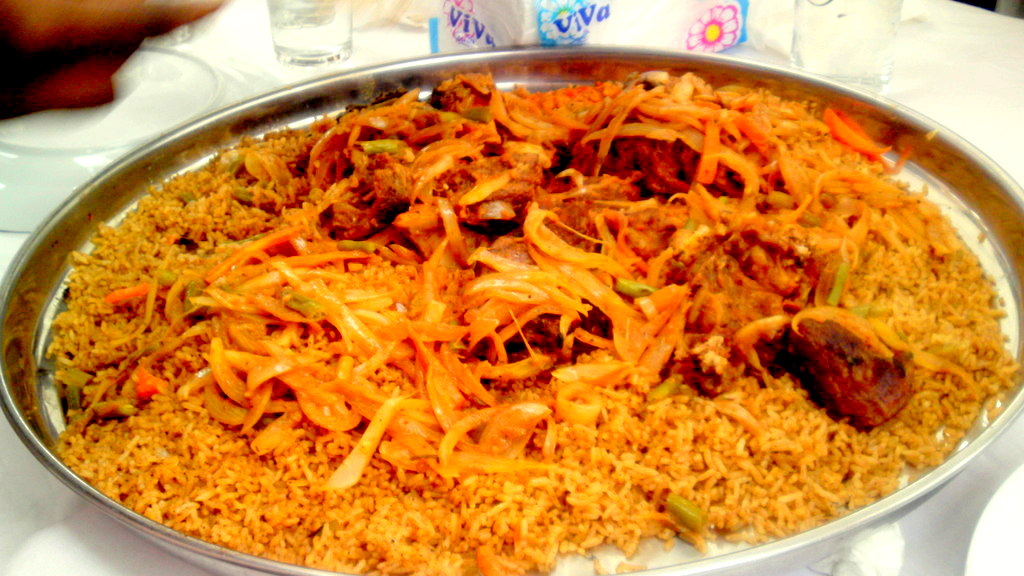 Riz grasMeat
🇧🇫 Burkina Faso and 4 moreWest African rice cooked with meat and vegetables, served hot
Main dish, Lunch, Dinner
Wat
🇪🇹 Ethiopia and 1 moreEthiopian and Eritrean stew thickened with onions and spiced butter
Stew or curry, Lunch, Dinner
Riz grasMeat
🇧🇫 Burkina Faso and 4 moreWest African rice cooked with meat and vegetables, served hot
Main dish, Lunch, Dinner
Wat
🇪🇹 Ethiopia and 1 moreEthiopian and Eritrean stew thickened with onions and spiced butter
Stew or curry, Lunch, Dinner