
Kushikatsu
In its own language: 串カツ
Deep-fried skewers of meat, seafood, and vegetables from Japan
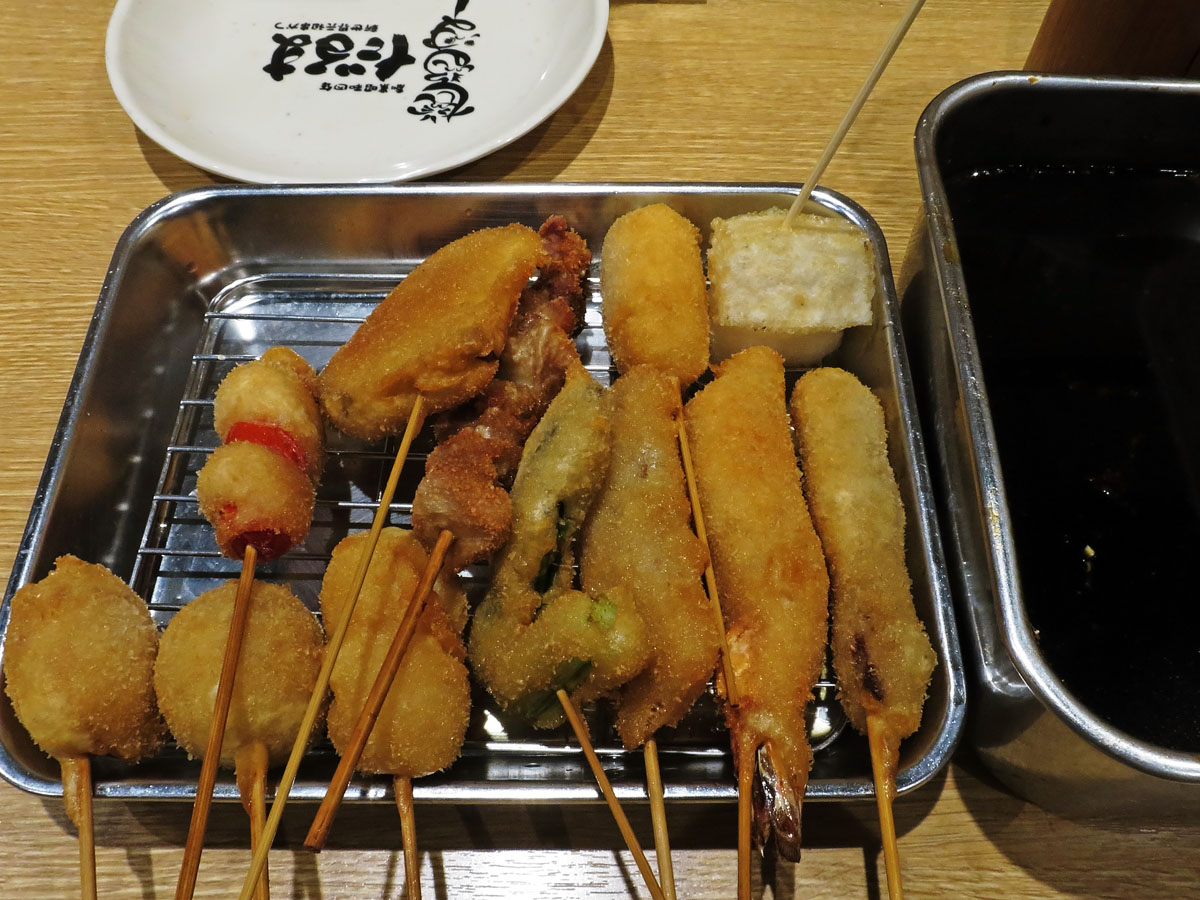
Kushikatsu is a Japanese dish of skewered meat, seafood, and vegetables, coated in batter and panko, then deep-fried. Originating in Osaka, it is eaten as a snack or meal and served with dipping sauces. The dish is popular in many regions of Japan, each with its own style and ingredients.
- Originated in Osaka in the late 1920s
- Made with meat, seafood, or vegetables on bamboo skewers
- Coated in flour, egg, and panko before deep-frying
- Served with communal dipping sauce and special etiquette
- Known as kushiage in some regions
What is Kushikatsu?
Kushikatsu is a Japanese dish made by threading pieces of meat, seafood, or vegetables onto bamboo skewers. Each skewer is coated in flour, dipped in egg, rolled in panko breadcrumbs, and deep-fried in oil until crisp. The fillings can range from chicken, pork, and beef to prawn, squid, and a variety of vegetables like onion, eggplant, and lotus root. Some versions use prepared foods such as cheese, dumplings, or mochi. The result is a golden, crunchy skewer that is served with dipping sauces, often brown and tangy.
Where does Kushikatsu come from?
Kushikatsu began in Osaka, where it was first served in the Shinsekai neighborhood at small food bars around 1929. The dish was created as a filling, affordable meal for workers, using skewered and deep-fried meat. Over time, kushikatsu spread to other parts of Osaka and then across Japan, with each region developing its own approach. In Osaka, the skewers are usually smaller and served in larger numbers, while Tokyo and Nagoya have their own styles and sauces.
How is Kushikatsu made?
To make kushikatsu, pieces of meat, seafood, or vegetables are skewered on bamboo sticks. These are coated in seasoned flour, dipped in egg, and covered with panko breadcrumbs. The skewers are then deep-fried in vegetable oil until golden and crisp. In Osaka, batter flour mixes may be used, while Tokyo often uses fresh egg and flour. Some restaurants offer a fondue-style experience, where diners fry their own skewers at the table.

![味噌 カツ 屋( 東京 ・ 港区 銀座 4-10-14、 東銀座駅 最寄りの「みそかつ 矢場とん 」 [1] )](https://thumb.wikimedia.org/wikipedia/commons/thumb/9/9f/Miso_katsu_restaurant_by_orangeobject_in_Ginza%2C_Tokyo.jpg/960px-Miso_katsu_restaurant_by_orangeobject_in_Ginza%2C_Tokyo.jpg)
How and when is Kushikatsu eaten?
Kushikatsu is eaten as a casual meal or snack, often in specialized restaurants or food bars. It is commonly served with a communal pot of dipping sauce. Good manners require not dipping a skewer back into the sauce after taking a bite; instead, diners may use cabbage leaves to pour sauce over the food. It is enjoyed at lunch, dinner, or as a snack, and is popular for sharing with friends or family.
Kinds of Kushikatsu
Osaka-style kushikatsu features single ingredients per skewer and a wide range of fillings, including pickled ginger and sausage. Tokyo-style uses pork and onion together on a skewer, with a sweeter brown sauce. Nagoya offers kushikatsu with a miso-based sauce called miso katsu, sometimes served alongside doteni, a local beef stew. Other regions may serve kushikatsu with different sauces, such as soy, sesame oil, or mayonnaise.
What Kushikatsu means
Kushikatsu is a symbol of Osaka’s food culture and is widely enjoyed across Japan. The dish has inspired etiquette rules, such as not double-dipping in communal sauce, and some restaurants provide instructions for visitors. Kushikatsu appears in popular culture, including children’s songs and TV programs. High-end and chain restaurants offer their own takes, and the dish remains a staple of Japanese street food.
Questions people ask about Kushikatsu
What is kushikatsu made of?
Kushikatsu is made by skewering pieces of meat, seafood, or vegetables, coating them in flour, egg, and panko breadcrumbs, and deep-frying them in oil. Common ingredients include chicken, pork, prawn, and seasonal vegetables.
Where does kushikatsu come from?
Kushikatsu originated in Osaka, Japan, in the Shinsekai neighborhood. It was first served in small food bars in the late 1920s and later spread across Japan.
How is kushikatsu eaten?
Kushikatsu is eaten by dipping the freshly fried skewers into a communal pot of sauce. It is considered bad manners to dip a skewer back into the sauce after biting it, so cabbage leaves are sometimes used to pour extra sauce.
Are there different types of kushikatsu?
Yes, regional variations exist. Osaka-style uses single ingredients per skewer, Tokyo-style often combines pork and onion, and Nagoya serves it with a miso-based sauce called miso katsu.
Is kushikatsu vegetarian or does it contain meat?
Kushikatsu varies: it can be made with meat, seafood, or vegetables. Some skewers are vegetarian, while others contain chicken, pork, or fish.
Good reading and sources
The facts on this page come from the Wikipedia article "Kushikatsu", written by its contributors and used under the CC BY-SA 4.0 licence, and from its Wikidata record (CC0). Thali rewrote the text in its own words, with AI assistance, and compares every page with the article to make sure no passage is copied. It may be reused under the same CC BY-SA 4.0 licence with a link back.
It may contain mistakes, and it is not dietary or allergy advice: recipes differ from cook to cook. If something is wrong, tell us. Last refreshed 2026-10-03.
More from Japan
All the food of Japan Pizza
🇮🇹 Italy and 4 moreFlatbread topped with tomato, cheese and baked at high heat
Main dish, Lunch, Dinner
Pizza
🇮🇹 Italy and 4 moreFlatbread topped with tomato, cheese and baked at high heat
Main dish, Lunch, Dinner
 Sushi寿司
🇯🇵 JapanVinegared rice paired with seafood, vegetables or other toppings
Main dish, Lunch, Dinner
TofuVegan豆腐
🇨🇳 China and 5 moreSoft white blocks made by curdling soy milk and pressing the curds
Main dish
Sushi寿司
🇯🇵 JapanVinegared rice paired with seafood, vegetables or other toppings
Main dish, Lunch, Dinner
TofuVegan豆腐
🇨🇳 China and 5 moreSoft white blocks made by curdling soy milk and pressing the curds
Main dish
 Sashimi刺身
🇯🇵 JapanThin slices of raw fish or meat, served with soy sauce and condiments
Main dish, Lunch, Dinner
Sashimi刺身
🇯🇵 JapanThin slices of raw fish or meat, served with soy sauce and condiments
Main dish, Lunch, Dinner
Its cousins elsewhere
All street food Empanada
🇪🇸 Spain and 5 morePastry turnovers filled with meat, cheese, or vegetables, baked or fried
Pie or savoury pastry, Lunch, Dinner
Empanada
🇪🇸 Spain and 5 morePastry turnovers filled with meat, cheese, or vegetables, baked or fried
Pie or savoury pastry, Lunch, Dinner
 Potato pancakeVegetarian
🇧🇾 Belarus and 5 moreShallow-fried pancakes made from grated or mashed potato, common across Europe
Main dish, Lunch, Dinner
Potato pancakeVegetarian
🇧🇾 Belarus and 5 moreShallow-fried pancakes made from grated or mashed potato, common across Europe
Main dish, Lunch, Dinner
 Migas
🇪🇸 Spain and 2 moreA dish of leftover bread or tortillas, cooked with savoury ingredients
Main dish, Breakfast, Lunch
Migas
🇪🇸 Spain and 2 moreA dish of leftover bread or tortillas, cooked with savoury ingredients
Main dish, Breakfast, Lunch
 Salteña
🇧🇴 Bolivia and 1 moreBolivian baked empanada with a juicy, mildly spicy filling
Pie or savoury pastry, Breakfast, Snacks
Salteña
🇧🇴 Bolivia and 1 moreBolivian baked empanada with a juicy, mildly spicy filling
Pie or savoury pastry, Breakfast, Snacks