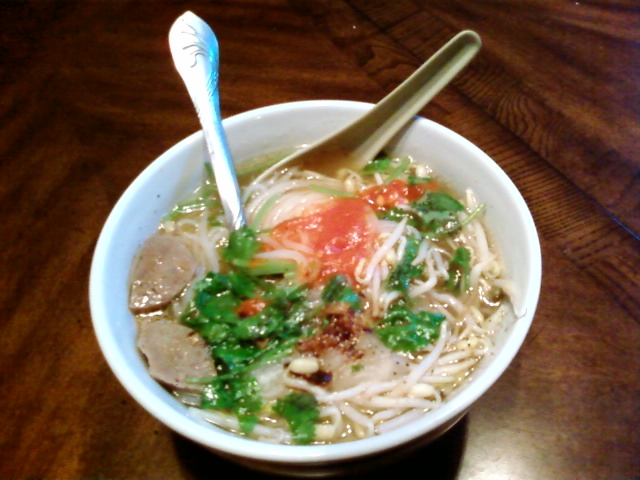
Kuy teav
In its own language: គុយទាវ
Cambodian noodle soup with rice noodles, pork broth and fresh garnishes
Kuy teav is a noodle soup from Cambodia made with rice noodles in a clear pork broth, topped with a mix of meats and fresh herbs. Eaten mainly for breakfast, it is found at street stalls and restaurants across the country, with diners customising each bowl using a range of garnishes and condiments.
- Most popular as a breakfast dish in Cambodia
- Served with a tray of fresh herbs and condiments
- Phnom Penh style features extra toppings like pork offal and shrimp
- Diners customise each bowl to taste at the table
What is Kuy teav?
Kuy teav is a noodle soup from Cambodia, built around thin rice noodles and a clear pork broth. The bowl is topped with a mix of meats—often pork in various forms, sometimes duck, seafood or offal—depending on what is available. The soup is finished with fresh herbs, lettuce, bean sprouts, and a squeeze of lime. At the table, diners add their own choice of condiments and garnishes, such as caramelised garlic oil, black pepper, and chilli, making each bowl unique.
Where does Kuy teav come from?
The name kuy teav comes from a Teochew Chinese word for rice noodles, reflecting the dish’s Chinese roots. Over time, it became a staple in Cambodia, especially as a morning meal. Its closest relatives are found in neighbouring countries, where similar noodle soups go by names like hủ tiếu in Vietnam and kway teow in Malaysia and Singapore. The Phnom Penh version is known for its extra variety of toppings, a nod to the city’s historical wealth.
How is Kuy teav made?
To make kuy teav, thin rice noodles are briefly boiled, then drained and placed in a bowl. They are dressed with garlic oil and a sauce of oyster sauce, soy sauce, and sugar. A clear broth, simmered from pork bones, dried squid, and sugar, is poured over the noodles and seasoned with fish sauce. Toppings can include ground pork, sliced pork, pork belly, offal, and sometimes shrimp or duck. The dish is finished with fresh herbs and vegetables, with condiments provided for diners to adjust the flavour.

How and when is Kuy teav eaten?
Kuy teav is most often eaten for breakfast in Cambodia, though it can also be found at lunch or dinner. It is sold by street vendors, in markets, and at restaurants. The soup is usually served with a tray of garnishes and condiments, allowing each person to add herbs, lime, pepper, chilli, or sauces to taste. Some people enjoy it with deep-fried breadsticks, similar to those eaten with rice porridge.
Kinds of Kuy teav
There are two main ways to serve kuy teav: with all ingredients in the soup, or with the broth on the side, making it more like a noodle salad. The Phnom Penh style is the most elaborate, with a range of pork cuts, offal, and sometimes seafood. Simpler versions may use just ground pork and dried shrimp. The choice of toppings often depends on what is available locally.
What Kuy teav means
Kuy teav is woven into Cambodian daily life, especially as a breakfast food. It is a common sight at markets and roadside stalls, where it is often sold out before midday. The custom of adding one’s own garnishes and condiments is central to the dish, reflecting the importance of personal taste in Cambodian cuisine. Kuy teav is also linked to similar noodle soups across Southeast Asia, showing the influence of Chinese migration in the region.
Questions people ask about Kuy teav
What is kuy teav made of?
Kuy teav is made from thin rice noodles served in a clear pork broth, topped with various meats such as pork, duck, seafood or offal, and finished with fresh herbs, lettuce, bean sprouts, and lime. Diners add condiments like garlic oil, pepper, and chilli to taste.
Where does kuy teav come from?
Kuy teav comes from Cambodia, where it is a staple breakfast dish. Its name and style reflect Chinese influence, and similar noodle soups are found in neighbouring Southeast Asian countries.
How is kuy teav usually served?
Kuy teav is served either with all ingredients in the soup or with the broth on the side. It comes with a tray of garnishes and condiments so each person can adjust the flavours to their liking.
When do people eat kuy teav?
It is most commonly eaten for breakfast in Cambodia, but can also be found at lunch or dinner. Street vendors and restaurants often sell out by midday.
What are the main ingredients in kuy teav?
The main ingredients are rice noodles, pork stock, garlic oil, oyster sauce, soy sauce, sugar, fish sauce, pork, fresh herbs, and lime. Toppings can vary depending on availability.
Good reading and sources
The facts on this page come from the Wikipedia article "Kuyteav", written by its contributors and used under the CC BY-SA 4.0 licence, and from its Wikidata record (CC0). Thali rewrote the text in its own words, with AI assistance, and compares every page with the article to make sure no passage is copied. It may be reused under the same CC BY-SA 4.0 licence with a link back.
It may contain mistakes, and it is not dietary or allergy advice: recipes differ from cook to cook. If something is wrong, tell us. Last refreshed 2026-10-03.
More from Cambodia
All the food of Cambodia Hot pot火鍋
🇨🇳 China and 5 moreSimmering broth at the table for cooking meats, vegetables and more as you eat
Main dish, Dinner, Lunch
Hot pot火鍋
🇨🇳 China and 5 moreSimmering broth at the table for cooking meats, vegetables and more as you eat
Main dish, Dinner, Lunch
 Hot and sour soup酸辣汤
🇨🇳 China and 5 moreA tangy, spicy soup with flexible ingredients, first made in China
Soup
Hot and sour soup酸辣汤
🇨🇳 China and 5 moreA tangy, spicy soup with flexible ingredients, first made in China
Soup
 Buddha Jumps Over the WallMeat佛跳牆
🇨🇳 China and 4 moreA lavish Fujian soup with seafood, meat and rare delicacies
Soup, Dinner
Buddha Jumps Over the WallMeat佛跳牆
🇨🇳 China and 4 moreA lavish Fujian soup with seafood, meat and rare delicacies
Soup, Dinner
 Num banhchokFish or seafoodនំបញ្ចុក
🇰🇭 CambodiaLightly fermented rice noodles served with fish-based sauces and fresh herbs
Noodle or pasta dish, Breakfast, Lunch
Num banhchokFish or seafoodនំបញ្ចុក
🇰🇭 CambodiaLightly fermented rice noodles served with fish-based sauces and fresh herbs
Noodle or pasta dish, Breakfast, Lunch
Its cousins elsewhere
All soups Pea soup
🇸🇪 Sweden and 5 moreA thick, hearty soup made from dried peas, found in many world cuisines
Soup, Lunch, Dinner
Pea soup
🇸🇪 Sweden and 5 moreA thick, hearty soup made from dried peas, found in many world cuisines
Soup, Lunch, Dinner
 Pozole
🇲🇽 Mexico and 1 moreMexican hominy soup with meat and a range of fresh toppings
Soup, Lunch, Dinner
Pozole
🇲🇽 Mexico and 1 moreMexican hominy soup with meat and a range of fresh toppings
Soup, Lunch, Dinner
 Chicken soupMeat
🇺🇸 United States and 4 moreA hot soup of chicken simmered with vegetables, noodles or grains
Soup, Lunch, Dinner
Chicken soupMeat
🇺🇸 United States and 4 moreA hot soup of chicken simmered with vegetables, noodles or grains
Soup, Lunch, Dinner
 Hariraالحريرة
🇲🇦 Morocco and 3 moreNorth African soup of tomato, legumes, herbs and spices, often served during Ramadan
Soup, Dinner, Supper
Hariraالحريرة
🇲🇦 Morocco and 3 moreNorth African soup of tomato, legumes, herbs and spices, often served during Ramadan
Soup, Dinner, Supper