
Lagana
In its own language: λαγάνα
Greek flatbread topped with sesame seeds, baked for Clean Monday
Lagana is a flat, oval bread from Greece, made especially for Clean Monday, the start of Lent. It is often sprinkled with sesame seeds and sometimes herbs, and seasoned with olive oil. While it was once always unleavened, most lagana today is made with yeast.
- Baked especially for Clean Monday, the first day of Greek Lent
- Traditionally unleavened, but now often made with yeast
- Topped with sesame seeds and sometimes herbs
- Name comes from ancient Greco-Roman laganon dough
What is Lagana?
Lagana is a Greek flatbread, usually oval and quite flat, with a soft but chewy texture. Its surface is often marked by fingertip impressions and scattered with sesame seeds, which add a nutty aroma and gentle crunch. Olive oil is sometimes brushed on top, and herbs may be sprinkled for extra flavor. Traditionally, lagana was made without yeast, but most versions today use a leavening agent, making the bread lighter. It is closely linked to Greek Orthodox customs and is especially prepared for Clean Monday, marking the start of Lent.
Where does Lagana come from?
The bread’s name, lagana, comes from an ancient Greco-Roman dough called laganon, which is also the root of the word 'lasagna.' While it was originally an unleavened bread, reflecting the fasting traditions of Lent, leavened versions have become common in modern times. Lagana has long been associated with Clean Monday, the first day of Great Lent in Greece, and its preparation is a custom that has survived for centuries.
How is Lagana made?
Lagana is made by mixing wheat flour with water and, in modern recipes, yeast. The dough is shaped into a flat, oval form and pressed with fingertips to create small indentations. Before baking, the surface is sprinkled generously with sesame seeds. Sometimes, olive oil is brushed on top, and herbs may be added. The bread is then baked until it develops a golden crust and a soft, airy crumb.
How and when is Lagana eaten?
Lagana is eaten on Clean Monday, which is the first day of Lent in the Greek Orthodox calendar. It is often served as part of a meal that avoids animal products, in keeping with fasting rules. People enjoy it with olives, pickled vegetables, and other simple, plant-based foods. The bread is usually shared among family and friends during gatherings that mark the beginning of the Lenten season.
Kinds of Lagana
While the classic lagana is topped with sesame seeds, some versions include other herbs for extra flavor. The bread may be made with or without yeast, depending on tradition or preference. In recent times, leavened lagana has become more popular, resulting in a lighter texture. Regional differences may appear in the choice of toppings or the thickness of the bread.
What Lagana means
Lagana holds a special place in Greek culture as the bread of Clean Monday, a day of outdoor gatherings and picnics that marks the start of Lent. Its preparation and sharing are part of religious observance for Greek Orthodox Christians. The bread’s ancient roots connect modern Greek customs with the traditions of the classical world, and its annual appearance signals a time of reflection and community.
When Lagana is on the table
Questions people ask about Lagana
What is lagana made of?
Lagana is made from wheat flour, water, and usually yeast, then topped with sesame seeds. Olive oil and herbs may also be added for extra flavor.
Where does lagana come from?
Lagana comes from Greece and is especially associated with Clean Monday, the first day of Lent in the Greek Orthodox tradition.
Is lagana always unleavened?
Traditionally, lagana was made without yeast, making it unleavened. However, most lagana today is leavened, meaning yeast is used to make the bread rise.
When is lagana eaten?
Lagana is eaten on Clean Monday, which marks the start of Great Lent in Greece. It is part of the traditional meal for this religious occasion.
What does lagana taste like?
Lagana has a soft, chewy texture with a nutty flavor from the sesame seeds. Olive oil and herbs, when used, add extra aroma and taste.
Good reading and sources
The facts on this page come from the Wikipedia article "Lagana (bread)", written by its contributors and used under the CC BY-SA 4.0 licence, and from its Wikidata record (CC0). Thali rewrote the text in its own words, with AI assistance, and compares every page with the article to make sure no passage is copied. It may be reused under the same CC BY-SA 4.0 licence with a link back.
It may contain mistakes, and it is not dietary or allergy advice: recipes differ from cook to cook. If something is wrong, tell us. Last refreshed 2026-10-03.
More from Greece
All the food of Greece PitaVegan
🇪🇬 Egypt and 5 moreRound, leavened flatbread baked from wheat flour, common across the Middle East and Mediterranean
Bread
PitaVegan
🇪🇬 Egypt and 5 moreRound, leavened flatbread baked from wheat flour, common across the Middle East and Mediterranean
Bread
 SimitVegan
🇹🇷 Turkey and 5 moreRing-shaped bread with a sesame seed crust, sold by street vendors
Bread, Breakfast, Snacks
SimitVegan
🇹🇷 Turkey and 5 moreRing-shaped bread with a sesame seed crust, sold by street vendors
Bread, Breakfast, Snacks
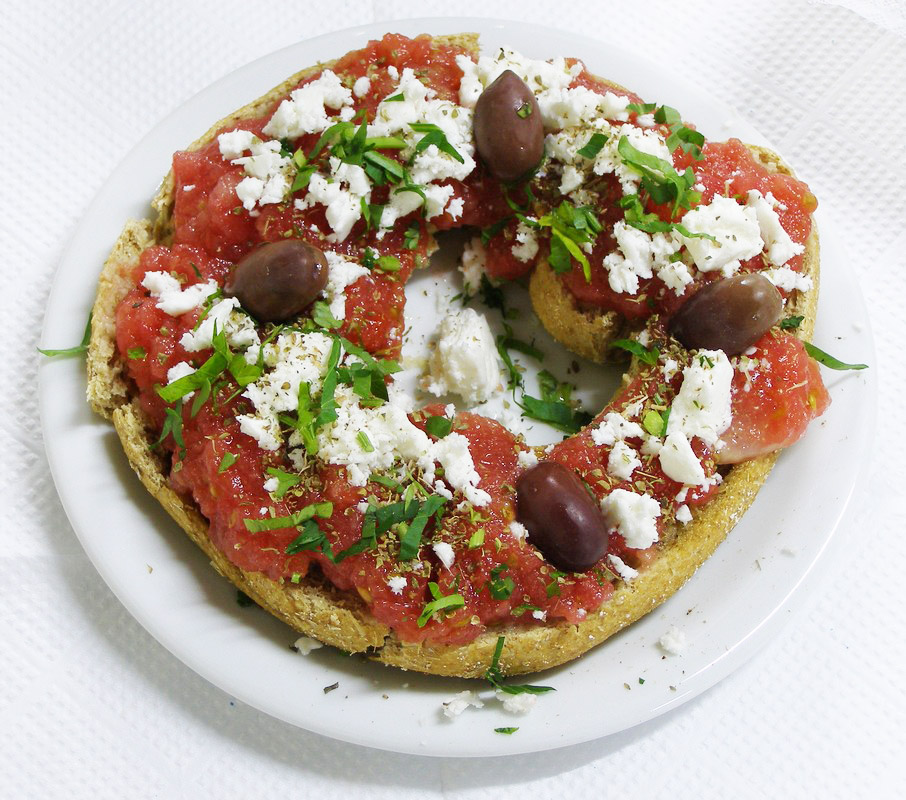 DakosVegetarianντάκος
🇬🇷 GreeceCretan salad of barley rusk topped with tomato, cheese, and herbs
Salad or side, Lunch, Dinner
DakosVegetarianντάκος
🇬🇷 GreeceCretan salad of barley rusk topped with tomato, cheese, and herbs
Salad or side, Lunch, Dinner
 VasilopitaΒασιλόπιτα
🇬🇷 Greece and 1 moreGreek New Year's bread or cake with a hidden coin for good luck
Bread
VasilopitaΒασιλόπιτα
🇬🇷 Greece and 1 moreGreek New Year's bread or cake with a hidden coin for good luck
Bread
Its cousins elsewhere
All breads LahmacunMeat
🇸🇾 Syria and 3 moreThin flatbread baked with a topping of minced meat, vegetables and herbs
Main dish, Lunch, Dinner
Naanनान
🇮🇳 India and 5 moreLeavened flatbread baked in a tandoor or on a pan, soft and spotted with golden brown
Bread, Lunch, Dinner
PuriVegan
🇮🇳 India and 2 moreUnleavened wheat flatbread, deep-fried until puffed and golden
Bread, Breakfast, Snacks
LahmacunMeat
🇸🇾 Syria and 3 moreThin flatbread baked with a topping of minced meat, vegetables and herbs
Main dish, Lunch, Dinner
Naanनान
🇮🇳 India and 5 moreLeavened flatbread baked in a tandoor or on a pan, soft and spotted with golden brown
Bread, Lunch, Dinner
PuriVegan
🇮🇳 India and 2 moreUnleavened wheat flatbread, deep-fried until puffed and golden
Bread, Breakfast, Snacks
 Cornbread
🇺🇸 United StatesA quick bread made from cornmeal, central to Southern U.S. and Native American cooking
Bread, Breakfast, Lunch
Cornbread
🇺🇸 United StatesA quick bread made from cornmeal, central to Southern U.S. and Native American cooking
Bread, Breakfast, Lunch