
Lahmacun
Thin flatbread baked with a topping of minced meat, vegetables and herbs
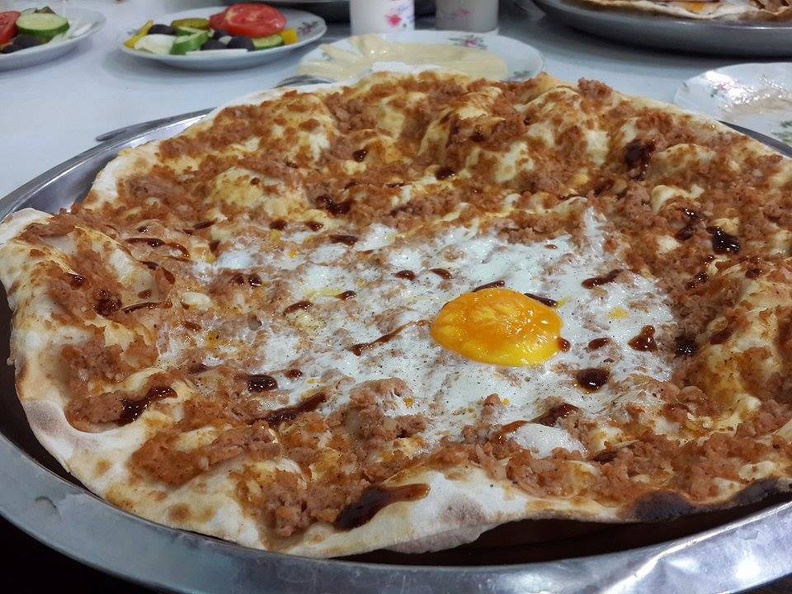
Lahmacun is a round, thin flatbread from the Levant, covered with a mixture of minced meat, vegetables, and herbs, then baked. It is enjoyed in Turkey, Armenia, Syria and Lebanon, often wrapped around salad or pickled vegetables and eaten warm as a main meal or snack.
- Earliest written recipe found in 13th-century Aleppo
- Traditionally made without cheese or tomato sauce
- Gaziantep lahmacun has EU protected status
- Known as 'lahm bi ʿajīn' in Arabic
- Popular street food in Turkey and Armenia
What is Lahmacun?
Lahmacun is a very thin, round flatbread with a savory topping. The topping is a blend of finely ground meat—usually lamb or beef—mixed with chopped vegetables like onion, tomato, and red pepper, along with fresh herbs such as parsley and garlic. Once spread over the dough, the whole thing is baked until the bread is crisp at the edges and the topping is cooked through. It is often served with salad or pickled vegetables, and can be rolled up for eating by hand. Cheese and tomato sauce are not part of the traditional version.
Where does Lahmacun come from?
The earliest known mention of lahmacun comes from medieval Syria, where it was called 'lahm bi ʿajīn', meaning 'meat with dough'. A 13th-century cookbook from Aleppo describes a dish of minced meat spread on dough and baked in an oven. The dish spread through the Levant and became popular in Lebanon and Syria. In Turkey, it was first known in the southeast, especially around Urfa and Gaziantep, and only reached Istanbul in the mid-20th century. Armenian communities adopted it during the Soviet era, especially through repatriates from the Middle East.
How is Lahmacun made?
To make lahmacun, a soft dough is rolled out into thin rounds. The topping is prepared by mixing minced meat with finely chopped vegetables and herbs. This mixture is spread thinly over the dough. The assembled breads are baked in a hot oven until the edges are crisp and the topping is cooked. Some regional versions add ingredients like garlic, onion, or pomegranate molasses to the topping.
How and when is Lahmacun eaten?
Lahmacun is usually eaten warm, either as a meal or a snack. It is often served with fresh salad, pickled vegetables, or roasted eggplant, which can be wrapped inside the flatbread. In some places, it is enjoyed with coffee, especially during times of mourning, such as in Assyrian tradition. In the Netherlands, it is sold as street food, sometimes filled with salad and sauces, and occasionally with added döner meat or cheese.
Kinds of Lahmacun
Several regional types exist. The Antep style includes garlic, while the Urfa version uses onion. Aleppo’s lahmacun may have both garlic and onion, plus pomegranate molasses for a tangy note. A smaller, thicker version called ʻUsh al-bulbul is found in Aleppo. In the Netherlands, it is adapted as 'Turkish pizza', often with extra fillings and sauces. Armenian lahmajo became part of local cuisine through diaspora communities.
What Lahmacun means
Lahmacun is part of everyday meals in many Middle Eastern homes and is also sold as street food. In Turkey, the Gaziantep version has received protected status from the European Union. The dish can be a symbol of cultural identity, and its origins are sometimes debated, especially between Turkish and Armenian communities. In Assyrian custom, it is served during mourning. Its popularity has led to adaptations and new names in different countries.
Questions people ask about Lahmacun
What is lahmacun made of?
Lahmacun is made from a thin wheat flour dough topped with a mixture of minced meat—usually lamb or beef—blended with chopped vegetables like onion, tomato, and red pepper, plus herbs such as parsley and garlic.
Where does lahmacun come from?
Lahmacun originated in the Levant region, with the earliest known recipe from medieval Syria. It is now popular in Syria, Lebanon, Turkey, and Armenia.
Is lahmacun the same as pizza?
Lahmacun is sometimes called 'Turkish pizza' or 'Armenian pizza' because of its round shape, but it does not have cheese or tomato sauce and has a much thinner crust.
How is lahmacun usually served?
It is served warm, often with salad or pickled vegetables. People may roll it up to eat by hand, and in some countries, it is sold as a street snack with extra fillings.
Are there different versions of lahmacun?
Yes, regional styles use different ingredients: Antep includes garlic, Urfa uses onion, and Aleppo versions may add pomegranate molasses. There are also smaller, thicker varieties.
Good reading and sources
- 'Armenian Pizza' Is the Comfort Food You Didn’t Know You Were Missing (Recipe)Smithsonian Magazine, Recipe
- Turkish flatbread lahmacunSouth China Morning Post, Article
- Review: Hot cheese breads and meat pies are only the start at L.A.'s best new Armenian restaurantLos Angeles Times, Article
The facts on this page come from the Wikipedia article "Lahmacun", written by its contributors and used under the CC BY-SA 4.0 licence, and from its Wikidata record (CC0). Thali rewrote the text in its own words, with AI assistance, and compares every page with the article to make sure no passage is copied. It may be reused under the same CC BY-SA 4.0 licence with a link back.
It may contain mistakes, and it is not dietary or allergy advice: recipes differ from cook to cook. If something is wrong, tell us. Last refreshed 2026-10-03.
More from Syria
All the food of Syria ShawarmaMeatشاورما
🇸🇾 Syria and 5 moreMeat roasted on a vertical spit and sliced into flatbread with sauces and vegetables
Street food, Lunch, Dinner
ShawarmaMeatشاورما
🇸🇾 Syria and 5 moreMeat roasted on a vertical spit and sliced into flatbread with sauces and vegetables
Street food, Lunch, Dinner
 Freekehفريكة
🇵🇸 Palestine and 5 moreRoasted green durum wheat grains, a staple across the eastern Mediterranean
Main dish, Lunch, Dinner
Freekehفريكة
🇵🇸 Palestine and 5 moreRoasted green durum wheat grains, a staple across the eastern Mediterranean
Main dish, Lunch, Dinner
 PitaVegan
🇪🇬 Egypt and 5 moreRound, leavened flatbread baked from wheat flour, common across the Middle East and Mediterranean
Bread
PitaVegan
🇪🇬 Egypt and 5 moreRound, leavened flatbread baked from wheat flour, common across the Middle East and Mediterranean
Bread
 ShakshukaVegetarian
🇹🇳 Tunisia and 5 moreEggs poached in a spiced tomato and pepper sauce from North Africa
Main dish, Breakfast, Dinner
ShakshukaVegetarian
🇹🇳 Tunisia and 5 moreEggs poached in a spiced tomato and pepper sauce from North Africa
Main dish, Breakfast, Dinner
Its cousins elsewhere
All main dishes Cataplana
🇵🇹 PortugalSeafood and meat stew cooked in a sealed metal vessel from Portugal's Algarve
Main dish, Lunch, Dinner
Cataplana
🇵🇹 PortugalSeafood and meat stew cooked in a sealed metal vessel from Portugal's Algarve
Main dish, Lunch, Dinner
 Indio viejoMeat
🇳🇮 NicaraguaNicaraguan maize and meat stew thickened with tomatoes and achiote
Stew or curry, Lunch, Dinner
Indio viejoMeat
🇳🇮 NicaraguaNicaraguan maize and meat stew thickened with tomatoes and achiote
Stew or curry, Lunch, Dinner
 DaubeMeat
🇫🇷 FranceFrench slow-cooked beef stew braised with wine, vegetables and herbs
Stew or curry, Dinner, Lunch
DaubeMeat
🇫🇷 FranceFrench slow-cooked beef stew braised with wine, vegetables and herbs
Stew or curry, Dinner, Lunch
 Arroz carreteiroMeat
🇧🇷 BrazilBrazilian rice cooked with beef, sausage, and aromatics
Main dish, Lunch, Dinner
Arroz carreteiroMeat
🇧🇷 BrazilBrazilian rice cooked with beef, sausage, and aromatics
Main dish, Lunch, Dinner