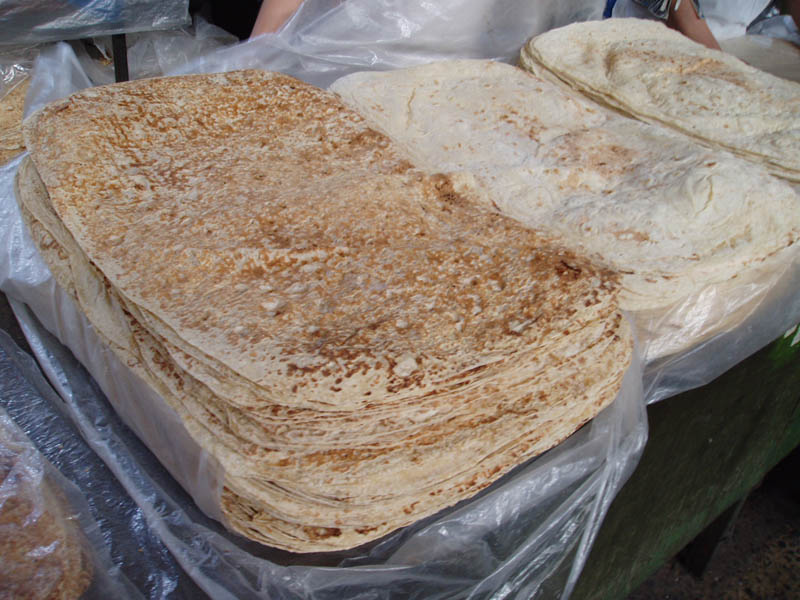
Lavash
In its own language: լավաշ
A thin West Asian flatbread slapped onto hot clay oven walls
Lavash is an ancient, delicate flatbread from the South Caucasus and West Asia, made simply from wheat flour, water, and salt. Baked in seconds inside a hot clay pit or over a griddle, it is eaten fresh at all hours or stored dry for months.
- Bakes against the searing wall of a clay tandoor in just fifteen to forty seconds
- Drying extends its shelf life up to six months, reviving quickly with a sprinkle of water
- Inscribed twice on the UNESCO Intangible Cultural Heritage list across six nations
- Armenian legend tells of King Arame concealing thin sheets of lavash in his armor to survive
What is Lavash?
Lavash is a wide, single-layer sheet bread that ranges from remarkably thin to slightly chewy. When lifted from the oven, it is pale cream with irregular golden blisters and scorched patches across its surface. Soft, fresh sheets bend easily without breaking, making them sturdy enough to wrap around sliced meats or fresh herbs. Left out in the open air, the moisture evaporates rapidly, turning the sheet brittle and crisp like a large cracker. A light splash of water brings dry sheets back to a tender, flexible state within minutes. Its taste is clean and wheaty, often carrying a mild tang when raised with sourdough.
Where does Lavash come from?
Cooks across West Asia and the South Caucasus have baked thin sheets of dough for thousands of years. Historians trace this tradition back to ancient hearths, where cooks moved dough from open embers onto smooth clay griddles, rolling the dough thinner so it would bake thoroughly without burning. Armenia, Iran, Azerbaijan, Georgia, and Turkey all share deep claims to its development, and ancient Persian records mention the bread as far back as the Arsacid era. Medieval regional literature, including the Book of Dede Korkut and the verses of poet Nizami Ganjavi, regularly mentions the flatbread as a staple of regional life.
How is Lavash made?
Bakers mix high-extraction wheat flour with water and salt to make a firm dough. Many batches are raised using yeast or a sourdough starter saved from an earlier bake, known in Armenia as ttkhmor, while unleavened varieties are also made. After resting, the dough is divided into small balls and rolled out into broad, thin sheets using a slender rolling pin. The baker stretches the fragile sheet over a padded cushion with a handle, then slaps it firmly against the fiery inside wall of a sunken clay tandoor. Baking takes between fifteen and forty seconds under intense heat. A cook hooks the browned sheet free and stacks it to stay warm.


How and when is Lavash eaten?
Fresh sheets often serve as an edible utensil, torn by hand to scoop up dips like hummus or grasp morsels of saucy stew. In the morning, families roll soft sheets around cheese, butter, and jam, or tuck spiced eggs inside. At midday or evening feasts, lavash encases barbecued meats, skewered kebabs, and fresh greens. Hardened sheets are saved in large stacks for winter rations. Armenia uses dry broken shards to thicken steaming bowls of khash, a traditional hoof stew, while Iranian tables sometimes feature dry pieces crushed with butter into small rounds. In Turkey, bakers also serve it alongside sweets such as halva.
Kinds of Lavash
Shapes and thicknesses shift across borders. Iranian lavash is prized for being paper-thin and nearly translucent, shaped into large rectangles or ovals. In eastern Georgia, the loaves are distinctly rounder and thicker. While traditional bakeries bake directly on the walls of clay pits or across convex metal griddles, modern operations often rely on automated rotary ovens and mechanical dough rollers. In Mersin, Turkey, cooks roll seasoned beef or lamb inside lavash to build a street snack called tantuni, while Kashmiri street stalls assemble spiced meat wraps known as masala lavasa.
What Lavash means
Baking lavash is a collective tradition that strengthens family and communal bonds. In Armenian villages, groups of women traditionally gather to mix, stretch, and bake large supplies together, transforming baking days into social celebrations. It carries deep ceremonial meaning and commonly appears at weddings to symbolize abundance. In 2014, UNESCO placed the cultural heritage of lavash in Armenia on its representative list. Following regional protests over national ownership of the bread, a shared listing was later recognized in 2016 for Azerbaijan, Iran, Kazakhstan, Kyrgyzstan, and Turkey.
Questions people ask about Lavash
What is lavash made of?
Lavash is made from wheat flour, water, and salt. The stiff dough may be left unleavened or raised with yeast, commercial leavening, or a sourdough starter saved from a previous batch.
Where does lavash come from?
Lavash originated in ancient West Asia and the South Caucasus. Multiple countries share its history and claim its origins, including Armenia, Iran, Azerbaijan, Georgia, and Turkey.
How do you refresh dried lavash?
Because dried lavash is very brittle, cooks sprinkle or soak the hard sheets lightly with water and cover them. The bread absorbs the moisture and becomes soft and pliable again within fifteen to twenty minutes.
How is lavash baked in a traditional oven?
A baker rolls the dough thin, drapes it over a special padded cushion, and slaps it directly onto the heated clay wall of a tandoor. It bubbles and browns in under a minute before being hooked out.
Good reading and sources
- On the Lavash Trail in ArmeniaSmithsonian Magazine, Article
- Lavash, the preparation, meaning and appearance of traditional bread as an expression of culture in ArmeniaUNESCO, Article
The facts on this page come from the Wikipedia article "Lavash", written by its contributors and used under the CC BY-SA 4.0 licence, and from its Wikidata record (CC0). EveryThali rewrote the text in its own words, with AI assistance, and compares every page with the article to make sure no passage is copied. It may be reused under the same CC BY-SA 4.0 licence with a link back.
It may contain mistakes, and it is not dietary or allergy advice: recipes differ from cook to cook. If something is wrong, tell us. Last refreshed 2026-10-04.
More from Armenia
All the food of Armenia LahmacunMeat
🇸🇾 Syria and 3 moreThin flatbread baked with a topping of minced meat, vegetables and herbs
Main dish, Lunch, Dinner
LahmacunMeat
🇸🇾 Syria and 3 moreThin flatbread baked with a topping of minced meat, vegetables and herbs
Main dish, Lunch, Dinner
 SimitVegan
🇹🇷 Turkey and 5 moreRing-shaped bread with a sesame seed crust, sold by street vendors
Bread, Breakfast, Snacks
SimitVegan
🇹🇷 Turkey and 5 moreRing-shaped bread with a sesame seed crust, sold by street vendors
Bread, Breakfast, Snacks
 Tandoor breadVegan
🇮🇶 Iraq and 5 moreFlatbread baked on the walls of a clay tandoor oven
Bread, Breakfast, Lunch
Tandoor breadVegan
🇮🇶 Iraq and 5 moreFlatbread baked on the walls of a clay tandoor oven
Bread, Breakfast, Lunch
Its cousins elsewhere
All breads PitaVegan
🇪🇬 Egypt and 5 moreRound, leavened flatbread baked from wheat flour, common across the Middle East and Mediterranean
Bread
PitaVegan
🇪🇬 Egypt and 5 moreRound, leavened flatbread baked from wheat flour, common across the Middle East and Mediterranean
Bread
 Bagel
🇵🇱 Poland and 2 moreRing-shaped bread roll, boiled then baked for a dense, chewy texture
Bread, Breakfast, Lunch
Bagel
🇵🇱 Poland and 2 moreRing-shaped bread roll, boiled then baked for a dense, chewy texture
Bread, Breakfast, Lunch
 Ftira
🇲🇹 MaltaRing-shaped Maltese bread, often filled or topped with local ingredients
Bread
Ftira
🇲🇹 MaltaRing-shaped Maltese bread, often filled or topped with local ingredients
Bread
 BaguetteVegan
🇫🇷 France and 5 moreLong, thin French bread with a crisp crust and soft interior
Bread, Breakfast, Lunch
BaguetteVegan
🇫🇷 France and 5 moreLong, thin French bread with a crisp crust and soft interior
Bread, Breakfast, Lunch