Lūʻau
Polynesian stew or parcel of taro leaves, often with coconut milk and meat or fish
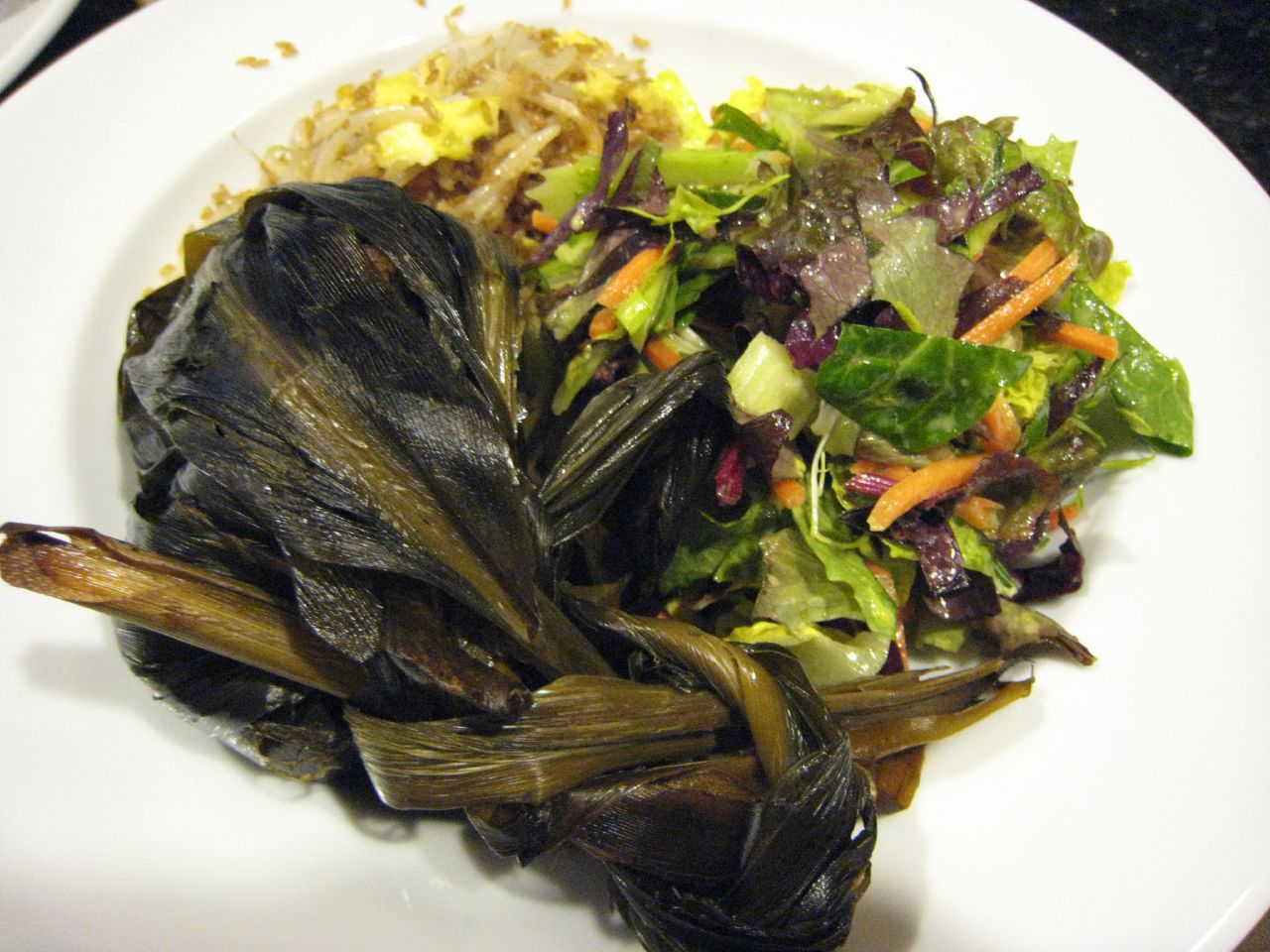
Lūʻau is a family of Polynesian dishes centered on taro leaves, cooked as a stew or wrapped parcel. The base is vegetarian, but coconut milk, meat, or fish are often added. Found in Hawaii, Samoa, Tonga, Fiji, French Polynesia, and the Cook Islands, it is served hot and eaten at everyday meals and celebrations.
- Made with taro leaves, coconut milk, and often meat or fish
- Found across Polynesia, with many local names and styles
- Can be a stew or a wrapped parcel, served hot
- Traditional and modern versions use different greens and wrappings
- Eaten at everyday meals and special gatherings
What is Lūʻau?
Lūʻau is a group of dishes from Polynesia made with the leaves of the taro plant. The leaves are cooked into a stew or wrapped around fillings to form parcels, sometimes baked or steamed. Coconut milk is a common addition, giving a rich and creamy texture. Meat or fish, such as beef, chicken, pork, lamb, or seafood, are often included, but the basic dish can be vegetarian. The finished dish can range from a thick soup to a dense, cake-like parcel. The flavor is earthy and mild from the taro leaves, with richness from coconut and savory notes from added proteins.
Where does Lūʻau come from?
Taro is one of the oldest cultivated crops, brought to the Pacific Islands by Austronesian peoples around 1300 BC. While the root is widely known, Polynesians also used the leaves and stems as food. Lūʻau and its related dishes developed across the region, adapting to local tastes and available ingredients. Over time, new foods like canned meats and spices were introduced by Westerners and through colonial contact, but taro and coconut remained central. The dish has roots in both daily meals and larger gatherings, with methods evolving from earth ovens to modern kitchens.
How is Lūʻau made?
To prepare lūʻau, taro leaves are cleaned and cooked thoroughly to remove natural irritants. In stews, the leaves are simmered with coconut milk and sometimes onions, garlic, or spices. Meat or fish may be added, either fresh or preserved, and the mixture is cooked until tender. In parcel versions, fillings are wrapped in taro leaves (and sometimes ti or banana leaves), then steamed or baked. In modern times, foil or casserole dishes may replace traditional wrappings. Where taro leaves are scarce, spinach or other greens can be used as substitutes.


How and when is Lūʻau eaten?
Lūʻau is served hot, often as a main dish for lunch or dinner. It can be eaten on ordinary days or at special occasions and religious ceremonies. In Hawaii, it is commonly paired with rice or poi, while in Fiji it may be served with cassava, roti, or chips. In French Polynesia, breadfruit, sweet potatoes, or rice are typical sides. The dish is shared at family meals and larger gatherings, and the style of serving—stew or parcel—varies by region and occasion.
Kinds of Lūʻau
Each island group has its own version. In the Cook Islands, rukau may be stewed or baked, with coconut milk and meats like fish or corned beef. Fiji's rourou can be a stew or stuffed parcel, sometimes pan-fried as patties. French Polynesia's poulet fāfā uses chicken and often substitutes spinach for taro leaves. In Hawaii, lūʻau stew is made with parboiled leaves and meats, while laulau refers to parcels wrapped in ti leaves. Samoa's palusami is a rich parcel with coconut cream and salted beef. Modern adaptations use other greens and wrappings where traditional ingredients are hard to find.
What Lūʻau means
Lūʻau and its related dishes are woven into the daily and festive life of Polynesian peoples. They appear at family gatherings, community feasts, and religious events. The labor of preparing traditional versions, especially for large groups, reflects the importance of sharing food in these cultures. The dish has adapted to changing times, with new ingredients and methods, but remains a symbol of heritage and identity. For many, it is a comfort food that connects them to their ancestral roots.
Questions people ask about Lūʻau
What is lūʻau made of?
Lūʻau is made mainly from taro leaves, often cooked with coconut milk. Meat or fish such as beef, chicken, pork, lamb, or seafood can be added, along with onions or other aromatics. The base recipe is vegetarian, but many versions include animal protein.
Where does lūʻau come from?
Lūʻau and its related dishes originate from Polynesia, including Hawaii, Samoa, Tonga, Fiji, French Polynesia, and the Cook Islands. The dish developed as taro became a staple crop in these islands.
How is lūʻau cooked?
Taro leaves are thoroughly cooked, often simmered in coconut milk to make a stew or wrapped around fillings to make parcels. The dish can be steamed, baked, or cooked in a casserole. Modern methods may use foil or substitute greens.
Is lūʻau always vegetarian?
No, while the base recipe is vegetarian, most versions include meat or fish. However, it can be made without animal products, especially in its simplest form with just taro leaves and coconut milk.
What does lūʻau taste like?
The dish has a mild, earthy flavor from the taro leaves, with a creamy richness from coconut milk. The taste varies depending on added meats, fish, or seasonings, and the texture can be soupy or dense.
Good reading and sources
The facts on this page come from the Wikipedia article "Lūʻau (food)", written by its contributors and used under the CC BY-SA 4.0 licence, and from its Wikidata record (CC0). Thali rewrote the text in its own words, with AI assistance, and compares every page with the article to make sure no passage is copied. It may be reused under the same CC BY-SA 4.0 licence with a link back.
It may contain mistakes, and it is not dietary or allergy advice: recipes differ from cook to cook. If something is wrong, tell us. Last refreshed 2026-10-03.
More from Samoa
All the food of Samoa Cha siu baoMeat叉燒包
🇨🇳 China and 2 moreCantonese steamed or baked buns filled with barbecue-flavored pork
Street food, Lunch, Snacks
Cha siu baoMeat叉燒包
🇨🇳 China and 2 moreCantonese steamed or baked buns filled with barbecue-flavored pork
Street food, Lunch, Snacks
 'Ota 'ikaFish or seafood
🇹🇴 Tonga and 3 moreFish in citrus and coconut milk, served with chopped vegetables across Oceania
Salad or side, Lunch, Dinner
'Ota 'ikaFish or seafood
🇹🇴 Tonga and 3 moreFish in citrus and coconut milk, served with chopped vegetables across Oceania
Salad or side, Lunch, Dinner
 KavaVegan
🇻🇺 Vanuatu and 4 moreA traditional Pacific drink made from the root of the kava plant
Drink
'OtaiVegan
🇹🇴 Tonga and 1 moreA chilled fruit and coconut drink from Tonga and Samoa
Drink
KavaVegan
🇻🇺 Vanuatu and 4 moreA traditional Pacific drink made from the root of the kava plant
Drink
'OtaiVegan
🇹🇴 Tonga and 1 moreA chilled fruit and coconut drink from Tonga and Samoa
Drink
Its cousins elsewhere
All stews and curries Laing
🇵🇭 PhilippinesTaro leaves and meat or seafood simmered in spiced coconut milk
Stew or curry, Lunch, Dinner
Laing
🇵🇭 PhilippinesTaro leaves and meat or seafood simmered in spiced coconut milk
Stew or curry, Lunch, Dinner
 Green curryแกงเขียวหวาน
🇹🇭 ThailandA Thai coconut curry colored and flavored with green chilies and herbs
Main dish, Lunch, Dinner
Green curryแกงเขียวหวาน
🇹🇭 ThailandA Thai coconut curry colored and flavored with green chilies and herbs
Main dish, Lunch, Dinner
 Gulai
🇮🇩 Indonesia and 4 moreSpiced Southeast Asian stew with coconut milk and a blend of local herbs
Main dish, Lunch, Dinner
Gulai
🇮🇩 Indonesia and 4 moreSpiced Southeast Asian stew with coconut milk and a blend of local herbs
Main dish, Lunch, Dinner
 Sinigang
🇵🇭 PhilippinesA Filipino soup or stew with a tangy broth, often made with tamarind
Soup, Lunch, Dinner
Sinigang
🇵🇭 PhilippinesA Filipino soup or stew with a tangy broth, often made with tamarind
Soup, Lunch, Dinner