
Mohinga
In its own language: မုန့်ဟင်းခါး
Rice noodle soup with fish broth, herbs, and crisp garnishes from Myanmar
Mohinga is a rice noodle soup with a fish-based broth, widely regarded as Myanmar’s national dish. Traditionally eaten for breakfast but now enjoyed at any time, it combines rice vermicelli, catfish, lemongrass, and spices, topped with fritters, boiled egg, and fresh herbs. It is commonly sold by street hawkers and at roadside stalls.
- National dish of Myanmar, eaten daily across the country
- Rice vermicelli and fish broth are the main components
- Commonly sold by street hawkers and at roadside stalls
- Topped with crispy fritters, boiled egg, and fresh herbs
- Many regional versions use different fish and garnishes
What is Mohinga?
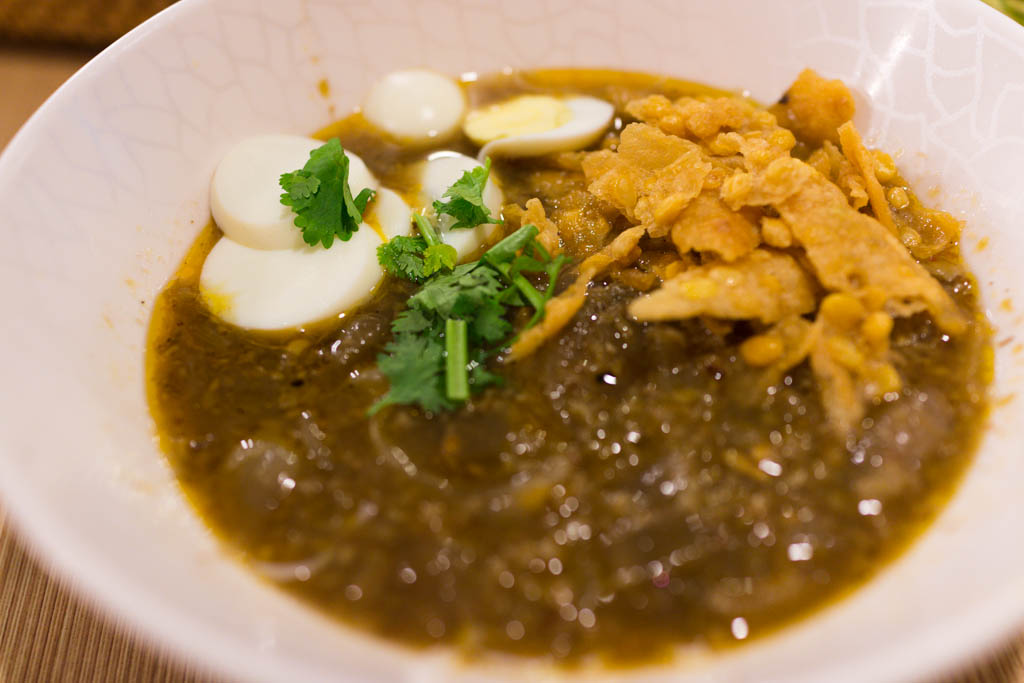
Mohinga is a hot noodle soup from Myanmar, made with thin rice vermicelli served in a broth of fish, often catfish, simmered with lemongrass, ginger, onions, garlic, and turmeric. The soup is thickened with chickpea flour or toasted rice, and seasoned with fish sauce and fish paste. It is typically topped with crispy fritters, boiled eggs, fresh coriander, and sometimes lime or fried onions. The dish is aromatic, with herbal and savory notes, and has a rich, hearty texture.
Where does Mohinga come from?
The exact beginnings of mohinga are unclear, as written records are scarce. Archaeological finds show that rice vermicelli has been made in Myanmar since the Pyu city-states, indicating a long tradition. The earliest known mention of mohinga appears in poetry from the Konbaung dynasty. Historians believe it was a commoner’s dish in pre-colonial times, as no formal recipes are found in royal archives. Over time, it became established as a national staple, especially in Lower Myanmar.
How is Mohinga made?
To make mohinga, a broth is prepared by simmering fish with aromatics like lemongrass, ginger, onions, and garlic. Chickpea flour or toasted rice is added to thicken the soup. Fish sauce and fish paste give depth and saltiness. Rice vermicelli is cooked separately and placed in bowls, then covered with the hot broth. Common garnishes include boiled eggs, fried onions, coriander, lime, and a variety of crispy fritters made from chickpeas or vegetables. Some versions use ready-made broth powder.

How and when is Mohinga eaten?
Mohinga is most often eaten for breakfast, but it is now served throughout the day in cities and towns across Myanmar. It is a popular street food, sold by hawkers who carry the soup and noodles on shoulder poles or from pavement stalls. The dish is eaten with Chinese-style soup spoons, called mohinga zun. It may be enjoyed alone or with extra toppings like boiled egg, parsley, or more fritters. It is considered an everyday food and is widely available.
Kinds of Mohinga
There are many regional styles of mohinga in Myanmar. In the Irrawaddy delta, versions like Bogale mohinga use black pepper, while Myaungmya mohinga combines several types of fish. Yangon’s style includes chickpeas and peanuts. In the Bago region, some versions use hilsa fish or pickled shrimp. Southern and eastern regions may add mint, bean sprouts, or jaggery, and in Upper Myanmar, chicken and chickpea flour may replace some ingredients. Each area adapts the soup to local tastes and available fish.
What Mohinga means
Mohinga is deeply woven into daily life in Myanmar and is recognized as the national dish. It is a staple at breakfast tables, roadside stalls, and open-air performances. The dish’s popularity has led to countless local variations and dedicated shops in major cities. Mohinga was also named as a food for the Belt and Road International Day, highlighting its cultural significance. Its presence in poetry and literature reflects its long-standing role in Burmese society.
Questions people ask about Mohinga
What is mohinga made of?
Mohinga is made with rice vermicelli noodles in a fish-based broth, usually catfish, flavored with lemongrass, ginger, onions, garlic, fish sauce, and fish paste. It is thickened with chickpea flour or toasted rice and topped with fritters, boiled egg, and herbs.
Where does mohinga come from?
Mohinga comes from Myanmar, where it is considered the national dish. Its origins are ancient, with rice vermicelli production dating back to early Myanmar civilizations.
When is mohinga usually eaten?
Mohinga is traditionally eaten for breakfast but is now enjoyed at any time of day, including lunch and dinner. It is widely available from street vendors and stalls.
Are there different types of mohinga?
Yes, there are many regional varieties of mohinga across Myanmar. Each region uses different fish, spices, and garnishes, such as black pepper, peanuts, or mint, to create unique versions.
How is mohinga served?
Mohinga is served hot, with rice noodles in a bowl of fish broth, and topped with crispy fritters, boiled egg, fresh coriander, and sometimes lime or fried onions. It is eaten with a soup spoon.
Good reading and sources
The facts on this page come from the Wikipedia article "Mohinga", written by its contributors and used under the CC BY-SA 4.0 licence, and from its Wikidata record (CC0). Thali rewrote the text in its own words, with AI assistance, and compares every page with the article to make sure no passage is copied. It may be reused under the same CC BY-SA 4.0 licence with a link back.
It may contain mistakes, and it is not dietary or allergy advice: recipes differ from cook to cook. If something is wrong, tell us. Last refreshed 2026-10-03.
More from Myanmar
All the food of Myanmar Biryani
🇮🇳 India and 5 moreRice and spiced meat or vegetables layered and cooked together
Main dish, Lunch, Dinner
Biryani
🇮🇳 India and 5 moreRice and spiced meat or vegetables layered and cooked together
Main dish, Lunch, Dinner
 Thingyan riceFish or seafoodသင်္ကြန်ထမင်း
🇲🇲 Myanmar and 1 moreRice in scented water, served cold with fried dried fish for the Burmese New Year
Main dish, Lunch, Dinner
Thingyan riceFish or seafoodသင်္ကြန်ထမင်း
🇲🇲 Myanmar and 1 moreRice in scented water, served cold with fried dried fish for the Burmese New Year
Main dish, Lunch, Dinner
 YoutiaoVegan油條
🇨🇳 China and 5 moreLong, golden-brown strips of deep-fried dough eaten across East and Southeast Asia
Street food, Breakfast, Snacks
YoutiaoVegan油條
🇨🇳 China and 5 moreLong, golden-brown strips of deep-fried dough eaten across East and Southeast Asia
Street food, Breakfast, Snacks
 Nam ngiaoMeatน้ำเงี้ยว
🇹🇭 Thailand and 2 moreNorthern Thai noodle soup with pork, tomato, and fermented soybeans
Soup, Lunch, Dinner
Nam ngiaoMeatน้ำเงี้ยว
🇹🇭 Thailand and 2 moreNorthern Thai noodle soup with pork, tomato, and fermented soybeans
Soup, Lunch, Dinner
Its cousins elsewhere
All soups Peppersoup
🇳🇬 Nigeria and 1 moreA spicy, watery soup made with meat or fish and West African spices
Soup, Dinner, Lunch
Peppersoup
🇳🇬 Nigeria and 1 moreA spicy, watery soup made with meat or fish and West African spices
Soup, Dinner, Lunch
 Maraqمرق
🇸🇴 Somalia and 3 moreSomali and Arabian meat or vegetable soup served with rice or bread
Soup, Lunch, Dinner
Maraqمرق
🇸🇴 Somalia and 3 moreSomali and Arabian meat or vegetable soup served with rice or bread
Soup, Lunch, Dinner
 GoulashMeatgulyás
🇭🇺 Hungary and 5 moreA paprika-spiced meat and vegetable soup from Hungary
Soup, Lunch, Dinner
GoulashMeatgulyás
🇭🇺 Hungary and 5 moreA paprika-spiced meat and vegetable soup from Hungary
Soup, Lunch, Dinner
 BouillabaisseFish or seafood
🇫🇷 FranceA Marseille fish stew with local seafood, herbs, and saffron broth
Stew or curry, Lunch, Dinner
BouillabaisseFish or seafood
🇫🇷 FranceA Marseille fish stew with local seafood, herbs, and saffron broth
Stew or curry, Lunch, Dinner