
Goulash
In its own language: gulyás
A paprika-spiced meat and vegetable soup from Hungary
Goulash is a Hungarian soup or stew made with meat, vegetables, and paprika. It began as a herdsmen's meal in Hungary and is now a national dish, widely enjoyed across Central Europe. Beef, onion, paprika, and potatoes are typical, with regional versions adding noodles, beans, or sauerkraut. Goulash is usually served hot as a main course.
- Goulash began as a meal for Hungarian cattle herders.
- Paprika is the key spice, giving goulash its color and flavor.
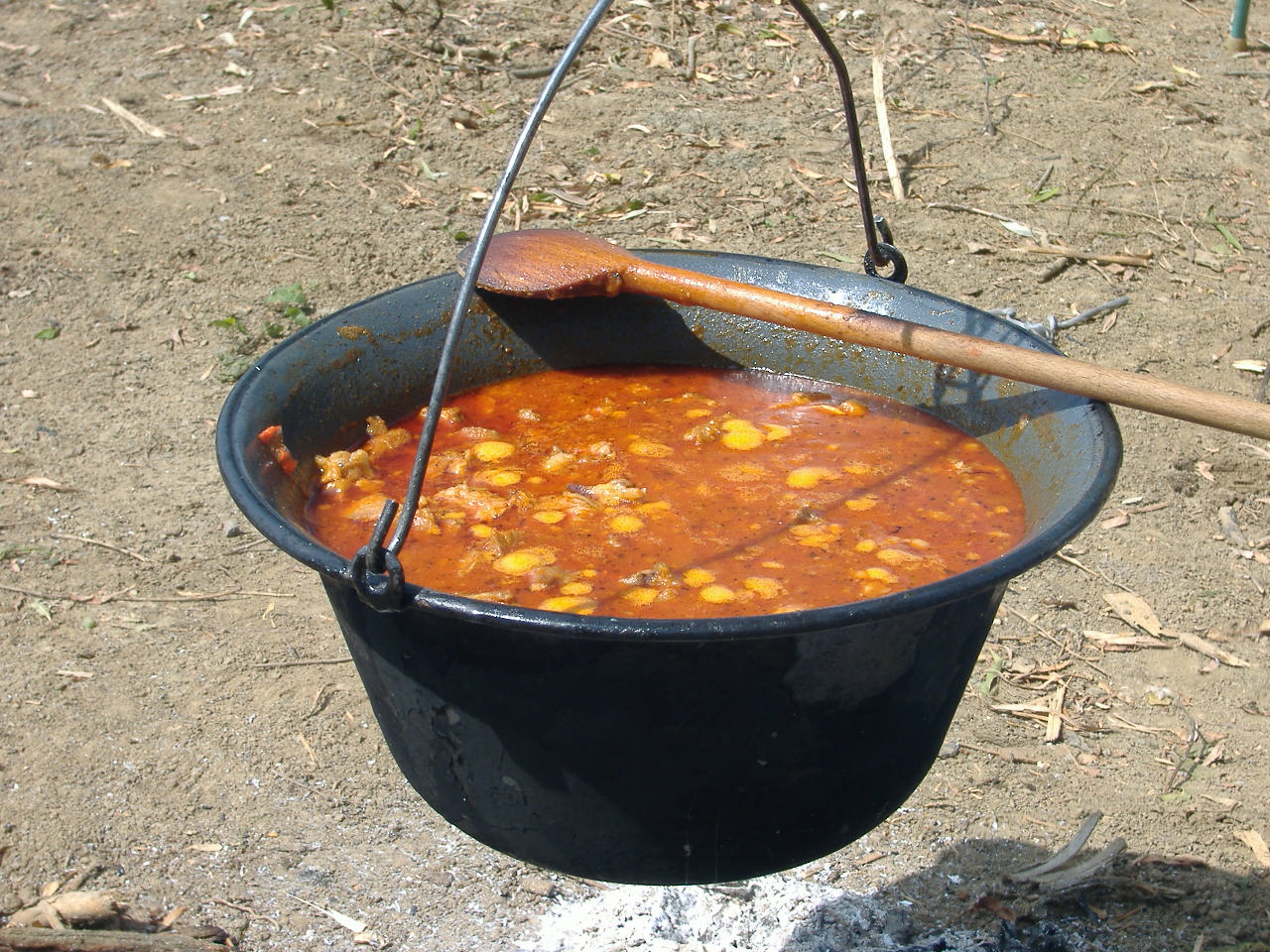
- Traditional goulash is cooked in a cauldron called a bogrács.
- It is a national dish and symbol of Hungary.
- Versions exist across Central and Eastern Europe.
What is Goulash?
Goulash is a soup or stew built around chunks of meat, usually beef, simmered with onions, paprika, and other vegetables such as carrots and potatoes. The dish is seasoned with spices like caraway and bay leaf, and sometimes includes small egg noodles called csipetke. It has a deep red color from the paprika and a rich, savory aroma. The texture can range from brothy to thick, depending on the version. Goulash is hearty and warming, with a gentle heat from the paprika.
Where does Goulash come from?
Goulash traces its roots to the Hungarian plains, where cattle herders made simple stews from whatever meat was available. The name comes from 'gulyás', meaning herdsman. Early versions were cooked, dried in the sun, and packed for travel, needing only water to reconstitute. Paprika, now central to the dish, was not used until after the 16th century. Over time, goulash became a symbol of Hungarian identity and spread throughout Central Europe.
How is Goulash made?
To make goulash, meat is cut into chunks, salted, and browned with sliced onions in oil or lard. Paprika is added, followed by water to create a broth. The soup simmers, and vegetables like potatoes and carrots are added later. Caraway seeds and bay leaves may be included for extra flavor. Near the end, small pinched noodles (csipetke) can be dropped in. The result is a one-pot meal, traditionally cooked in a cauldron over an open fire.


How and when is Goulash eaten?
Goulash is eaten hot, usually as a main dish for lunch or dinner. In Hungary, it is served as a soup with bread or sometimes with small noodles. In other countries, it may come with dumplings, potatoes, or polenta. It is a common everyday meal, enjoyed at home, in restaurants, and at gatherings. Outdoor versions are cooked in a bogrács, a traditional cauldron, especially for social occasions.
Kinds of Goulash
Hungarian goulash has several forms: bográcsgulyás is cooked outdoors in a kettle; bean gulyás uses beans instead of potatoes; Székely gulyás adds sauerkraut and sour cream. Other countries have their own takes: in Austria, goulash is a thick stew with lots of onions; in Croatia, game meats or mushrooms may be used; in the Czech Republic and Slovakia, it is often served with dumplings and sometimes includes beer. Meatless or pork versions also exist.
What Goulash means
Goulash is considered a national dish of Hungary and a symbol of its food culture. It is closely tied to the history of the Hungarian plains and the life of cattle herders. The dish has spread throughout Central Europe, becoming part of the everyday cuisine in many countries. Cooking goulash in a cauldron outdoors is a tradition at social gatherings. The dish is also a point of regional pride, with each country and area developing its own style.
Questions people ask about Goulash
What is goulash made of?
Goulash is made from chunks of meat, usually beef, onions, paprika, and vegetables like potatoes and carrots. It is seasoned with spices such as caraway and bay leaf, and sometimes includes small egg noodles.
Where does goulash come from?
Goulash comes from Hungary, where it was originally cooked by cattle herders on the plains. It is now a national dish and has spread to many Central European countries.
Is goulash a soup or a stew?
In Hungary, goulash is considered a soup, though it can be thick and hearty. Other countries may serve it as a stew, and the texture can vary from brothy to thick.
How is goulash traditionally cooked?
Traditional goulash is cooked in a single pot, often a cauldron called a bogrács, over an open fire. Meat and onions are browned, paprika is added, and then water and vegetables are simmered together.
Are there different types of goulash?
Yes, there are many variations. Some add beans or sauerkraut, others use different meats or noodles. Each region in Central Europe has its own style.
Good reading and sources
- Encyclopaedia BritannicaArticle
- The Humble Beginnings of GoulashSmithsonian Magazine, Article
- Top 10 National Dishes -- National GeographicNational Geographic, Article
The facts on this page come from the Wikipedia article "Goulash", written by its contributors and used under the CC BY-SA 4.0 licence, and from its Wikidata record (CC0). Thali rewrote the text in its own words, with AI assistance, and compares every page with the article to make sure no passage is copied. It may be reused under the same CC BY-SA 4.0 licence with a link back.
It may contain mistakes, and it is not dietary or allergy advice: recipes differ from cook to cook. If something is wrong, tell us. Last refreshed 2026-10-03.
More from Hungary
All the food of Hungary Foie grasMeat
🇫🇷 France and 5 moreFattened duck or goose liver, a French delicacy served whole or as a spread
Main dish, Lunch, Dinner
Foie grasMeat
🇫🇷 France and 5 moreFattened duck or goose liver, a French delicacy served whole or as a spread
Main dish, Lunch, Dinner
 Cabbage roll
🇺🇦 Ukraine and 5 moreCooked cabbage leaves wrapped around seasoned fillings, simmered or baked
Main dish, Lunch, Dinner
Cabbage roll
🇺🇦 Ukraine and 5 moreCooked cabbage leaves wrapped around seasoned fillings, simmered or baked
Main dish, Lunch, Dinner
 SpätzleSpätzla
🇩🇪 Germany and 5 moreIrregular egg noodles from Swabia, served as a side or main dish
Main dish, Lunch, Dinner
SpätzleSpätzla
🇩🇪 Germany and 5 moreIrregular egg noodles from Swabia, served as a side or main dish
Main dish, Lunch, Dinner
 SchnitzelMeat
🇦🇹 Austria and 5 moreThin slices of meat, pounded, breaded and fried until crisp
Main dish, Lunch, Dinner
SchnitzelMeat
🇦🇹 Austria and 5 moreThin slices of meat, pounded, breaded and fried until crisp
Main dish, Lunch, Dinner
Its cousins elsewhere
All soups Shchiщи
🇷🇺 Russia and 1 moreRussian cabbage soup, made with fresh or fermented cabbage
Soup, Lunch, Dinner
Shchiщи
🇷🇺 Russia and 1 moreRussian cabbage soup, made with fresh or fermented cabbage
Soup, Lunch, Dinner
 Lentil soupVegan
🇪🇬 Egypt and 5 moreA hearty soup made from lentils, often with vegetables and spices
Soup, Lunch, Dinner
Lentil soupVegan
🇪🇬 Egypt and 5 moreA hearty soup made from lentils, often with vegetables and spices
Soup, Lunch, Dinner
 DalVeganदाल
🇮🇳 India and 5 moreSoupy dish made from split lentils, peas or beans, a staple across South Asia
Main dish, Lunch, Dinner
DalVeganदाल
🇮🇳 India and 5 moreSoupy dish made from split lentils, peas or beans, a staple across South Asia
Main dish, Lunch, Dinner
 Chicken soupMeat
🇺🇸 United States and 4 moreA hot soup of chicken simmered with vegetables, noodles or grains
Soup, Lunch, Dinner
Chicken soupMeat
🇺🇸 United States and 4 moreA hot soup of chicken simmered with vegetables, noodles or grains
Soup, Lunch, Dinner