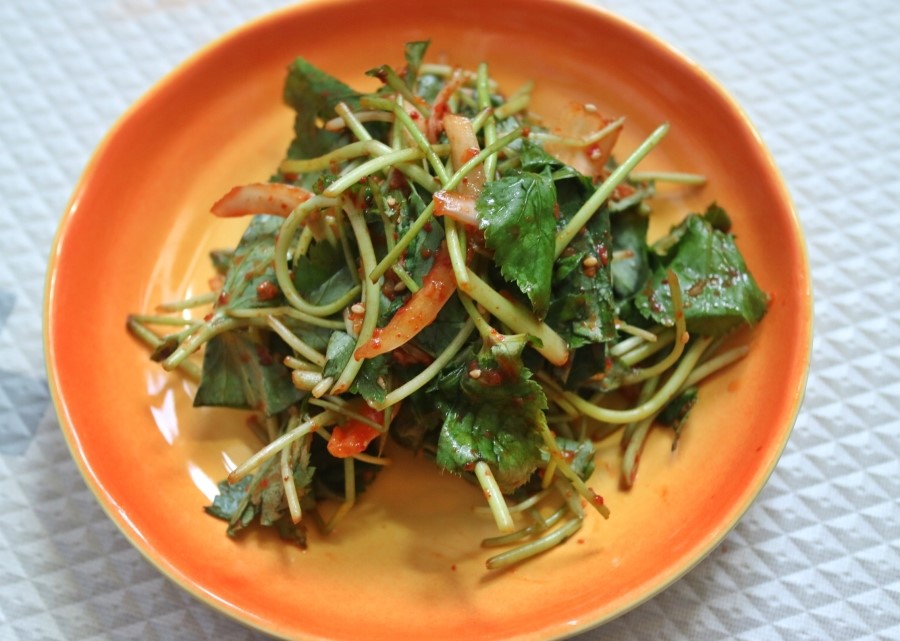
![An plate of namul (sauteed vegetables) for bibim ssambap (a variant of bibimbap and ssambap ) at a restaurant in [Gyeongju], North Gyeongsang province , South Korea](https://thumb.wikimedia.org/wikipedia/commons/thumb/1/13/Korean_food-Bibim_ssambap_ingredient-01.jpg/1280px-Korean_food-Bibim_ssambap_ingredient-01.jpg)
Namul
In its own language: 나물
Seasoned Korean vegetable side dishes made from greens, roots, or even seaweed
Namul is a Korean term for a range of dishes made from seasoned vegetables, greens, or herbs, often served as side dishes. Ingredients can include roots, leaves, stems, sprouts, seaweed, and mushrooms, prepared in various ways such as blanched, raw, or sautéed. Namul is eaten year-round and plays a role in special occasions like Daeboreum.
- Namul can be made from almost any vegetable, green, or herb
- Special namul is eaten on Daeboreum, the first full moon of the lunar year
- Namul dishes are usually served as banchan, or side dishes, with rice
- Preparation methods include blanching, steaming, frying, and fermenting
What is Namul?
Namul refers to a variety of Korean dishes made from seasoned vegetables, greens, or herbs. The main ingredients can be almost any edible plant part, such as leaves, roots, stems, seeds, sprouts, petals, or even fruits. Some versions use seaweed, mushrooms, or, less commonly, animal products like beef tendons. Namul dishes are typically served as banchan, which are small side dishes that accompany rice. The taste and texture depend on the ingredients and seasoning, which can include soy sauce, sesame oil, salt, vinegar, and other condiments.
Where does Namul come from?
Namul has a long-standing place in Korean food culture, with its roots in the use of wild and cultivated greens. Special types of namul are tied to the seasons, such as san-namul (wild greens) and bom-namul (spring vegetables). On Daeboreum, the first full moon of the lunar year, Koreans eat boreum-namul with five-grain rice. There is a belief that eating these preserved greens in winter helps people endure the coming summer heat.
How is Namul made?
To prepare namul, a wide variety of vegetables or greens are selected, including roots, leaves, and sprouts. These may be blanched, boiled, steamed, sautéed, fried, fermented, dried, or sometimes served raw. Seasonings vary, but often include salt, vinegar, sesame oil, perilla oil, soy sauce, doenjang (soybean paste), gochujang (chili paste), and other spices. Each namul dish is usually named for its main ingredient and the method of preparation.


How and when is Namul eaten?
Namul is most often served as a banchan, or side dish, alongside rice at lunch or dinner. Multiple types of namul can appear at a single meal, offering a range of flavors and textures. On Daeboreum, special preserved namul is eaten with five-grain rice. The dishes are enjoyed both in everyday meals and during festivals, reflecting their versatility and importance in Korean dining.
Kinds of Namul
There are many types of namul, each based on the main ingredient and preparation. Wild greens (san-namul) and spring vegetables (bom-namul) are popular seasonal versions. Some namul dishes use seaweed or mushrooms, while others may include animal products. The method of seasoning and serving can also vary, resulting in a wide range of tastes and appearances.
What Namul means
Namul is closely tied to Korean tradition and seasonal customs. Eating boreum-namul on Daeboreum is believed to bring health benefits, helping people withstand summer heat. The variety of namul reflects the importance of vegetables in Korean meals and the value placed on seasonal and preserved foods. Namul is a familiar part of daily life and festive occasions alike.
When Namul is on the table
Questions people ask about Namul
What is namul made of?
Namul can be made from a wide range of vegetables, greens, herbs, roots, seaweed, mushrooms, and sometimes even animal products. The main ingredient is usually seasoned with soy sauce, sesame oil, salt, vinegar, and other condiments.
Where does namul come from?
Namul is a traditional Korean dish, deeply rooted in Korean food culture. It uses both wild and cultivated greens, and special types are tied to seasonal and festive occasions.
How is namul prepared?
Namul can be blanched, boiled, steamed, sautéed, fried, fermented, dried, or served raw. After preparation, it is seasoned with ingredients like soy sauce, sesame oil, salt, and vinegar.
When is namul eaten?
Namul is commonly eaten as a side dish with rice during lunch or dinner. On Daeboreum, the first full moon of the lunar year, special preserved namul is eaten with five-grain rice.
Is namul always vegetarian?
Namul is usually made from plant ingredients, but some versions include animal products such as beef tendons. The diet type can vary depending on the recipe.
Good reading and sources
The facts on this page come from the Wikipedia article "Namul", written by its contributors and used under the CC BY-SA 4.0 licence, and from its Wikidata record (CC0). Thali rewrote the text in its own words, with AI assistance, and compares every page with the article to make sure no passage is copied. It may be reused under the same CC BY-SA 4.0 licence with a link back.
It may contain mistakes, and it is not dietary or allergy advice: recipes differ from cook to cook. If something is wrong, tell us. Last refreshed 2026-10-03.
More from South Korea
All the food of South Korea KimchiVegan김치
🇰🇷 South Korea and 1 moreFermented and seasoned vegetables central to Korean meals
Sauce, pickle or ferment, Lunch, Dinner
KimchiVegan김치
🇰🇷 South Korea and 1 moreFermented and seasoned vegetables central to Korean meals
Sauce, pickle or ferment, Lunch, Dinner
 Banchan반찬
🇰🇷 South KoreaSmall Korean side dishes served with rice and shared at the table
Salad or side, Lunch, Dinner
Banchan반찬
🇰🇷 South KoreaSmall Korean side dishes served with rice and shared at the table
Salad or side, Lunch, Dinner
 CappuccinoVegetarian
🇮🇹 Italy and 5 moreEspresso with steamed milk and a thick layer of milk foam, served in a small cup
Drink, Breakfast
Blood sausageMeat
🇫🇷 France and 5 moreA sausage made with animal blood, fillers and spices, cooked or dried until firm
Main dish, Lunch, Dinner
CappuccinoVegetarian
🇮🇹 Italy and 5 moreEspresso with steamed milk and a thick layer of milk foam, served in a small cup
Drink, Breakfast
Blood sausageMeat
🇫🇷 France and 5 moreA sausage made with animal blood, fillers and spices, cooked or dried until firm
Main dish, Lunch, Dinner
Its cousins elsewhere
All salads and sides Pickled cucumberVegan
🇺🇸 United States and 5 moreCucumbers preserved in brine or vinegar, enjoyed worldwide in many styles
Sauce, pickle or ferment, Lunch, Dinner
Pickled cucumberVegan
🇺🇸 United States and 5 moreCucumbers preserved in brine or vinegar, enjoyed worldwide in many styles
Sauce, pickle or ferment, Lunch, Dinner
 Potato saladVegetarianKartoffelsalat
🇦🇹 Austria and 5 moreBoiled potatoes mixed with dressing, herbs, and vegetables, served cold or warm
Salad or side, Lunch, Dinner
Potato saladVegetarianKartoffelsalat
🇦🇹 Austria and 5 moreBoiled potatoes mixed with dressing, herbs, and vegetables, served cold or warm
Salad or side, Lunch, Dinner
 Bruschetta
🇮🇹 Italy and 1 moreGrilled bread rubbed with garlic and olive oil, often topped with tomato or other ingredients
Bread, Snacks, Tea time
Bruschetta
🇮🇹 Italy and 1 moreGrilled bread rubbed with garlic and olive oil, often topped with tomato or other ingredients
Bread, Snacks, Tea time
 ColeslawVegetariankoolsla
🇳🇱 Netherlands and 5 moreShredded raw cabbage salad with a creamy or tangy dressing
Salad or side, Lunch, Dinner
ColeslawVegetariankoolsla
🇳🇱 Netherlands and 5 moreShredded raw cabbage salad with a creamy or tangy dressing
Salad or side, Lunch, Dinner