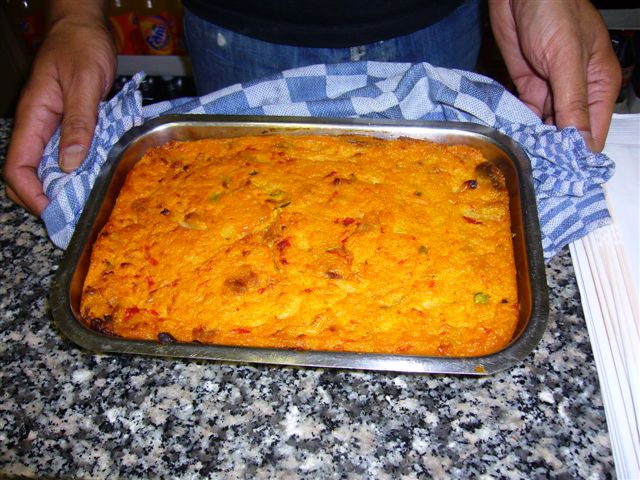
Pom
Surinamese baked dish of grated root and chicken with citrus
Pom is a baked casserole from Suriname, made with grated arrowleaf elephant ear root (pomtajer), chicken, and citrus juice. It is a favourite at celebrations in Surinamese communities, both in Suriname and the Netherlands. The dish is often served at festive gatherings and has become a symbol of Surinamese cuisine.
- Pom uses grated arrowleaf elephant ear root instead of potato
- It is the most popular festive dish among Surinamese people
- Chicken and citrus juice are always included
- Broodje pom is pom served in a bread roll
- Pom is widely eaten in Suriname and the Netherlands
What is Pom?
Pom is a casserole that brings together grated pomtajer (the root of the arrowleaf elephant ear plant), pieces of chicken, and citrus juice. The root is pale and starchy, and when baked, it forms a golden crust. The dish is layered, with chicken in the middle and the grated root above and below. Tomatoes, onions, and spices like nutmeg are also added. The result is a savoury, aromatic bake that is both hearty and tangy.
Where does Pom come from?
Pom has roots in Suriname’s colonial history. It is linked to the Portuguese-Jewish community, who adapted a European potato casserole to local conditions. Since potatoes did not grow well in Suriname, cooks used pomtajer instead. The first known written account of pom dates back to the early 20th century, describing it as a pie of grated root and chicken or fish, flavoured with bitter orange juice. Over time, pom became a favourite for celebrations and is now a staple at Surinamese gatherings.
How is Pom made?
To prepare pom, the corm of the pomtajer plant is peeled and grated. Chicken is cooked and placed between two layers of the grated root. The mixture is moistened with citrus juice and a sauce of tomatoes, onions, and spices. Everything is assembled in a baking dish and cooked in the oven until the top is browned and the flavours meld. Only the underground stem of the pomtajer is used for this dish.
How and when is Pom eaten?
Pom is usually served hot as a main course during lunch or dinner, especially at festive occasions. It is central to Surinamese celebrations and is often found at family gatherings. In the Netherlands, it is also popular in Surinamese restaurants and takeaways. A well-known variation is 'broodje pom', where the baked dish is served in a bread roll, making it easy to eat as a snack or quick meal.
Kinds of Pom
While chicken is the most common filling, some versions use fish instead. In the Netherlands, 'broodje pom' has become widespread, offering a portable way to enjoy the dish. The essential elements remain the same: grated pomtajer, a savoury filling, and citrus for brightness. Modern recipes may adapt the seasoning or add other vegetables, but the core remains unchanged.
What Pom means
Pom is deeply woven into Surinamese identity and is seen as the country’s most beloved festive dish. It is a symbol of celebration and togetherness, especially in Surinamese communities abroad. In the Netherlands, pom is widely available in Surinamese eateries and has even inspired exhibitions about its cultural role. Its presence in cookbooks and restaurants reflects its importance to Surinamese heritage.
Questions people ask about Pom
What is pom made of?
Pom is made from grated arrowleaf elephant ear root (pomtajer), chicken, citrus juice, tomatoes, onions, and spices such as nutmeg.
Where does pom come from?
Pom comes from Suriname and is especially popular in Surinamese communities in both Suriname and the Netherlands.
How is pom usually served?
Pom is baked and served hot, often as a main dish at festive gatherings or family meals. It can also be found in a bread roll as 'broodje pom.'
Is pom vegetarian?
No, pom is traditionally made with chicken, though some versions may use fish. The classic dish is not vegetarian.
What does pom taste like?
Pom has a savoury and tangy flavour, with a golden crust from baking and a filling that combines the earthiness of pomtajer root with the richness of chicken and the brightness of citrus.
Good reading and sources
The facts on this page come from the Wikipedia article "Pom (dish)", written by its contributors and used under the CC BY-SA 4.0 licence, and from its Wikidata record (CC0). Thali rewrote the text in its own words, with AI assistance, and compares every page with the article to make sure no passage is copied. It may be reused under the same CC BY-SA 4.0 licence with a link back.
It may contain mistakes, and it is not dietary or allergy advice: recipes differ from cook to cook. If something is wrong, tell us. Last refreshed 2026-10-03.
More from Suriname
All the food of Suriname Roti
🇮🇳 India and 5 moreUnleavened flatbread made from whole-wheat flour, common across South Asia and beyond
Bread, Breakfast, Lunch
Roti
🇮🇳 India and 5 moreUnleavened flatbread made from whole-wheat flour, common across South Asia and beyond
Bread, Breakfast, Lunch
 Nasi goreng
🇮🇩 Indonesia and 5 moreSoutheast Asian fried rice seasoned with sweet soy sauce and spices
Main dish, Breakfast, Lunch
Nasi goreng
🇮🇩 Indonesia and 5 moreSoutheast Asian fried rice seasoned with sweet soy sauce and spices
Main dish, Breakfast, Lunch
 Soto
🇮🇩 Indonesia and 3 moreIndonesian soup of spiced broth, meat and vegetables with many regional versions
Soup, Lunch, Dinner
Soto
🇮🇩 Indonesia and 3 moreIndonesian soup of spiced broth, meat and vegetables with many regional versions
Soup, Lunch, Dinner
 Nasi udukꦤꦱꦶꦮꦸꦢꦸꦏ꧀
🇮🇩 Indonesia and 2 moreSteamed coconut rice with spices, served with assorted side dishes
Main dish, Breakfast, Lunch
Nasi udukꦤꦱꦶꦮꦸꦢꦸꦏ꧀
🇮🇩 Indonesia and 2 moreSteamed coconut rice with spices, served with assorted side dishes
Main dish, Breakfast, Lunch
Its cousins elsewhere
All main dishes Freekehفريكة
🇵🇸 Palestine and 5 moreRoasted green durum wheat grains, a staple across the eastern Mediterranean
Main dish, Lunch, Dinner
Freekehفريكة
🇵🇸 Palestine and 5 moreRoasted green durum wheat grains, a staple across the eastern Mediterranean
Main dish, Lunch, Dinner
 Chicken tikka masalaMeat
🇬🇧 United Kingdom and 4 moreRoasted marinated chicken in a creamy, spiced tomato-based sauce
Main dish, Lunch, Dinner
Chicken tikka masalaMeat
🇬🇧 United Kingdom and 4 moreRoasted marinated chicken in a creamy, spiced tomato-based sauce
Main dish, Lunch, Dinner
 Kabsaكبسة
🇸🇦 Saudi Arabia and 4 moreRice and meat cooked with aromatic spices, a staple of the Arabian Peninsula
Main dish, Lunch, Dinner
Kabsaكبسة
🇸🇦 Saudi Arabia and 4 moreRice and meat cooked with aromatic spices, a staple of the Arabian Peninsula
Main dish, Lunch, Dinner
 Jambalaya
🇺🇸 United States and 5 moreLouisiana rice cooked with meats, vegetables and spices in one pot
Main dish, Lunch, Dinner
Jambalaya
🇺🇸 United States and 5 moreLouisiana rice cooked with meats, vegetables and spices in one pot
Main dish, Lunch, Dinner