
Sopaipilla
Fried wheat dough pastry enjoyed sweet or savory across the Americas
Sopaipilla is a fried quick bread or pastry made from leavened wheat dough, sometimes with pumpkin, cut into shapes and deep-fried until puffed. Eaten in Chile, Mexico, Peru, Argentina, Uruguay and the southwestern United States, it can be served as a snack, dessert, or main dish, with sweet or savory toppings or fillings.
- Fried dough that puffs up to form a hollow pocket
- Served sweet with honey or syrup, or savory with sauces or fillings
- Pumpkin is added to the dough in some Chilean versions
- Known as torta frita in Argentina and Uruguay
- Named a state pastry in Texas alongside strudel
What is Sopaipilla?
Sopaipilla is a fried dough pastry, often round, square, or triangular, made from wheat flour dough that is leavened and sometimes enriched with butter, shortening, or pumpkin. The dough is rolled out, cut into pieces, and deep-fried until it puffs up, forming a hollow center. The result is a light, airy bread with a crisp exterior. Depending on the region, sopaipillas can be served plain, with savory sauces or fillings, or topped with sweet syrups, honey, or sugar.
Where does Sopaipilla come from?
The name sopaipilla comes from the Spanish word sopaipa, itself from Mozarabic, meaning bread soaked in oil. This fried bread has roots in Spanish and Moorish cooking, with similar fried doughs found worldwide. Sopaipilla developed in regions of the Americas with Spanish heritage, including Chile, Mexico, Peru, Argentina, Uruguay, and the southwestern United States, each adapting the basic idea to local tastes and ingredients.
How is Sopaipilla made?
To make sopaipillas, wheat flour is mixed with a raising agent and sometimes pumpkin, then combined with shortening or butter, salt, and water to form a dough. The dough is left to rise, then rolled out and cut into shapes. These are deep-fried in oil or tallow until they puff and turn golden. In some places, the dough is pricked with a fork before frying. The size and thickness vary: smaller for desserts, larger for stuffing or savory uses.


How and when is Sopaipilla eaten?
Sopaipillas are eaten in many ways. In Chile, they may be served with pebre (a spicy sauce), cheese, or boiled in sweet chancaca syrup. In Peru, they are often a breakfast food, sometimes flavored with cinnamon. In the United States, especially New Mexico and Texas, they can be served with honey as a dessert, or filled with savory ingredients like meat and cheese for a main course. In Uruguay and Argentina, they are popular snacks, especially on rainy days, sometimes dusted with sugar or eaten with quince cheese.
Kinds of Sopaipilla
Regional differences are strong. Chilean sopaipillas often include pumpkin in the dough and are round and flat, while in southern Chile they may be rhomboid. Peruvian cachanga is larger, thinner, and more rigid, and can be sweet or savory. In New Mexico, sopapillas are pillow-shaped and sometimes filled with meats and cheese. Tex-Mex versions are always sweet, coated with cinnamon sugar. In Uruguay and Argentina, torta frita is made with tallow and eaten salty or sweet.
What Sopaipilla means
Sopaipillas are tied to local traditions and weather, such as being made at home or sold as street food during winter or rainy days in Chile and Uruguay. In New Mexico and Texas, they are part of regional identity and restaurant culture, sometimes served as a complimentary dessert. Sopaipilla and strudel were named Texas state pastries for a period. The pastry’s adaptability has made it a staple in celebrations and everyday meals across several countries.
Questions people ask about Sopaipilla
What is sopaipilla made of?
Sopaipilla is made from leavened wheat flour dough, sometimes with pumpkin, and includes shortening or butter. The dough is cut into shapes and deep-fried in oil or tallow.
Where does sopaipilla come from?
Sopaipilla is found in several countries with Spanish heritage in the Americas, including Chile, Mexico, Peru, Argentina, Uruguay, and the southwestern United States.
Is sopaipilla sweet or savory?
Sopaipilla can be either sweet or savory. It may be served with honey, syrup, or sugar, or filled with meats, cheese, or served with sauces, depending on the region.
How is sopaipilla typically eaten?
It is eaten as a snack, dessert, or main dish. In some places, it is served with sweet toppings; in others, it is filled with savory ingredients or eaten with sauces.
Are there different versions of sopaipilla?
Yes, versions vary by country. Some include pumpkin in the dough, others are larger or thinner, and some are always sweet or always savory.
Good reading and sources
The facts on this page come from the Wikipedia article "Sopaipilla", written by its contributors and used under the CC BY-SA 4.0 licence, and from its Wikidata record (CC0). Thali rewrote the text in its own words, with AI assistance, and compares every page with the article to make sure no passage is copied. It may be reused under the same CC BY-SA 4.0 licence with a link back.
It may contain mistakes, and it is not dietary or allergy advice: recipes differ from cook to cook. If something is wrong, tell us. Last refreshed 2026-10-03.
More from Chile
All the food of Chile KabochaVeganカボチャ
🇯🇵 Japan and 5 moreA sweet, dense winter squash with edible skin, used in Japanese and Asian cooking
Main dish, Lunch, Dinner
KabochaVeganカボチャ
🇯🇵 Japan and 5 moreA sweet, dense winter squash with edible skin, used in Japanese and Asian cooking
Main dish, Lunch, Dinner
 Empanada
🇪🇸 Spain and 5 morePastry turnovers filled with meat, cheese, or vegetables, baked or fried
Pie or savoury pastry, Lunch, Dinner
Empanada
🇪🇸 Spain and 5 morePastry turnovers filled with meat, cheese, or vegetables, baked or fried
Pie or savoury pastry, Lunch, Dinner
 Alfajor
🇦🇷 Argentina and 4 moreSweet biscuits or pastry joined with a filling, often dulce de leche or honey and nuts
Sweet or dessert, Snacks
Alfajor
🇦🇷 Argentina and 4 moreSweet biscuits or pastry joined with a filling, often dulce de leche or honey and nuts
Sweet or dessert, Snacks
 Pastel de chocloMeat
🇨🇱 Chile and 4 moreSavory pie of sweetcorn topping over a spiced meat filling
Main dish, Lunch, Dinner
Pastel de chocloMeat
🇨🇱 Chile and 4 moreSavory pie of sweetcorn topping over a spiced meat filling
Main dish, Lunch, Dinner
Its cousins elsewhere
All pies and savoury pastries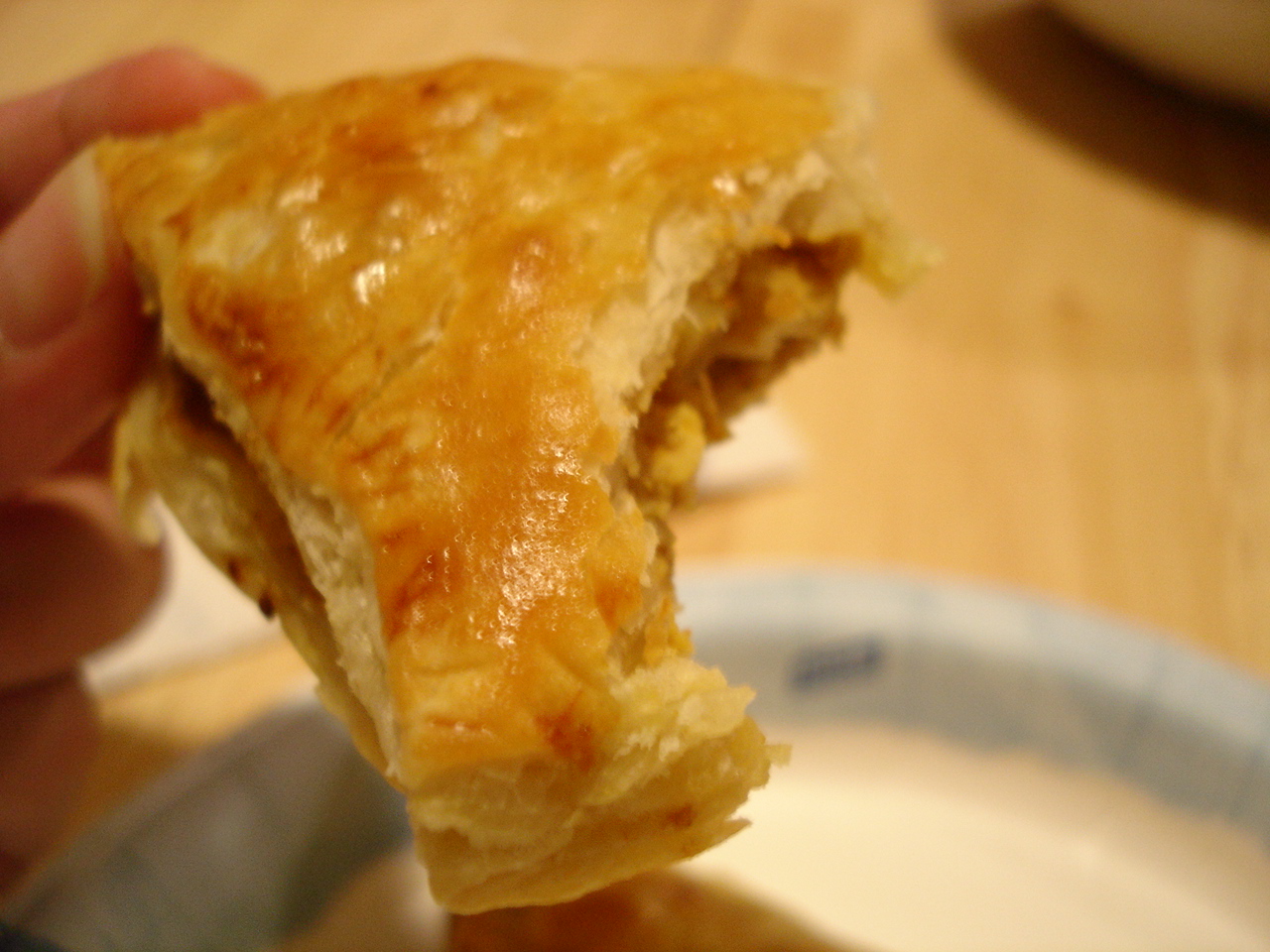 Curry puff
🇲🇾 Malaysia and 5 moreA pastry turnover with a thick curry filling, fried or baked
Pie or savoury pastry, Snacks
Curry puff
🇲🇾 Malaysia and 5 moreA pastry turnover with a thick curry filling, fried or baked
Pie or savoury pastry, Snacks
 Pain au chocolatVegetarian
🇫🇷 France and 2 moreA flaky pastry filled with bars of dark chocolate
Pie or savoury pastry, Breakfast, Snacks
Pain au chocolatVegetarian
🇫🇷 France and 2 moreA flaky pastry filled with bars of dark chocolate
Pie or savoury pastry, Breakfast, Snacks
 BanitsaVegetarianбаница
🇧🇬 Bulgaria and 2 moreBulgarian pastry with layers of filo, eggs, yogurt, and white cheese
Pie or savoury pastry, Breakfast, Snacks
Qutab
🇦🇿 Azerbaijan and 2 moreThin dough folded around savory or vegetable fillings and cooked on a griddle
Main dish, Snacks, Lunch
BanitsaVegetarianбаница
🇧🇬 Bulgaria and 2 moreBulgarian pastry with layers of filo, eggs, yogurt, and white cheese
Pie or savoury pastry, Breakfast, Snacks
Qutab
🇦🇿 Azerbaijan and 2 moreThin dough folded around savory or vegetable fillings and cooked on a griddle
Main dish, Snacks, Lunch