Tihlo
In its own language: ጥሕሎ
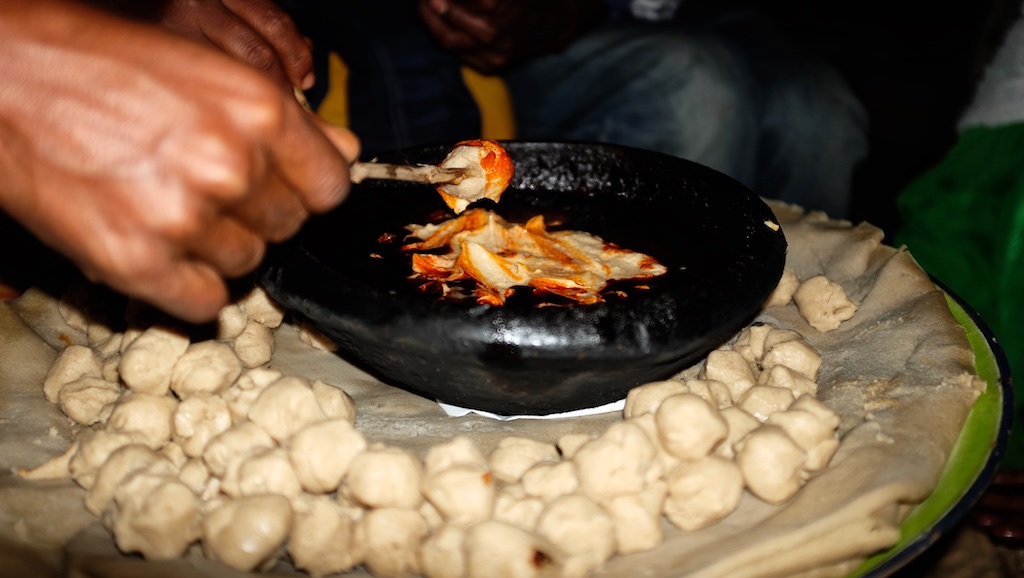
Barley dough balls served with spicy meat stew from Tigray, Ethiopia
Tihlo is a traditional food from the Agame area in Tigray, Ethiopia, made of small balls of roasted barley dough served with a spicy meat and berbere sauce. It is usually eaten as a snack or side dish, especially during cultural holidays in Tigrayan communities.
- Made from roasted barley dough shaped into small balls
- Served with spicy meat stew flavored with berbere
- Eaten using a two-pronged wooden fork called shint’ar
- Traditional to the Agame region in Tigray, Ethiopia
What is Tihlo?
Tihlo is made from barley flour that has been roasted, moistened, and kneaded into a smooth dough. The dough is shaped into small balls, which are arranged around a bowl of spicy stew made with meat and berbere, a chili and spice blend common in Ethiopian cooking. The dish is eaten with a special two-pronged wooden fork called a shint’ar. Tihlo is often served with yoghurt and has a hearty, earthy flavor from the barley, balanced by the heat and depth of the sauce.
Where does Tihlo come from?
Tihlo comes from the Agame region in the Tigray area of northern Ethiopia. It is closely associated with Tigrayan communities and is considered a local specialty. The dish is traditionally prepared for gatherings and cultural holidays, reflecting its roots in communal eating and celebration. While its exact origins are not detailed in the sources, Tihlo’s preparation and serving style are distinct to this part of Ethiopia.
How is Tihlo made?
To make Tihlo, barley grains are first dehulled and ground into flour. The flour is roasted, then mixed with water to form a dough, which is kneaded until smooth. Small balls are pinched off and shaped by hand. These are arranged around a bowl of meat stew, which is flavored with berbere. Diners use a shint’ar fork to pick up the dough balls and dip them into the sauce before eating.
How and when is Tihlo eaten?
Tihlo is commonly eaten as a snack or side dish, but can also be part of a main meal. It is especially popular during cultural holidays and gatherings in Tigrayan communities. The use of the shint’ar fork to dip the dough balls into the stew is a key part of the experience. Tihlo may be served with yoghurt, which helps balance the spiciness of the berbere sauce.
Kinds of Tihlo
The sources do not list specific variations of Tihlo, but the basic elements—barley dough balls and spicy meat stew—may be adapted slightly in different households or occasions. Some versions may include yoghurt as a side, and the type of meat or spice level in the sauce can vary.
What Tihlo means
Tihlo holds a special place in Tigrayan culture, often appearing at cultural holidays and community gatherings. Its preparation and sharing are seen as a communal activity, and the use of the shint’ar fork is unique to this dish. Tihlo is less common outside its home region, marking it as a symbol of local identity.
Questions people ask about Tihlo
What is Tihlo made of?
Tihlo is made from roasted barley flour formed into small dough balls, served with a spicy meat stew that uses berbere, a chili and spice blend. Yoghurt may also be served on the side.
Where does Tihlo come from?
Tihlo originates from the Agame region in Tigray, northern Ethiopia, and is especially associated with Tigrayan communities.
How is Tihlo eaten?
Tihlo is eaten by spearing the barley dough balls with a special two-pronged wooden fork called a shint’ar and dipping them into the spicy meat stew.
When is Tihlo usually served?
Tihlo is commonly served as a snack or side dish, especially during cultural holidays and gatherings in Tigrayan communities.
What does the sauce for Tihlo contain?
The sauce for Tihlo is a stew made with meat and berbere, a blend of chili and spices widely used in Ethiopian cooking.
Good reading and sources
The facts on this page come from the Wikipedia article "Tihlo", written by its contributors and used under the CC BY-SA 4.0 licence, and from its Wikidata record (CC0). Thali rewrote the text in its own words, with AI assistance, and compares every page with the article to make sure no passage is copied. It may be reused under the same CC BY-SA 4.0 licence with a link back.
It may contain mistakes, and it is not dietary or allergy advice: recipes differ from cook to cook. If something is wrong, tell us. Last refreshed 2026-10-03.
More from Ethiopia
All the food of Ethiopia HilbetVeganሕልበት
🇪🇷 Eritrea and 1 moreCreamy vegan dip of fava beans, lentils and spices from Eritrea and Ethiopia
Main dish, Lunch, Dinner
OodkacMeat
🇸🇴 Somalia and 3 moreSomali preserved meat cubes cooked and stored in butter
Main dish, Breakfast, Lunch
HilbetVeganሕልበት
🇪🇷 Eritrea and 1 moreCreamy vegan dip of fava beans, lentils and spices from Eritrea and Ethiopia
Main dish, Lunch, Dinner
OodkacMeat
🇸🇴 Somalia and 3 moreSomali preserved meat cubes cooked and stored in butter
Main dish, Breakfast, Lunch
 KochoVeganቆጮ
🇪🇹 EthiopiaFermented flatbread made from the enset plant in Ethiopia
Bread, Lunch, Dinner
KochoVeganቆጮ
🇪🇹 EthiopiaFermented flatbread made from the enset plant in Ethiopia
Bread, Lunch, Dinner
 Beyaynetuበያይነቱ
🇪🇹 Ethiopia and 1 moreEthiopian platter of injera with assorted vegetables and meats
Main dish, Lunch, Dinner
Beyaynetuበያይነቱ
🇪🇹 Ethiopia and 1 moreEthiopian platter of injera with assorted vegetables and meats
Main dish, Lunch, Dinner
Its cousins elsewhere
All main dishes Biryani
🇮🇳 India and 5 moreRice and spiced meat or vegetables layered and cooked together
Main dish, Lunch, Dinner
Blood sausageMeat
🇫🇷 France and 5 moreA sausage made with animal blood, fillers and spices, cooked or dried until firm
Main dish, Lunch, Dinner
Biryani
🇮🇳 India and 5 moreRice and spiced meat or vegetables layered and cooked together
Main dish, Lunch, Dinner
Blood sausageMeat
🇫🇷 France and 5 moreA sausage made with animal blood, fillers and spices, cooked or dried until firm
Main dish, Lunch, Dinner
 CholentMeatטשאָלנט
🇫🇷 France and 5 moreA slow-cooked Jewish stew of meat, beans, grains and potatoes for the Sabbath
Stew or curry, Lunch
CholentMeatטשאָלנט
🇫🇷 France and 5 moreA slow-cooked Jewish stew of meat, beans, grains and potatoes for the Sabbath
Stew or curry, Lunch
 KeşkekMeat
🇹🇷 Turkey and 3 moreA ceremonial wheat and meat stew shared across Turkey, Armenia, and the region
Stew or curry, Lunch, Dinner
KeşkekMeat
🇹🇷 Turkey and 3 moreA ceremonial wheat and meat stew shared across Turkey, Armenia, and the region
Stew or curry, Lunch, Dinner