Places to eat
Dhaba
The roadside eating house of North India and Pakistan: fresh bread from a clay oven, dal, tea and a rope cot to rest on.
Presented by ClearTrust Free for cooks, travellers and the curious.
A dhaba is a simple restaurant beside a highway. It began as a stop for truck drivers on long hauls, open at all hours, serving hot Punjabi food cooked in view of the road. City people now drive out of town just to eat at a well-known one.

What it is
The traditional dhaba is open-fronted, with a clay tandoor oven and large pots near the entrance. Seating is on charpais, wooden cots strung with rope, with a plank laid across as a table. The food is filling and rich in butter and ghee: black lentils simmered for hours, chickpeas, kidney beans, mustard greens, stuffed flatbreads, tandoori bread, yoghurt and raw onion. Some dhabas are fully vegetarian. Others are known for chicken and mutton. Tea is strong, milky and sweet, and lassi comes in tall steel glasses.
Where it comes from
Dhabas are most closely tied to Punjab and to the Grand Trunk Road, the old highway that runs across the north of the subcontinent. Punjabi truckers wanted the food of home, and Punjabi families set up kitchens along the routes to serve it. After the partition of 1947 many displaced Punjabis opened dhabas in Delhi and other cities. The style of cooking they served, including tandoori dishes, shaped what much of the world now thinks of as North Indian restaurant food.
How it works
You park, wash your hands at a tap, and sit. There may be a painted menu on the wall or the server may simply recite it. Bread is made to order and arrives in batches, hot from the oven, as you eat. A blob of white butter is often added without asking. You pay at the counter. Many dhabas never close. The village of Murthal, on the highway north of Delhi, is famous for stuffed parathas.
How to do it
- Choose a dhaba with many trucks or cars parked outside.
- Order a dal, one vegetable or meat dish and bread to start.
- Ask for bread a few pieces at a time so it stays hot.
- Have lassi with the meal or tea after it.
- Pay at the counter when you leave.
Good manners
- Eat with your right hand, tearing bread to scoop the food.
- Check whether a dhaba is vegetarian before asking for meat.
- Rope cots are for sitting and resting. Take your shoes off first.
What is eaten
 Dal makhaniCreamy black lentils slow-cooked with butter and spices
 ParathaLayered flatbread from the Indian subcontinent, often fried and sometimes stuffed
 Butter chickenChicken in a rich, creamy tomato and butter sauce
 Sarson ka saagMustard greens cooked with spices, a winter dish from Punjab
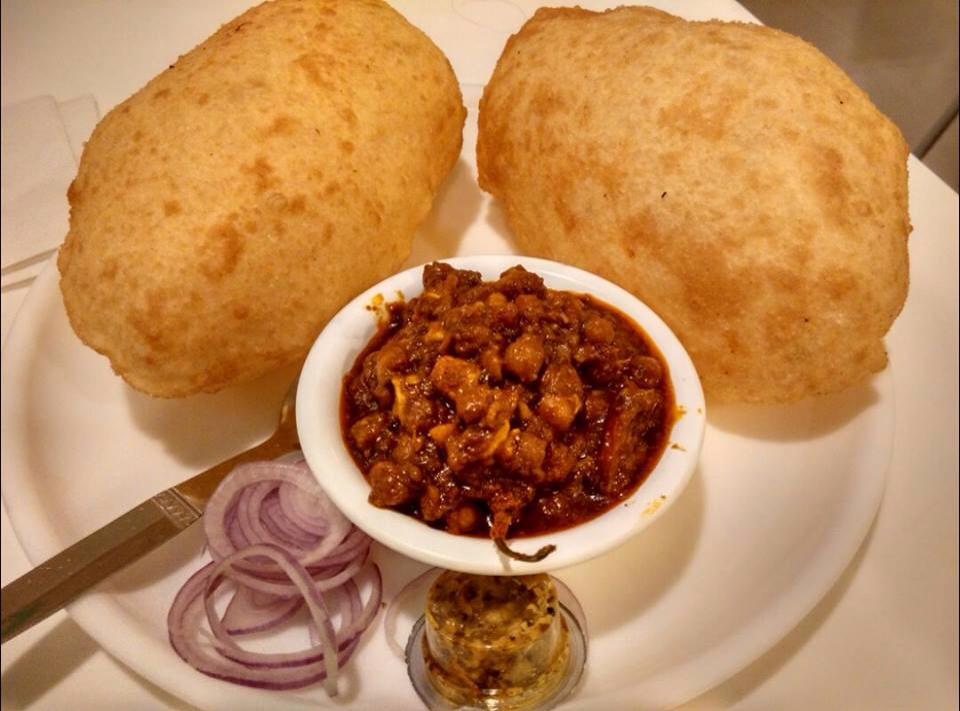 Chole bhatureChickpea curry served with deep-fried, puffy bread
 RajmaKidney beans stewed with spices, often served with rice in North India and NepalNaanLeavened flatbread baked in a tandoor or on a pan, soft and spotted with golden brown
 LassiYogurt blended with water and spices, served chilled
Sources and further reading
Original text by the Thali desk, written with AI assistance and checked against the sources above. Customs vary from place to place. If we have something wrong, tell us.
Photo credits on this page
The small pictures above come from Wikimedia Commons under free licences. Some are cropped to fit.
- Paratha: Wagaung at English Wikipedia, CC BY-SA 3.0, source
- Lassi: Swami Stream, CC BY 2.0, source
- Butter chicken: stu_spivack, CC BY-SA 2.0, source
- Rajma: Monali.mishra, CC BY-SA 4.0, source
- Dal makhani: Charles Haynes, CC BY-SA 2.0, source
- Chole bhature: MaharajaMandy, CC BY-SA 4.0, source
- Sarson ka saag: Biswarup Ganguly, CC BY 3.0, source