🇦🇿 The food of Azerbaijan
16 dishes from Azerbaijan, best known first, across 2 cities and regions.
Azerbaijani cooking blends influences from the Middle East, Turkic, Iranian, and Eastern European traditions, shaped by grassland agriculture and the Caspian Sea. Meals center on rice, meats, dairy, and abundant herbs, with copper cookware and distinct serving customs setting it apart. Plov, kebabs, and thick soups are key, and black tea is a staple at gatherings.
- Over 200 types of plov are made in Azerbaijan.
- Saffron is used in more than 50 national dishes.
- Black tea is served after meals and to guests.
- Copper cookware is traditional and still in use.
- Caspian sturgeon and caviar are prized local foods.
The cooking of Azerbaijan
Azerbaijani food draws from a mix of cultures due to its location between Europe and Asia and its history of shifting empires. The cuisine is rich in meats, dairy, fish, and fresh produce, with rice and bread as daily essentials. Herbs and spices, especially saffron, mint, and sumac, are used generously. Traditional methods, like cooking with copper pots, are still valued. Meals often feature several courses, with plov (rice with accompaniments) as a highlight. Soups are thick and hearty, and kebabs are common. The use of dried fruits, nuts, and a variety of breads adds depth. Black tea is served after meals and to guests, often with fruit preserves.
Staple foods in Azerbaijan
Rice, flour-based breads like lavash and tandoor bread, and dairy products such as butter, cheese, and yogurt are everyday foods. Lamb, beef, poultry, and fish from the Caspian Sea are main proteins. Vegetables like eggplant, tomato, and greens, along with herbs such as coriander and dill, are widely used. Saffron and sumac are signature seasonings.
Breakfast in Azerbaijan 1 dish
Breakfast often features dairy—cheese, butter, cream—alongside honey, tandoori bread, and eggs, which may be scrambled or made into kuku (an herb omelet). Sometimes, foods like porridge, quark, and crepes appear, reflecting Eastern European influence from past Russian rule.
Snacks and street food in Azerbaijan
Light snacks include plates of fresh herbs (goy), bread, white cheese, sour yogurt (qatik), and pickles (turshu). These are served before or with main dishes, in a style similar to Turkish meze. Such snacks are meant to stimulate the appetite before richer courses like soups, meats, or plov.
Sweets and drinks in Azerbaijan
Sticky pastries like pakhlava and shaki halva, along with nut-filled shekerbura and badambura, are traditional sweets. Fruit preserves (murabba) are eaten with tea or added to it. Black tea, often made in a samovar, is the main drink, with ayran (a salty yogurt beverage) and sherbet (sweet fruit drinks) also popular. Wine is produced locally and has ancient roots.
From region to region in Azerbaijan
Dishes and ingredients vary by region. Shaki in the northwest is known for its special halva. The Absheron Peninsula grows saffron, a key spice. The Caspian coast provides sturgeon and caviar, while regions like Tovuz are famous for wine-making. Rural areas often make their own butter and cheeses using traditional methods.
At the table in Azerbaijan
Meals are usually three courses, starting with snacks or soup, followed by main dishes like plov or kebabs, and ending with tea and fruit or sweets. Food is often served in copper dishes. Plov is served on separate platters—rice, accompaniments, and herbs are not mixed. Tea is offered to guests as a sign of hospitality.
Festival and religious food in Azerbaijan
Special occasions, such as Nowruz (the spring festival), feature lamb dishes and elaborate plovs. Sweets like pakhlava and shekerbura are made for weddings and wakes. On festive days, rare meats like goose or pheasant may be served, and tea with preserves is shared among family and guests.
The facts in this overview come from the Wikipedia article "Azerbaijani cuisine", written by its contributors and used under the CC BY-SA 4.0 licence. Thali rewrote the text in its own words, with AI assistance, and compares every page with the article to make sure no passage is copied. It may be reused under the same CC BY-SA 4.0 licence with a link back.
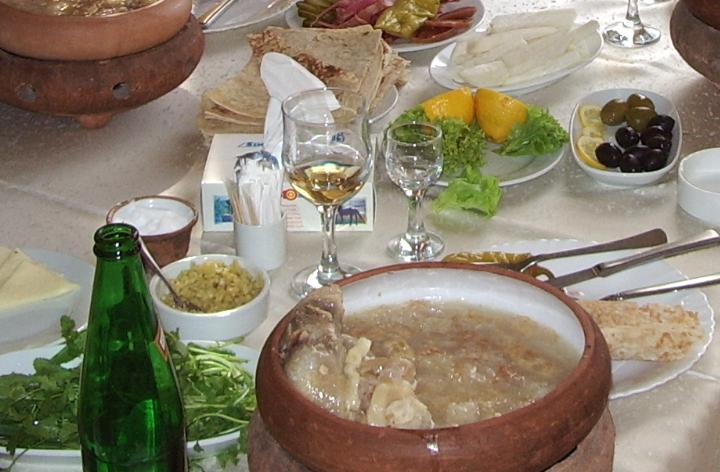 KhashMeatխաշ
🇦🇲 Armenia and 5 moreA rich stew of slow-cooked cow or sheep parts, eaten across the Caucasus and Middle East
Stew or curry, Breakfast
KhashMeatխաշ
🇦🇲 Armenia and 5 moreA rich stew of slow-cooked cow or sheep parts, eaten across the Caucasus and Middle East
Stew or curry, Breakfast
 Fesenjānفسنجان
🇮🇷 Iran and 5 morePersian stew of pomegranate, walnuts and poultry, served with rice
Main dish, Dinner
Fesenjānفسنجان
🇮🇷 Iran and 5 morePersian stew of pomegranate, walnuts and poultry, served with rice
Main dish, Dinner
 PitiMeat
🇦🇿 Azerbaijan and 3 moreMutton and chickpea stew slow-cooked in a sealed crock
Stew or curry, Lunch, Dinner
PitiMeat
🇦🇿 Azerbaijan and 3 moreMutton and chickpea stew slow-cooked in a sealed crock
Stew or curry, Lunch, Dinner
 AbgooshtMeatآبگوشت
🇮🇷 Iran and 2 morePersian lamb and chickpea stew served in stoneware pots
Main dish, Lunch, Dinner
AbgooshtMeatآبگوشت
🇮🇷 Iran and 2 morePersian lamb and chickpea stew served in stoneware pots
Main dish, Lunch, Dinner
 Kuru fasulye
🇹🇷 Turkey and 1 moreTurkish white bean stew with tomato, onion and olive oil
Stew or curry, Lunch, Dinner
Kuru fasulye
🇹🇷 Turkey and 1 moreTurkish white bean stew with tomato, onion and olive oil
Stew or curry, Lunch, Dinner
Photo credits on this page
The small pictures above come from Wikimedia Commons under free licences. Some are cropped to fit.
- Abgoosht: RezAzizi at Persian Wikipedia, Public domain, source
- Khash: Chaojoker, CC BY-SA 3.0, source
- Piti: Tərxan Paşazadə, CC BY-SA 3.0, source
- Fesenjān: stringparts, CC BY 2.0, source
- Kuru fasulye: E4024, CC BY-SA 4.0, source