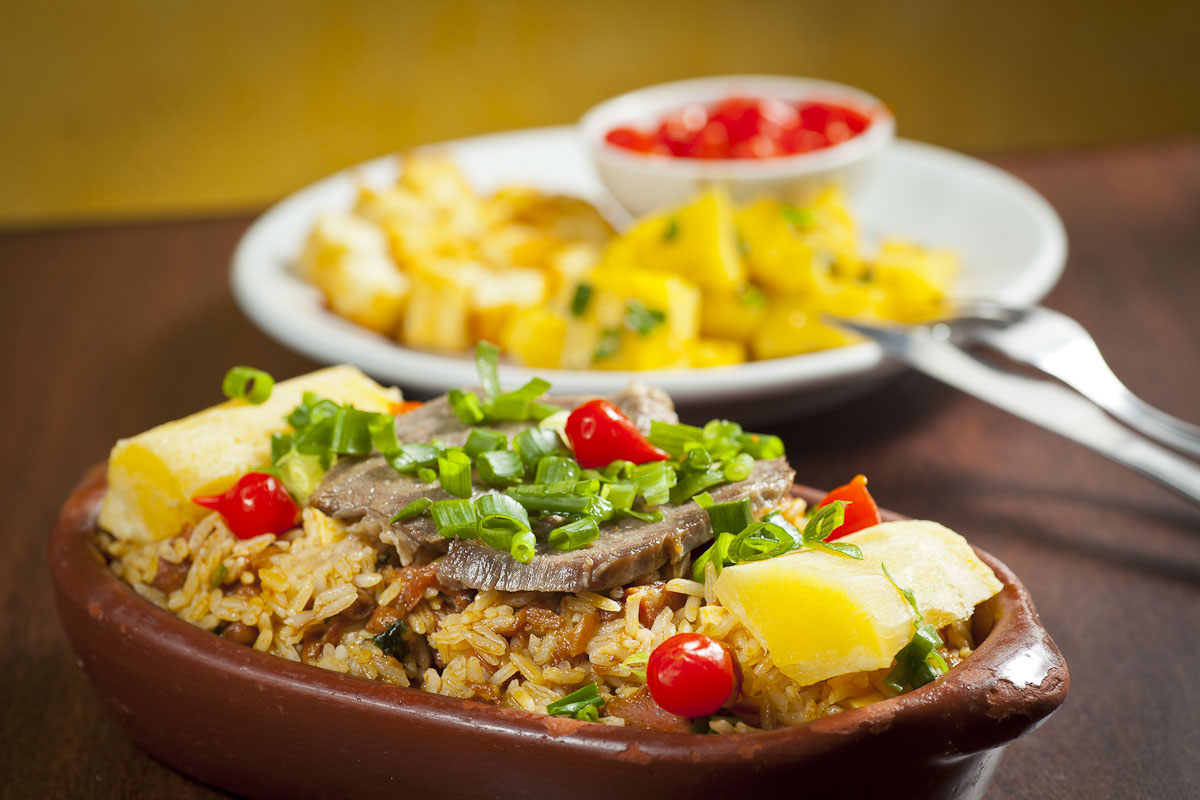
Baião de dois
Rice and beans cooked together, often with cheese and dried meat, from Northeast Brazil
Baião de dois is a Brazilian dish from Ceará and the Northeast, made by simmering rice and beans together, often with queijo coalho (a firm cheese) and sometimes dried meat or cassava. It is a staple in rural areas and has local versions, such as rubacão in Paraíba and Pernambuco. The dish is usually eaten for dinner, using leftover beans from earlier in the day.
- Rice and beans are cooked together in one pot
- Queijo coalho cheese is often mixed in
- Dried meat is common in some regions but not in Ceará
- Rubacão is a well-known local variant
- Named after a regional music and dance style
What is Baião de dois?
Baião de dois is a hearty dish where rice and beans are cooked together, often with local ingredients like queijo coalho, a firm cheese that holds its shape when heated. Some versions include dried meat or cassava, especially outside Ceará. The beans used are usually fresh or new varieties common in Brazil. The finished dish is moist, with the grains and beans blending together, and is often seasoned with onion, tomato, pepper, coriander, and chives.
Where does Baião de dois come from?
This dish comes from Ceará in Northeast Brazil and is now common across the wider region, as well as parts of the North. Its name links to baião, a local music and dance, and 'dois' refers to the two main ingredients. The combination of rice and beans has long been a practical choice in rural areas, making use of what is available and stretching leftovers. Folklorists have traced its mention back to at least the 1940s.
How is Baião de dois made?
To prepare baião de dois, beans are first cooked, and then rice is added to the pot so both simmer together in the bean broth. Onion, tomato, pepper, coriander, and chives are added for flavor. In many places, queijo coalho cheese and sometimes cream are stirred in at the end. Dried meat may be included in some regions, but not in Ceará. The result is a unified, flavorful dish.
How and when is Baião de dois eaten?
Baião de dois is usually served hot, often in the evening, making use of beans left from earlier meals. It is a common everyday food, especially in rural households. People may eat it on its own or with sides like cassava. The dish is filling and practical, suited to family meals and gatherings.
Kinds of Baião de dois
In Paraíba and Pernambuco, a similar dish called rubacão is popular, especially in the Sertão area. While the base of rice and beans stays the same, additions like dried meat or cassava vary by region. The choice of bean type and whether cheese or cream is used also changes from place to place.
What Baião de dois means
Baião de dois is closely tied to the culture of Northeast Brazil, both in its name and its role as a staple food. Its connection to local music and dance highlights its place in regional identity. The dish is practical and beloved, representing the resourcefulness and tastes of rural communities.
Questions people ask about Baião de dois
What is baião de dois made of?
It is made by cooking rice and beans together, usually with onion, tomato, pepper, coriander, and chives. Many versions also include queijo coalho cheese, and some add dried meat or cassava.
Where does baião de dois come from?
Baião de dois comes from Ceará in Northeast Brazil, but it is now common throughout the Northeast and parts of the North.
Is baião de dois vegetarian?
It can be vegetarian if made without dried meat, but some versions include meat. Cheese is a usual ingredient, so it is not vegan.
When is baião de dois usually eaten?
It is typically eaten at dinner, often using leftover beans from earlier in the day. It is a regular, everyday meal in many rural homes.
Are there different versions of baião de dois?
Yes, there are regional variations. In Paraíba and Pernambuco, a similar dish called rubacão is popular, and ingredients like dried meat or cassava may be added depending on the area.
Good reading and sources
- Baião de dois on WikipediaEncyclopedia
- More photos on Wikimedia CommonsPhotos
- Wikidata recordOpen data
The facts on this page come from the Wikipedia article "Baião de dois", written by its contributors and used under the CC BY-SA 4.0 licence, and from its Wikidata record (CC0). Thali rewrote the text in its own words, with AI assistance, and compares every page with the article to make sure no passage is copied. It may be reused under the same CC BY-SA 4.0 licence with a link back.
It may contain mistakes, and it is not dietary or allergy advice: recipes differ from cook to cook. If something is wrong, tell us. Last refreshed 2026-10-03.
More from Brazil
All the food of Brazil PolentaVegan
🇮🇹 Italy and 5 moreBoiled cornmeal porridge from northern Italy, served soft or set and sliced
Main dish
PolentaVegan
🇮🇹 Italy and 5 moreBoiled cornmeal porridge from northern Italy, served soft or set and sliced
Main dish
 ChorizoMeat
🇪🇸 Spain and 5 moreA seasoned pork sausage from the Iberian Peninsula, made in many regional styles
Sausage or cured food, Breakfast, Lunch
ChorizoMeat
🇪🇸 Spain and 5 moreA seasoned pork sausage from the Iberian Peninsula, made in many regional styles
Sausage or cured food, Breakfast, Lunch
 Steak tartareMeat
🇫🇷 France and 5 moreRaw minced beef, seasoned and often topped with a raw egg yolk
Main dish, Lunch, Dinner
Steak tartareMeat
🇫🇷 France and 5 moreRaw minced beef, seasoned and often topped with a raw egg yolk
Main dish, Lunch, Dinner
Its cousins elsewhere
All main dishes Fajita
🇲🇽 Mexico and 1 moreGrilled meat and peppers served with tortillas and toppings
Main dish, Lunch, Dinner
Fajita
🇲🇽 Mexico and 1 moreGrilled meat and peppers served with tortillas and toppings
Main dish, Lunch, Dinner
 Gallo PintoVegan
🇨🇷 Costa Rica and 1 moreRice and beans cooked together, a staple in Costa Rica and Nicaragua
Main dish, Breakfast, Lunch
Gallo PintoVegan
🇨🇷 Costa Rica and 1 moreRice and beans cooked together, a staple in Costa Rica and Nicaragua
Main dish, Breakfast, Lunch
 HamburgerMeat
🇺🇸 United States and 1 moreA hot ground meat patty in a sliced bun, often with salad and sauces
Main dish, Lunch, Dinner
HamburgerMeat
🇺🇸 United States and 1 moreA hot ground meat patty in a sliced bun, often with salad and sauces
Main dish, Lunch, Dinner
 Kebabكَبَاب
🇹🇷 Turkey and 5 moreGrilled or roasted meat, often on skewers, found across the Middle East and beyond
Main dish, Lunch, Dinner
Kebabكَبَاب
🇹🇷 Turkey and 5 moreGrilled or roasted meat, often on skewers, found across the Middle East and beyond
Main dish, Lunch, Dinner