
Chiles en nogada
Poblano chiles stuffed with fruit and meat, topped with walnut sauce and pomegranate
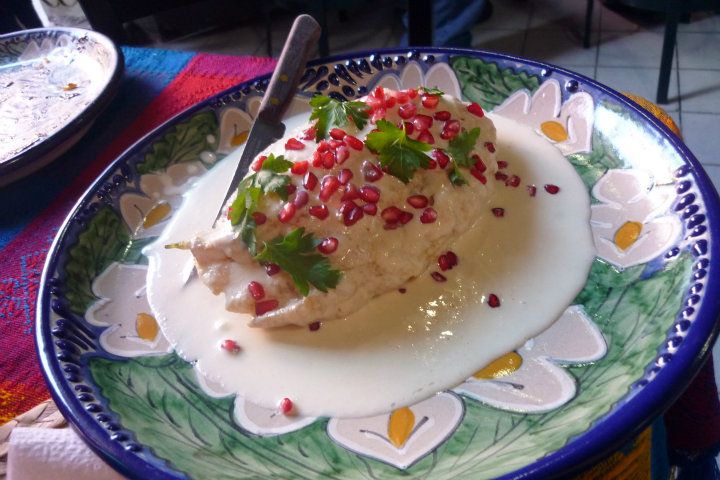
Chiles en nogada is a main dish from Mexico, especially Puebla, made with poblano chiles filled with a mixture of minced meat, local fruits and spices, covered in a creamy walnut sauce, and garnished with pomegranate seeds and parsley. It is usually served at room temperature in late summer and early autumn, when pomegranates are in season.
- Stuffed poblano chiles with a sweet and savory meat and fruit filling
- Topped with a creamy walnut sauce called nogada
- Garnished with pomegranate seeds and parsley
- Colors represent the Mexican flag
- Traditionally served in Puebla during Independence Day season
What is Chiles en nogada?
Chiles en nogada is a dish where large green poblano chiles are filled with a sweet and savory mixture called picadillo. This filling combines minced meat with local fruits such as panochera apple, sweet-milk pear, and criollo peach, along with spices and aromatics. The stuffed chiles are covered in a smooth, creamy sauce made from walnuts, milk, cream, fresh cheese, and a touch of sherry. The dish is finished with a scattering of bright red pomegranate seeds and parsley, echoing the colors of the Mexican flag.
Where does Chiles en nogada come from?
This dish comes from Puebla, Mexico, and is closely linked to the country's independence. According to tradition, it was first made to honor Agustín de Iturbide after the signing of the Treaty of Córdoba. There is some debate about its creators: some historians credit the Monjas Clarisas, while others point to the Madres Contemplativas Agustinas of the Santa Mónica convent in Puebla. Over time, chiles en nogada has become a symbol of national pride in Puebla and across Mexico.
How is Chiles en nogada made?
To make chiles en nogada, poblano chiles are roasted, peeled, and carefully seeded. The picadillo filling is prepared by cooking minced meat with diced apple, pear, and peach, along with spices and aromatics. This mixture is stuffed into the chiles. The nogada sauce is blended from walnuts (traditionally Castilian walnuts), milk, cream, fresh cheese, and sometimes sherry. The filled chiles are covered with the sauce and topped with pomegranate seeds and parsley before serving at room temperature.


How and when is Chiles en nogada eaten?
Chiles en nogada is usually eaten in late summer and early autumn, especially in August and September, when pomegranates are available. It is often served for lunch or dinner during celebrations, particularly around Mexican Independence Day. The dish is enjoyed at family gatherings and in restaurants, especially in Puebla. It is typically served on its own, as the centerpiece of the meal.
Kinds of Chiles en nogada
While the classic version uses Castilian walnuts for the sauce, some cooks use pecans instead or mix them with walnuts. The fruit in the filling may vary depending on what is available locally. Although the dish is most closely tied to Puebla, it is also made in other parts of Central Mexico, with slight differences in the filling or sauce.
What Chiles en nogada means
Chiles en nogada is widely seen as a national dish of Mexico, celebrated for its connection to independence and its use of local, seasonal ingredients. The colors of the dish—green, white, and red—are a tribute to the Mexican flag. Its preparation and enjoyment are a source of pride in Puebla, where it is a highlight of the Independence Day festivities.
Questions people ask about Chiles en nogada
What is chiles en nogada made of?
It is made from poblano chiles stuffed with minced meat, local fruits like apple, pear, and peach, then covered with a walnut-based cream sauce and topped with pomegranate seeds and parsley.
Where does chiles en nogada come from?
Chiles en nogada comes from Puebla, Mexico, and is especially associated with the country's Independence Day celebrations.
When is chiles en nogada usually eaten?
It is typically eaten in late summer and early autumn, especially in August and September, when pomegranates are in season and around Independence Day.
What does the name 'nogada' mean?
Nogada refers to the creamy sauce made from walnuts (nogal means walnut tree in Spanish) that covers the stuffed chiles.
Is chiles en nogada always made with meat?
The traditional filling includes minced meat along with fruits and spices, though some variations may exist.
Good reading and sources
- Chiles en nogada on WikipediaEncyclopedia
- More photos on Wikimedia CommonsPhotos
- Wikidata recordOpen data
The facts on this page come from the Wikipedia article "Chiles en nogada", written by its contributors and used under the CC BY-SA 4.0 licence, and from its Wikidata record (CC0). Thali rewrote the text in its own words, with AI assistance, and compares every page with the article to make sure no passage is copied. It may be reused under the same CC BY-SA 4.0 licence with a link back.
It may contain mistakes, and it is not dietary or allergy advice: recipes differ from cook to cook. If something is wrong, tell us. Last refreshed 2026-10-03.
More from Mexico
All the food of Mexico Taco
🇲🇽 Mexico and 1 moreA folded tortilla filled with meat, beans or vegetables, eaten by hand
Street food, Lunch, Dinner
Blood sausageMeat
🇫🇷 France and 5 moreA sausage made with animal blood, fillers and spices, cooked or dried until firm
Main dish, Lunch, Dinner
Taco
🇲🇽 Mexico and 1 moreA folded tortilla filled with meat, beans or vegetables, eaten by hand
Street food, Lunch, Dinner
Blood sausageMeat
🇫🇷 France and 5 moreA sausage made with animal blood, fillers and spices, cooked or dried until firm
Main dish, Lunch, Dinner
 MolleteVegetarian
🇲🇽 Mexico and 6 moreOpen-faced Mexican sandwich with refried beans and melted cheese
Bread, Breakfast, Snacks
MolleteVegetarian
🇲🇽 Mexico and 6 moreOpen-faced Mexican sandwich with refried beans and melted cheese
Bread, Breakfast, Snacks
 BarbacoaMeat
🇲🇽 Mexico and 3 moreMeat slow-cooked in a pit lined with agave or banana leaves
Main dish, Lunch, Dinner
BarbacoaMeat
🇲🇽 Mexico and 3 moreMeat slow-cooked in a pit lined with agave or banana leaves
Main dish, Lunch, Dinner
Its cousins elsewhere
All main dishes BobotieMeat
🇿🇦 South Africa and 5 moreSpiced minced meat baked with an egg topping, often with dried fruit
Main dish, Lunch, Dinner
BobotieMeat
🇿🇦 South Africa and 5 moreSpiced minced meat baked with an egg topping, often with dried fruit
Main dish, Lunch, Dinner
 Moussakaμουσακάς
🇬🇷 Greece and 5 moreBaked casserole of eggplant or potato, often layered with meat and sauce
Main dish, Lunch, Dinner
Moussakaμουσακάς
🇬🇷 Greece and 5 moreBaked casserole of eggplant or potato, often layered with meat and sauce
Main dish, Lunch, Dinner
 French toast
🇫🇷 France and 5 moreBread soaked in egg and milk, pan-fried and served sweet or savoury
Main dish, Breakfast, Snacks
French toast
🇫🇷 France and 5 moreBread soaked in egg and milk, pan-fried and served sweet or savoury
Main dish, Breakfast, Snacks
 Pie
🇬🇧 United Kingdom and 5 moreA baked dish with a pastry crust and sweet or savoury filling
Main dish, Lunch, Dinner
Pie
🇬🇧 United Kingdom and 5 moreA baked dish with a pastry crust and sweet or savoury filling
Main dish, Lunch, Dinner