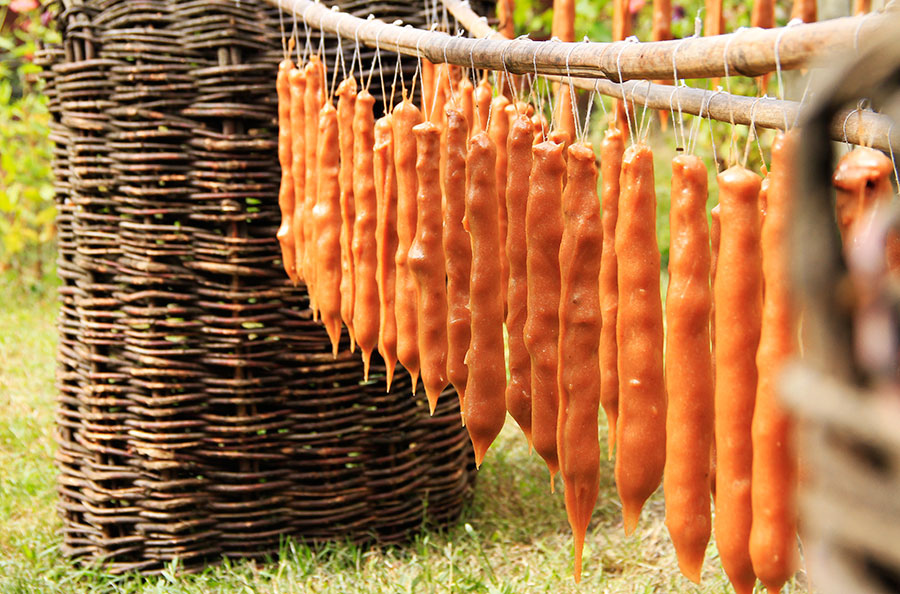
Churchkhela
In its own language: ჩურჩხელა
Candle-shaped Georgian sweet made by dipping nuts in thickened grape juice
Churchkhela is a traditional sweet from Georgia, shaped like a candle and made by dipping strings of nuts into thickened grape must or fruit juice. It is enjoyed as a snack or dessert, especially around New Year and Christmas, and is known for being calorie-rich and portable.
- Made by dipping threaded nuts in thickened grape or fruit juice
- Candle-shaped and dried before eating
- Traditional in many regions of Georgia, especially Kakheti
- Listed as Intangible Cultural Heritage of Georgia since 2015
- Eaten at New Year and Christmas, and as a snack
What is Churchkhela?
Churchkhela is a Georgian sweet that looks like a candle, with a glossy, firm outer layer and a string of nuts inside. Walnuts or hazelnuts are most common, but other nuts can be used. The nuts are threaded onto a string, then dipped in a thick, sweet coating made from grape must (freshly pressed grape juice with skins, seeds, and stems), flour, and sometimes other fruit juices like mulberry. The result is chewy and sweet, with a nutty center.
Where does Churchkhela come from?
Churchkhela comes from Georgia, where it has long been made in various regions. The Kakheti region is especially known for its traditional method, which was recognized as part of Georgia's Intangible Cultural Heritage in 2015. The treat is also found in places like Abkhazia, where it is called adzhindzhukhua. Its origins are tied to the grape harvest and the use of local nuts, making it a seasonal and regional specialty.
How is Churchkhela made?
To make churchkhela, nuts are first threaded onto a string. Grape must is thickened with flour to form a dense, sweet mixture. The strings of nuts are dipped into this mixture, sometimes repeatedly, to build up a coating. In eastern Georgia, wheat flour is used, while in western regions, corn flour is common. The coated strings are then hung to dry, forming a firm, candle-like shape. Variations use mulberry or other fruit juices in place of grape must.


How and when is Churchkhela eaten?
Churchkhela is eaten as a snack between meals or served as a dessert. It is especially popular during New Year and Christmas celebrations in Georgia. Because it is high in calories and keeps well, it was once carried by Georgian soldiers as a portable energy food. Today, it is also a popular souvenir, especially in regions like Abkhazia. It is usually eaten in slices, revealing the nutty core inside.
Kinds of Churchkhela
Different regions of Georgia have their own ways of making churchkhela. In Kakheti, Kartli, and Meskheti, wheat flour is used to thicken the grape must, while in Samtskhe-Javakheti, it is used for mulberry juice. Western regions like Racha and Abkhazia use corn flour and call the thickened grape juice pelamushi. The type of nut and fruit juice can also vary, giving each version a distinct taste and texture.
What Churchkhela means
Churchkhela is more than just a sweet in Georgia; it is part of the country's food heritage. Its traditional preparation in Kakheti is officially recognized as intangible cultural heritage. The treat is closely linked to festive times like Christmas and New Year, and is often given as a gift or souvenir. Its practical value as a high-energy food made it a staple for soldiers in the past.
When Churchkhela is on the table
Questions people ask about Churchkhela
What is churchkhela made of?
Churchkhela is made by threading nuts, usually walnuts or hazelnuts, onto a string and dipping them into a thickened mixture of grape must and flour. Sometimes other fruit juices like mulberry are used.
Where does churchkhela come from?
Churchkhela is a traditional sweet from Georgia, with special ties to regions like Kakheti, Kartli, and Abkhazia. Its preparation is recognized as part of Georgia's cultural heritage.
How is churchkhela eaten?
Churchkhela is eaten as a snack or dessert, often sliced to reveal the nuts inside. It is especially enjoyed during New Year and Christmas celebrations in Georgia.
Is churchkhela vegetarian?
Yes, churchkhela is vegetarian. It is made from nuts, grape must or fruit juice, and flour, with no animal products.
What does churchkhela look like?
Churchkhela is shaped like a candle, with a glossy, firm coating on the outside and a string of nuts running through the center.
Good reading and sources
The facts on this page come from the Wikipedia article "Churchkhela", written by its contributors and used under the CC BY-SA 4.0 licence, and from its Wikidata record (CC0). Thali rewrote the text in its own words, with AI assistance, and compares every page with the article to make sure no passage is copied. It may be reused under the same CC BY-SA 4.0 licence with a link back.
It may contain mistakes, and it is not dietary or allergy advice: recipes differ from cook to cook. If something is wrong, tell us. Last refreshed 2026-10-03.
More from Georgia
All the food of Georgia Kaymak
🇹🇷 Turkey and 5 moreThick, creamy dairy spread made from slowly simmered milk
Sauce, pickle or ferment, Breakfast, Snacks
Kaymak
🇹🇷 Turkey and 5 moreThick, creamy dairy spread made from slowly simmered milk
Sauce, pickle or ferment, Breakfast, Snacks
 WineVegan
🇬🇪 Georgia and 5 moreAlcoholic drink made by fermenting grape juice in many styles and colors
Drink
KhachapuriVegetarianხაჭაპური
🇬🇪 Georgia and 4 moreLeavened bread filled with cheese, sometimes egg, from Georgia
Bread, Breakfast, Lunch
WineVegan
🇬🇪 Georgia and 5 moreAlcoholic drink made by fermenting grape juice in many styles and colors
Drink
KhachapuriVegetarianხაჭაპური
🇬🇪 Georgia and 4 moreLeavened bread filled with cheese, sometimes egg, from Georgia
Bread, Breakfast, Lunch
 Khinkaliხინკალი
🇬🇪 GeorgiaGeorgian dumplings with spiced meat or vegetable filling and a juicy broth inside
Dumpling, Lunch, Dinner
Khinkaliხინკალი
🇬🇪 GeorgiaGeorgian dumplings with spiced meat or vegetable filling and a juicy broth inside
Dumpling, Lunch, Dinner
Its cousins elsewhere
All sweets and desserts LinzertorteVegetarianLinzer Torte
🇦🇹 Austria and 3 moreAustrian shortcrust pastry with fruit preserves and a lattice top
Sweet or dessert, Tea time, Snacks
LinzertorteVegetarianLinzer Torte
🇦🇹 Austria and 3 moreAustrian shortcrust pastry with fruit preserves and a lattice top
Sweet or dessert, Tea time, Snacks
 KahkVegetarianكحك
🇪🇬 EgyptEgyptian shortbread biscuits dusted with powdered sugar, made for Eid and other feasts
Sweet or dessert, Snacks, Tea time
KahkVegetarianكحك
🇪🇬 EgyptEgyptian shortbread biscuits dusted with powdered sugar, made for Eid and other feasts
Sweet or dessert, Snacks, Tea time
 CroissantVegetarian
🇫🇷 France and 5 moreA crescent-shaped, flaky pastry made from layered yeast dough and butter
Pie or savoury pastry, Breakfast, Tea time
CroissantVegetarian
🇫🇷 France and 5 moreA crescent-shaped, flaky pastry made from layered yeast dough and butter
Pie or savoury pastry, Breakfast, Tea time
 Pancake
🇺🇸 United States and 5 moreFlat cakes made from batter, cooked on a griddle or pan and served sweet or savoury
Main dish, Breakfast, Snacks
Pancake
🇺🇸 United States and 5 moreFlat cakes made from batter, cooked on a griddle or pan and served sweet or savoury
Main dish, Breakfast, Snacks