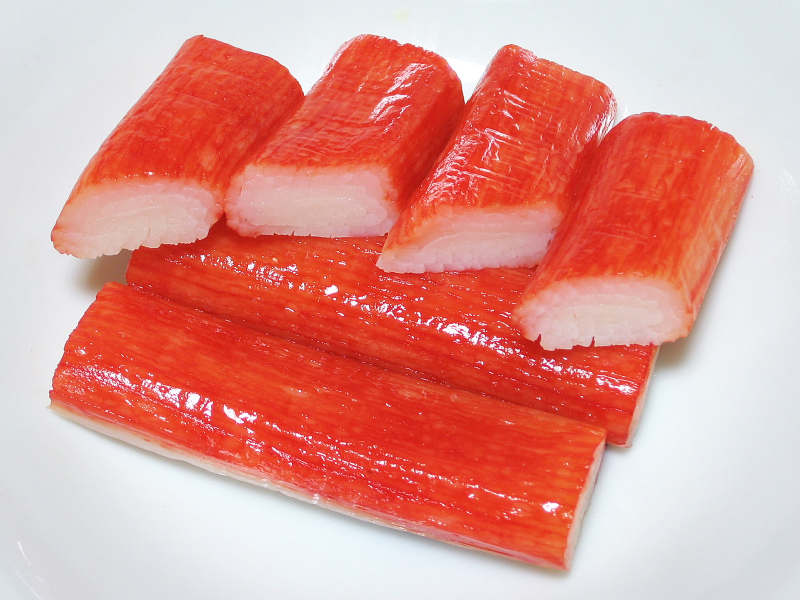
Crab stick
In its own language: カニカマ
Pressed white fish shaped and flavored to mimic crab meat
Crab sticks are a Japanese food made by processing white fish into a paste, shaping it, and adding flavor and color to resemble crab. Developed in Japan in the 1970s, they are now used worldwide in sushi, salads, and cooked dishes. Despite the name, they typically contain no actual crab.
- Invented in Japan in the 1970s
- Made mostly from Alaska pollock
- No real crab is usually included
- Used in sushi, salads, and cooked dishes
- Known as 'kanikama' in Japanese
What is Crab stick?
Crab sticks are a processed seafood product from Japan. They are made by grinding white fish, usually Alaska pollock, into a smooth paste called surimi. This paste is blended with starch, egg, oil, and other binders, then shaped and colored to look like strips of crab. The outside is often tinted red to imitate the appearance of cooked shellfish. The flavor is mild and slightly sweet, with a texture that pulls apart in strands.
Where does Crab stick come from?
Crab sticks were first created in Japan in the 1970s. The company Sugiyo developed and patented a flaked imitation crab in 1974, followed by Osaki Suisan's patent for stick-shaped versions in 1975. The product was introduced to international markets in 1977 through a partnership with a US company. In Japan, the name 'kanikama' combines the words for crab and fish cake.
How is Crab stick made?
To make crab sticks, white fish is minced and washed to form surimi, which is then mixed with starch, oil, egg, and sometimes soy. Flavorings are added, often artificial to mimic the taste of crab. The mixture is shaped into sticks, cured, and a red coating is applied to the outside. The finished product is packaged and ready to eat or cook.


How and when is Crab stick eaten?
Crab sticks are used in many dishes. In Japan and elsewhere, they are common in sushi rolls, salads, and as a topping or filling. They can also be battered and fried, as in tempura. Crab sticks are eaten cold or cooked, depending on the dish. They are popular for their convenience and versatility.
Kinds of Crab stick
While most crab sticks are made from Alaska pollock, other white fish can be used. Some brands add wheat or other fillers, and the flavoring can vary from brand to brand. Internationally, they are sold under names like Sea Legs or Ocean Sticks, and regulations in some countries prevent them from being called 'crab sticks' if they do not contain real crab.
What Crab stick means
Crab sticks are a familiar part of Japanese food culture, especially in convenience foods and sushi. The product's name and appearance have led to legal rules about labeling in some countries. In Japan, 'kanikama' is a standard term, and the product is widely recognized as an affordable substitute for crab.
Questions people ask about Crab stick
What are crab sticks made of?
Crab sticks are made from surimi, which is a paste of white fish such as Alaska pollock. Other ingredients include starch, vegetable oil, egg, soy, sugar, and salt. Crab flavoring and red coloring are added to imitate the look and taste of crab.
Where did crab sticks originate?
Crab sticks were first developed in Japan in the 1970s. The product was created by Japanese companies and later introduced to international markets.
Do crab sticks contain real crab?
Most crab sticks do not contain any actual crab meat. They are made from processed white fish and flavored to taste like crab.
How are crab sticks used in cooking?
Crab sticks are used in sushi, salads, and as a filling or topping in various dishes. They can be eaten cold or cooked, such as being fried in tempura batter.
What is the Japanese name for crab sticks?
In Japan, crab sticks are called 'kanikama,' which combines the words for crab and fish cake.
Good reading and sources
The facts on this page come from the Wikipedia article "Crab stick", written by its contributors and used under the CC BY-SA 4.0 licence, and from its Wikidata record (CC0). EveryThali rewrote the text in its own words, with AI assistance, and compares every page with the article to make sure no passage is copied. It may be reused under the same CC BY-SA 4.0 licence with a link back.
It may contain mistakes, and it is not dietary or allergy advice: recipes differ from cook to cook. If something is wrong, tell us. Last refreshed 2026-10-05.
More from Japan
All the food of Japan Pizza
🇮🇹 Italy and 4 moreFlatbread topped with tomato, cheese and baked at high heat
Main dish, Lunch, Dinner
Pizza
🇮🇹 Italy and 4 moreFlatbread topped with tomato, cheese and baked at high heat
Main dish, Lunch, Dinner
 Sushi寿司
🇯🇵 JapanVinegared rice with seafood, vegetables or other toppings, from Japan
Main dish, Lunch, Dinner
TofuVegan豆腐
🇨🇳 China and 5 moreSoft white blocks made by curdling soy milk and pressing the curds
Main dish
Sushi寿司
🇯🇵 JapanVinegared rice with seafood, vegetables or other toppings, from Japan
Main dish, Lunch, Dinner
TofuVegan豆腐
🇨🇳 China and 5 moreSoft white blocks made by curdling soy milk and pressing the curds
Main dish
 Sashimi刺身
🇯🇵 JapanThin slices of raw fish or meat, served with soy sauce and condiments
Main dish, Lunch, Dinner
Sashimi刺身
🇯🇵 JapanThin slices of raw fish or meat, served with soy sauce and condiments
Main dish, Lunch, Dinner
Its cousins elsewhere
All main dishes Crêpe
🇫🇷 FranceThin French pancakes, served sweet or savoury with a range of fillings
Main dish, Breakfast, Lunch
Crêpe
🇫🇷 FranceThin French pancakes, served sweet or savoury with a range of fillings
Main dish, Breakfast, Lunch
 Potato pancakeVegetarian
🇧🇾 Belarus and 5 moreShallow-fried pancakes made from grated or mashed potato, common across Europe
Main dish, Lunch, Dinner
Potato pancakeVegetarian
🇧🇾 Belarus and 5 moreShallow-fried pancakes made from grated or mashed potato, common across Europe
Main dish, Lunch, Dinner
 SyrnikiVegetarianсирники
🇺🇦 Ukraine and 5 moreFried pancakes made from curd cheese, popular in Eastern Europe
Sweet or dessert, Breakfast
SyrnikiVegetarianсирники
🇺🇦 Ukraine and 5 moreFried pancakes made from curd cheese, popular in Eastern Europe
Sweet or dessert, Breakfast
 Dampfnudel
🇩🇪 Germany and 3 moreSoft yeast dumplings cooked in a covered pan until golden underneath
Dumpling, Lunch, Dinner
Dampfnudel
🇩🇪 Germany and 3 moreSoft yeast dumplings cooked in a covered pan until golden underneath
Dumpling, Lunch, Dinner