
Enchilada
Corn tortillas rolled around a filling and covered with savory sauce
Enchiladas are a Mexican dish made by rolling corn tortillas around a filling, then topping them with a savory sauce. Fillings can include meat, cheese, beans, potatoes or vegetables, and sauces range from chili-based to mole or cheese sauces. Enchiladas are enjoyed across Mexico and have inspired regional versions in Central America.
- Enchiladas are made by rolling corn tortillas around a filling
- Sauces include chili, mole, tomato, or cheese-based varieties
- Fillings can be meat, cheese, beans, potatoes, or vegetables
- Earliest forms were simple tortillas dipped in chili sauce
- Central American versions differ in form and toppings
What is Enchilada?
An enchilada is made by wrapping a corn tortilla around a filling, then covering it with a sauce. The filling can be meat such as beef, chicken or pork, cheese, beans, potatoes, vegetables, or a mix of these. Sauces vary: some are chili-based like salsa roja, others use mole (a complex sauce with chili and spices), tomato-based salsa verde, or cheese sauces. Toppings often include cheese, sour cream, lettuce, olives, onions, chili peppers, avocado, salsa or cilantro. The dish is colorful and aromatic, with the sauce and fillings giving it a rich, savory flavor.
Where does Enchilada come from?
Enchiladas have roots in Mexico, where people have rolled corn tortillas around food for thousands of years. Early records describe tortillas folded around small fish in the Valley of Mexico. The Spanish chronicler Bernal Díaz del Castillo noted tortillas served at feasts in the 16th century. The word 'enchilada' comes from the Spanish verb 'enchilar', meaning 'to add chili pepper to.' The first Mexican cookbook from 1831 and later works mention enchiladas, showing their established place in Mexican cooking.
How is Enchilada made?
To make enchiladas, corn tortillas are first softened, then filled with ingredients such as meat, cheese, beans, or vegetables. The filled tortillas are rolled up and placed in a dish. A sauce, which could be chili-based, mole, tomato, or cheese, is poured over the top. The dish may be baked or simply heated until the sauce is bubbling and the cheese melts. Garnishes like chopped onions, lettuce, sour cream, or avocado are often added before serving.



How and when is Enchilada eaten?
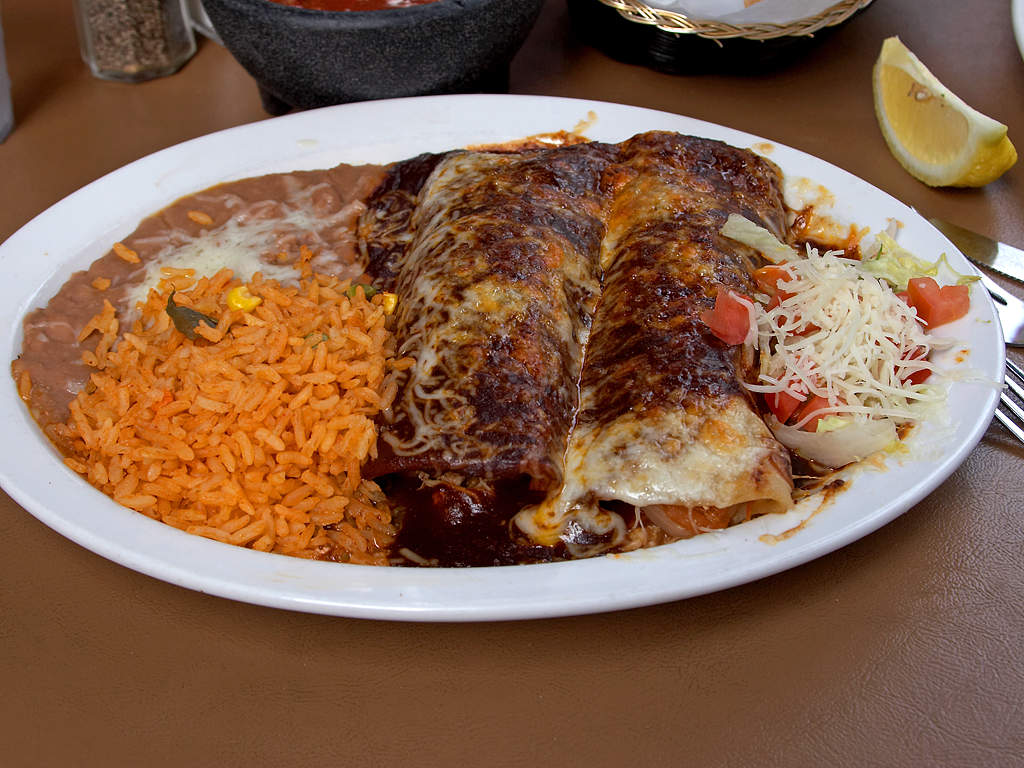
Enchiladas are usually eaten as a main course for lunch or dinner. They are often served with sides like refried beans and rice. In Mexico, they can be found in homes, restaurants, and as street food. The dish may be part of a casual meal or a larger gathering. Toppings and accompaniments vary by region and personal taste, making enchiladas a flexible and widely enjoyed food.
Kinds of Enchilada
There are many types of enchiladas, mainly distinguished by their sauces and fillings. Some use red chili sauce, others mole, green salsa, or cheese sauce. Enchiladas suizas are topped with a creamy white sauce. In Central America, the term 'enchilada' can mean something different: in Honduras and Guatemala, it refers to a flat, fried tortilla with toppings, while in Nicaragua, enchiladas are filled, battered, and deep-fried. Each region adapts the dish to local tastes and ingredients.
What Enchilada means
Enchiladas are a staple of Mexican cuisine and appear in early cookbooks and historical accounts. They are part of everyday meals and are also served at gatherings. The dish reflects the diversity of Mexican cooking, with each region offering its own take. In Central America, local versions show how the idea of a filled or topped tortilla has spread and evolved. Enchiladas are recognized as a symbol of Mexican food culture.
Questions people ask about Enchilada
What are enchiladas made of?
Enchiladas are made from corn tortillas rolled around a filling, such as meat, cheese, beans, potatoes, or vegetables, and then covered with a savory sauce like chili, mole, tomato, or cheese sauce.
Where do enchiladas come from?
Enchiladas originated in Mexico, with a history dating back thousands of years. The practice of rolling tortillas around food is ancient and was documented by early Spanish chroniclers.
What sauces are used on enchiladas?
Common sauces for enchiladas include chili-based sauces like salsa roja, mole (a chili and spice sauce), tomato-based salsa verde, and cheese sauces such as chile con queso.
Are enchiladas always filled with meat?
No, enchiladas can be filled with a variety of ingredients, including cheese, beans, potatoes, vegetables, or combinations, as well as different meats.
How are enchiladas served?
Enchiladas are typically served as a main dish for lunch or dinner, often accompanied by sides like refried beans and rice, and topped with garnishes such as cheese, sour cream, lettuce, or salsa.
Good reading and sources
The facts on this page come from the Wikipedia article "Enchilada", written by its contributors and used under the CC BY-SA 4.0 licence, and from its Wikidata record (CC0). Thali rewrote the text in its own words, with AI assistance, and compares every page with the article to make sure no passage is copied. It may be reused under the same CC BY-SA 4.0 licence with a link back.
It may contain mistakes, and it is not dietary or allergy advice: recipes differ from cook to cook. If something is wrong, tell us. Last refreshed 2026-10-03.
More from Mexico
All the food of Mexico Taco
🇲🇽 Mexico and 1 moreA folded tortilla filled with meat, beans or vegetables, eaten by hand
Street food, Lunch, Dinner
Blood sausageMeat
🇫🇷 France and 5 moreA sausage made with animal blood, fillers and spices, cooked or dried until firm
Main dish, Lunch, Dinner
Taco
🇲🇽 Mexico and 1 moreA folded tortilla filled with meat, beans or vegetables, eaten by hand
Street food, Lunch, Dinner
Blood sausageMeat
🇫🇷 France and 5 moreA sausage made with animal blood, fillers and spices, cooked or dried until firm
Main dish, Lunch, Dinner
 MolleteVegetarian
🇲🇽 Mexico and 6 moreOpen-faced Mexican sandwich with refried beans and melted cheese
Bread, Breakfast, Snacks
MolleteVegetarian
🇲🇽 Mexico and 6 moreOpen-faced Mexican sandwich with refried beans and melted cheese
Bread, Breakfast, Snacks
 BarbacoaMeat
🇲🇽 Mexico and 3 moreMeat slow-cooked in a pit lined with agave or banana leaves
Main dish, Lunch, Dinner
BarbacoaMeat
🇲🇽 Mexico and 3 moreMeat slow-cooked in a pit lined with agave or banana leaves
Main dish, Lunch, Dinner
Its cousins elsewhere
All main dishes Empanada
🇪🇸 Spain and 5 morePastry turnovers filled with meat, cheese, or vegetables, baked or fried
Pie or savoury pastry, Lunch, Dinner
Empanada
🇪🇸 Spain and 5 morePastry turnovers filled with meat, cheese, or vegetables, baked or fried
Pie or savoury pastry, Lunch, Dinner
 Pie
🇬🇧 United Kingdom and 5 moreA baked dish with a pastry crust and sweet or savoury filling
Main dish, Lunch, Dinner
Pie
🇬🇧 United Kingdom and 5 moreA baked dish with a pastry crust and sweet or savoury filling
Main dish, Lunch, Dinner
 Smörgåsbord
🇸🇪 Sweden and 2 moreA Swedish buffet meal with a spread of cold and hot dishes
Main dish, Lunch, Dinner
Smörgåsbord
🇸🇪 Sweden and 2 moreA Swedish buffet meal with a spread of cold and hot dishes
Main dish, Lunch, Dinner
 Börek
🇹🇷 Turkey and 5 moreFlaky pastry filled with cheese, meat or vegetables, baked or fried
Pie or savoury pastry, Breakfast, Lunch
Börek
🇹🇷 Turkey and 5 moreFlaky pastry filled with cheese, meat or vegetables, baked or fried
Pie or savoury pastry, Breakfast, Lunch