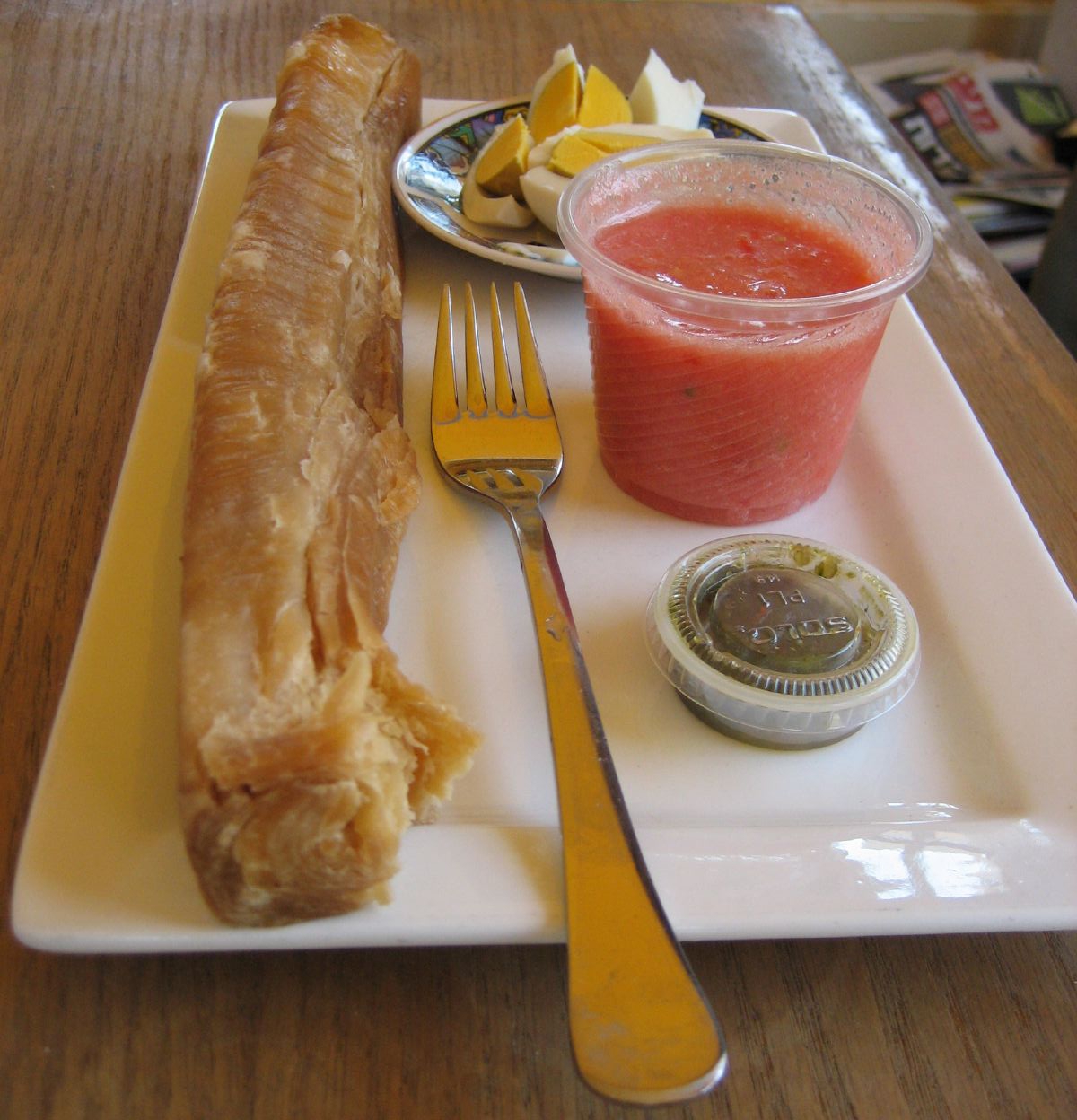
Jachnun
In its own language: גַ'חְנוּן
Slow-baked Yemenite Jewish bread for Shabbat mornings
Jachnun is a bread from Yemenite Jewish tradition, made by rolling enriched dough with clarified butter and baking it slowly overnight. It is most often eaten on Shabbat morning, served hot with tomato, eggs, and a spicy herb sauce. Today, it is popular in Israel as well as among Yemenite Jewish communities.
- Baked overnight for Shabbat breakfast
- Originated with Yemenite Jews from Aden
- Served with tomato, eggs, and spicy herb sauce
- Dough is enriched with clarified butter and fenugreek
- Popular in Israel as well as Yemenite communities
What is Jachnun?
Jachnun is a bread made by Yemenite Jews, shaped from a dough enriched with clarified butter and sometimes a touch of honey. The dough is rolled into thin sheets, then coiled or folded and placed in a pot to cook at low heat for many hours. When ready, the bread is a rich amber color, soft and sweet, with a caramelized flavor. It is usually served hot, alongside tomato, hard-boiled eggs, and a spicy green sauce called zhug.
Where does Jachnun come from?
Jachnun comes from the Jewish community of Aden in Yemen. Its slow-cooking method was developed to fit the rules of Shabbat, when cooking or using electricity is not allowed. This practice of preparing food to cook overnight for the Sabbath has deep roots, with similar traditions found in dishes like cholent. Some food historians believe jachnun and related breads were influenced by Sephardic Jewish pastries brought to Yemen after the expulsion from Spain.
How is Jachnun made?
To make jachnun, bakers start with a dough similar to that used for malawach, another Yemenite bread. The dough is rolled out thin, brushed with clarified butter—sometimes spiced with fenugreek and aged for extra flavor—and occasionally sweetened with honey. The dough is then rolled up and arranged in a covered pot. It is left to bake slowly at a low temperature, often on a hotplate, from Friday morning until Saturday morning, so it is ready for Shabbat.

How and when is Jachnun eaten?
Jachnun is traditionally eaten on Shabbat morning, when Jewish law prohibits cooking. It is served hot, straight from the pot, often with fresh tomato, hard-boiled eggs, and a spicy herb paste. In Israel, it can be found at home, in restaurants, or even at roadside stands, especially on weekends. The bread is pulled apart by hand and dipped or topped with the accompaniments.
Kinds of Jachnun
While the classic version uses clarified butter spiced with fenugreek, some cooks use plain butter or vegetable shortening. A little honey may be added for sweetness. The dough and method are closely related to malawach, which is pan-fried instead of baked. Regional and family traditions may influence the spices or the accompaniments served with jachnun.
What Jachnun means
Jachnun is closely tied to Yemenite Jewish identity and the observance of Shabbat. Its preparation reflects both religious practice and communal tradition. After the migration of Yemenite Jews to Israel, jachnun became a familiar weekend food there, enjoyed by many beyond its original community. It is a symbol of heritage and adaptation, connecting families to their roots each week.
Questions people ask about Jachnun
What is jachnun made of?
Jachnun is prepared from a dough of wheat flour, clarified butter (often spiced with fenugreek), and sometimes honey. The dough is rolled thin, brushed with the butter, and baked slowly overnight.
Where does jachnun come from?
Jachnun originated with the Jewish community of Aden in Yemen. It became popular in Israel after Yemenite Jews migrated there.
When is jachnun usually eaten?
It is traditionally served on Shabbat morning, prepared in advance and cooked overnight so it can be eaten hot without breaking Sabbath rules.
How is jachnun served?
Jachnun is eaten hot, commonly with fresh tomato, hard-boiled eggs, and a spicy green herb sauce called zhug.
Is jachnun vegetarian?
Yes, jachnun is vegetarian, as it contains no meat or fish. It is made with flour, clarified butter, and sometimes honey.
Good reading and sources
The facts on this page come from the Wikipedia article "Jachnun", written by its contributors and used under the CC BY-SA 4.0 licence, and from its Wikidata record (CC0). Thali rewrote the text in its own words, with AI assistance, and compares every page with the article to make sure no passage is copied. It may be reused under the same CC BY-SA 4.0 licence with a link back.
It may contain mistakes, and it is not dietary or allergy advice: recipes differ from cook to cook. If something is wrong, tell us. Last refreshed 2026-10-03.
More from Yemen
All the food of Yemen MurtabakMeatمُطَبَّق
🇾🇪 Yemen and 5 moreA stuffed, folded pancake or flatbread with savoury or sweet fillings
Main dish, Lunch, Dinner
MurtabakMeatمُطَبَّق
🇾🇪 Yemen and 5 moreA stuffed, folded pancake or flatbread with savoury or sweet fillings
Main dish, Lunch, Dinner
 Bint al-sahnVegetarianبنت الصحن
🇾🇪 YemenLayered Yemeni pastry served warm with honey and black cumin
Pie or savoury pastry, Tea time, Snacks
Bint al-sahnVegetarianبنت الصحن
🇾🇪 YemenLayered Yemeni pastry served warm with honey and black cumin
Pie or savoury pastry, Tea time, Snacks
 CoffeeVegan
🇾🇪 Yemen and 5 moreA dark, bitter drink made by brewing roasted coffee beans
Drink, Breakfast, Snacks
CoffeeVegan
🇾🇪 Yemen and 5 moreA dark, bitter drink made by brewing roasted coffee beans
Drink, Breakfast, Snacks
 Turkish coffeeVeganTürk kahvesi
🇹🇷 Turkey and 5 moreUnfiltered coffee brewed in a small pot and served with its fine grounds
Drink, Snacks
Turkish coffeeVeganTürk kahvesi
🇹🇷 Turkey and 5 moreUnfiltered coffee brewed in a small pot and served with its fine grounds
Drink, Snacks
Its cousins elsewhere
All breads Bagel
🇵🇱 Poland and 2 moreRing-shaped bread roll, boiled then baked for a dense, chewy texture
Bread, Breakfast, Lunch
Bagel
🇵🇱 Poland and 2 moreRing-shaped bread roll, boiled then baked for a dense, chewy texture
Bread, Breakfast, Lunch
 PitaVegan
🇪🇬 Egypt and 5 moreRound, leavened flatbread baked from wheat flour, common across the Middle East and Mediterranean
Bread
PitaVegan
🇪🇬 Egypt and 5 moreRound, leavened flatbread baked from wheat flour, common across the Middle East and Mediterranean
Bread
 Cinnamon rollVegetarian
🇸🇪 Sweden and 4 moreA sweet rolled bun with cinnamon and sugar, baked and often topped with icing
Sweet or dessert, Breakfast, Tea time
Cinnamon rollVegetarian
🇸🇪 Sweden and 4 moreA sweet rolled bun with cinnamon and sugar, baked and often topped with icing
Sweet or dessert, Breakfast, Tea time
 Lángos
🇭🇺 Hungary and 5 moreHungarian deep-fried flatbread, often topped with cheese or sour cream
Bread, Breakfast, Snacks
Lángos
🇭🇺 Hungary and 5 moreHungarian deep-fried flatbread, often topped with cheese or sour cream
Bread, Breakfast, Snacks