
Kati roll
In its own language: কাঠি রোল
Paratha flatbread rolled around spiced kebab or other fillings
Kati roll is a street food from Kolkata, India, where skewered kebab or other fillings are wrapped in a fried paratha flatbread. The filling can be meat, egg, or vegetables, often with chutney and onions. Originally made with kebab cooked on bamboo sticks, it is now a popular snack or meal sold at stalls and shops.
- Originated at Nizam Restaurant in Kolkata in the 1930s
- Named after 'kati', the Bengali word for stick or skewer
- Traditionally made with kebab, now has many fillings
- Paratha bread is often coated with egg before rolling
- Commonly sold at street stalls and small shops
What is Kati roll?
A kati roll is a rolled flatbread street food from Kolkata. It starts with a paratha, a flaky fried bread, which is wrapped around a filling. The classic filling is kebab—spiced meat cooked on a skewer—along with onions, chutney, and sometimes egg. Other fillings like potato, paneer (a fresh cheese), or mixed vegetables are also common. The roll is usually handed to you wrapped in paper, making it easy to eat on the go.
Where does Kati roll come from?
Kati roll began at Nizam Restaurant in Kolkata in the 1930s. The idea was to make kebab more portable for busy customers. Originally, the kebabs were cooked on heavy iron skewers, but as demand grew, the restaurant switched to bamboo sticks, called 'kati' in Bengali. This gave the roll its name. Over time, the concept spread across Kolkata and beyond, and the term 'kati roll' came to mean any flatbread rolled around a filling, not just kebab.
How is Kati roll made?
To make a kati roll, a paratha is first prepared by coiling and flattening dough, then frying it on a griddle. If egg is used, it is cracked onto the griddle and the paratha is cooked on top of it, so the egg coats one side. The filling—often kebab meat, but sometimes chicken, mutton, or vegetables—is cooked on skewers, then tossed with onions and spices. The filling is placed in a line down the paratha, sauces and lime are added, and the bread is rolled up in paper.
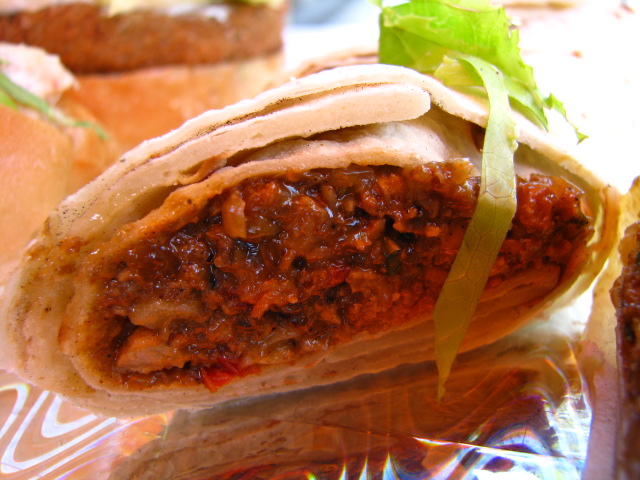
How and when is Kati roll eaten?
Kati rolls are eaten as a quick meal or snack, often bought from street stalls or small shops known as 'Roll-er-dokaan' in West Bengal. They are popular for lunch, dinner, or as a filling snack. The roll is usually handed over wrapped in paper, sometimes covering just half the roll, making it easy to eat while walking. Common accompaniments include extra chutney or a squeeze of lime.
Kinds of Kati roll
There are many versions of the kati roll. Fillings can include egg, potato, paneer, mixed vegetables, or curried meats. Some shops use different breads, such as naan or rumali roti, instead of paratha. Sauces and garnishes vary, and some modern versions use global flavors like Thai or Sichuan curries. Chicken roll and egg roll are especially popular in Kolkata.
What Kati roll means
Kati roll is a staple of Kolkata street food culture and is widely recognized across India. The roll is so common in West Bengal that people simply call it 'roll.' Shops specializing in these are an everyday sight in Kolkata. The dish has inspired fast food versions and adaptations, and its name has become generic for any rolled flatbread with a filling.
Questions people ask about Kati roll
What is a kati roll made of?
A kati roll is made by wrapping a paratha flatbread around a filling, which can be kebab, chicken, mutton, egg, potato, paneer, or mixed vegetables, often with onions, chutney, and spices.
Where does the kati roll come from?
The kati roll comes from Kolkata, West Bengal, India. It was first served at Nizam Restaurant in the 1930s and has since become popular across India.
Is a kati roll always made with meat?
No, while the original kati roll used meat kebab, there are now many vegetarian versions with fillings like egg, potato, paneer, or mixed vegetables.
How is the bread for a kati roll prepared?
The bread is a paratha, made by coiling and flattening dough, then frying it on a griddle. Sometimes, an egg is cooked onto one side of the paratha before adding the filling.
How is a kati roll eaten?
A kati roll is usually served wrapped in paper, making it easy to eat by hand while walking or standing. It is a popular street food for lunch, dinner, or as a snack.
Good reading and sources
The facts on this page come from the Wikipedia article "Kati roll", written by its contributors and used under the CC BY-SA 4.0 licence, and from its Wikidata record (CC0). Thali rewrote the text in its own words, with AI assistance, and compares every page with the article to make sure no passage is copied. It may be reused under the same CC BY-SA 4.0 licence with a link back.
It may contain mistakes, and it is not dietary or allergy advice: recipes differ from cook to cook. If something is wrong, tell us. Last refreshed 2026-10-03.
More from India
All the food of India Kebabكَبَاب
🇹🇷 Turkey and 5 moreGrilled or roasted meat, often on skewers, found across the Middle East and beyond
Main dish, Lunch, Dinner
Kebabكَبَاب
🇹🇷 Turkey and 5 moreGrilled or roasted meat, often on skewers, found across the Middle East and beyond
Main dish, Lunch, Dinner
 Samosa
🇮🇳 India and 5 moreFried or baked pastry with a spiced filling, shaped into triangles or cones
Pie or savoury pastry, Snacks, Lunch
Samosa
🇮🇳 India and 5 moreFried or baked pastry with a spiced filling, shaped into triangles or cones
Pie or savoury pastry, Snacks, Lunch
 Biryani
🇮🇳 India and 5 moreRice and spiced meat or vegetables layered and cooked together
Main dish, Lunch, Dinner
Biryani
🇮🇳 India and 5 moreRice and spiced meat or vegetables layered and cooked together
Main dish, Lunch, Dinner
 French toast
🇫🇷 France and 5 moreBread soaked in egg and milk, pan-fried and served sweet or savoury
Main dish, Breakfast, Snacks
French toast
🇫🇷 France and 5 moreBread soaked in egg and milk, pan-fried and served sweet or savoury
Main dish, Breakfast, Snacks
Its cousins elsewhere
All street food Brikبريك
🇹🇳 Tunisia and 2 moreA deep-fried North African pastry filled with egg, tuna, and herbs
Pie or savoury pastry, Snacks
Blood sausageMeat
🇫🇷 France and 5 moreA sausage made with animal blood, fillers and spices, cooked or dried until firm
Main dish, Lunch, Dinner
Brikبريك
🇹🇳 Tunisia and 2 moreA deep-fried North African pastry filled with egg, tuna, and herbs
Pie or savoury pastry, Snacks
Blood sausageMeat
🇫🇷 France and 5 moreA sausage made with animal blood, fillers and spices, cooked or dried until firm
Main dish, Lunch, Dinner
 EsquitesVegetarian
🇲🇽 MexicoMexican street snack of cooked corn served in a cup with toppings
Street food, Snacks
EsquitesVegetarian
🇲🇽 MexicoMexican street snack of cooked corn served in a cup with toppings
Street food, Snacks
 TomatokeftedesVegan
🇬🇷 GreeceFried tomato fritters from Santorini made with herbs and flour
Street food, Snacks
TomatokeftedesVegan
🇬🇷 GreeceFried tomato fritters from Santorini made with herbs and flour
Street food, Snacks